
The shop gives you a number, and it’s higher than you hoped. Now you’re choosing between paying for the repair and putting that money toward a new unit. Either choice can be the right one. The answer depends on three things: what the repair costs compared to a new generator, how much engine life is left, and what actually failed.
The 30-second answer: If the repair costs less than about a third of a comparable new unit, fix it. Between a third and a half, it depends on the hours and the failure. Above half, or any job on the engine or the alternator windings, a new unit is usually the better buy.
- Most small portable repairs cost far less than a new unit.
- Replacement makes more sense when the repair is a large share of the new price, or when the engine itself needs work.
- Ask the shop what they tested. A quote without test results isn’t enough to decide on.
Compare the Quote to a New Unit
Get the total from the quote. Then find a new unit with the same running watts and outlet layout, and write down its price. Divide the quote by that price.
| Repair as a share of a new unit | What to do |
|---|---|
| Under about one third | Repair, as long as the engine has life left. |
| About one third to one half | Repair if the hours are low and the failure is a common one. Otherwise, compare more closely. |
| Over about one half | Replace, unless the unit is hard to find or you need its exact model. |
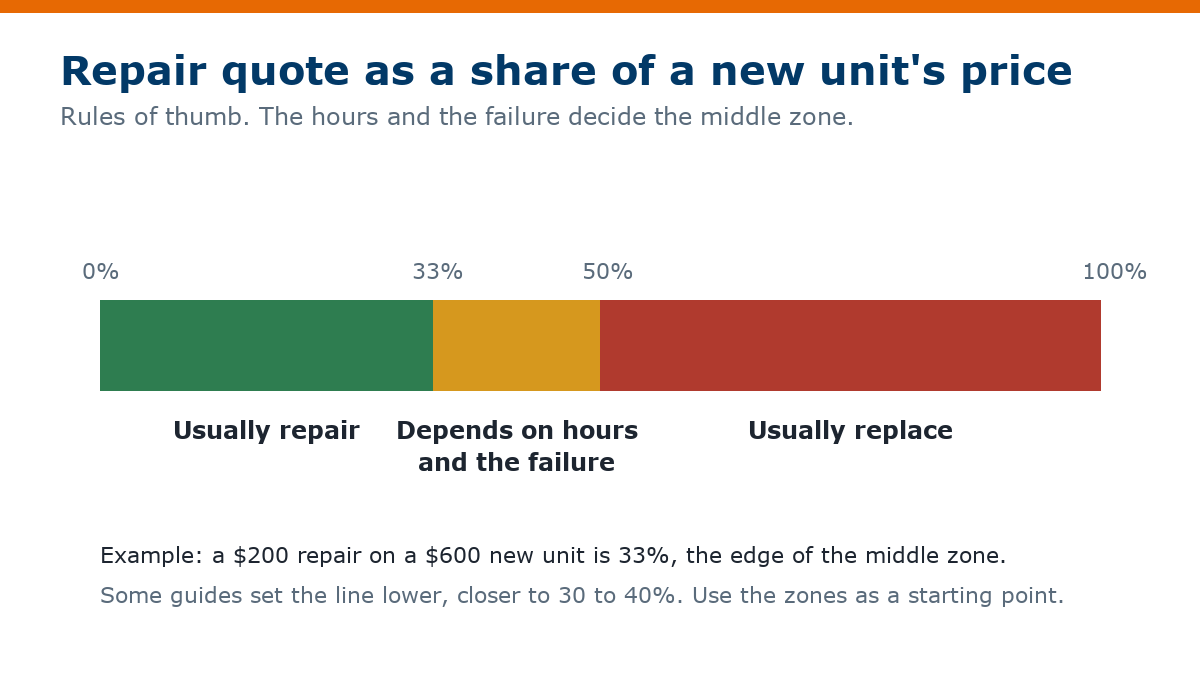
These cutoffs are rules of thumb from contractor and cost-guide sites, not a standard. Some guides set the line lower, around 30 to 40 percent of the new price. Use the cutoff as a starting point, and let the hours and the failure decide the close calls. The Angi generator repair cost guide gives typical repair ranges.
Check the Hours and the Age
The engine sets how long the generator lasts, and a repair only buys time on what’s left. Engines are rated in hours, and many portables never get near the top of that rating. If the unit has an hour meter, read it. If it doesn’t, estimate from how often you run it and how long each run lasts.
A unit with a few hundred hours that needs a carburetor or a regulator is a good repair. A unit with thousands of hours that needs an engine repair usually isn’t.
Repairs Usually Worth Paying For
These are cheap parts and cheap labor. If a shop quotes one of them, paying is reasonable. Most can also be done at home.
- Carburetor cleaning or a carb kit. Stale fuel causes most no-starts, and a clean carb often brings the unit back. See how to clean a generator carburetor.
- Spark plug, air filter, or fuel filter. These are inexpensive, and a shop checks them first anyway.
- A voltage regulator (AVR) or capacitor, once a test confirms it has failed. The AVR test and replace guide shows how to check it.
- A recoil starter or a pull cord on an otherwise healthy engine.
- A battery, solenoid, or switch on an electric-start unit that cranks weakly or not at all.
Repairs That Usually Mean Replace
Some repairs cost enough that a new unit is the better buy.
- Internal engine damage, such as low compression or a bent crankshaft. These are major jobs. Run a compression test before you approve one.
- Alternator rewinds. Check the windings with the stator test and ask the shop for their readings before you approve a rewind.
- Frame or fuel tank rust-out. A repair rarely fixes a structure that’s failing.
- A part that has already failed twice. The next repair often runs into the same problem.
Before you approve a large repair, ask which part failed, how the shop tested it, and what the parts and labor cost separately. A quote that only says “the alternator is bad” is worth a second opinion.
This video follows the repair of four broken Generac units, working through them one at a time. It shows what a real diagnosis looks like before anyone decides whether a unit is worth fixing.
Five Questions to Settle It
Answer these five questions. If most of the answers point the same way, you have your decision.
- Is the quote under half the price of a comparable new unit?
- Is the failure on the worth-fixing list above?
- Does the engine have life left, judging by the hours or how often you run it?
- Has this same part already failed?
- Did you check the cheap causes yourself before paying for the expensive one?
Yes to the first three and no to the last two points to repair. Anything else calls for a second opinion or a new unit.
If You Replace It
Size the new unit to the loads you actually run. The wattage sizing guide shows how. Read the warranty terms and register the unit if the maker asks. Keep the receipt and the repair quote together in case you need them later. The buying guide covers the features worth comparing.
Frequently Asked Questions
Is a 10-year-old generator worth repairing?
Often, yes, if it has modest hours and the repair is a common one. Age matters less than the hours and the failure.
Should I pay someone to clean the carburetor?
It depends on the quote. The parts cost little, but the cleaning takes patience and small tools. If the quote is close to the cost of the parts and you don’t want to work on the carb, paying is reasonable.
Can an engine with internal damage be fixed?
Sometimes, but on a portable it’s usually a major job. Get a compression test and a written diagnosis before you decide.
What if I still can’t decide?
Run the Fix My Generator diagnostic to narrow down the fault. Then compare the likely repair against the questions above.