
A generator that won’t start in cold weather almost always needs one of three things: choke fully closed (not halfway), fresh oil thin enough to flow at low temperatures, or a charged battery if it’s electric start. Check those three before anything else — they solve about 80% of cold-weather no-starts for free.
Why Cold Weather Makes Generators Refuse to Start
Cold changes the physics of starting a small engine in three ways that don’t apply when it’s warm. First, cold air is denser — the engine pulls in more oxygen per intake stroke, which leans out the mixture unless the choke compensates by restricting airflow. A generator that starts on the first pull at 75°F can need four or five choke-assisted pulls at 35°F and won’t fire at all below 20°F if you skip the choke entirely. Second, oil thickens. The 10W-30 that flows freely in July turns sluggish at freezing — the engine cranks harder, builds oil pressure slower, and the low-oil sensor can trip on a cold, thick oil column before the engine ever fires. Third, battery capacity drops. A battery that reads 12.6V on a warm bench delivers roughly 30% less cranking current at 20°F. If your battery was marginal going into fall, it’ll be useless in January.
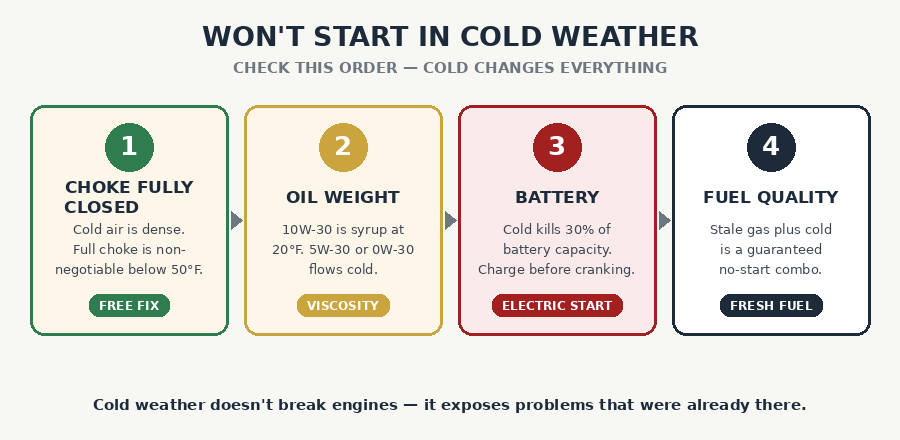
Step One: Choke Position — the Free Fix for Half of These
I’ve watched people yank a pull cord thirty times in a cold garage and never once fully close the choke. In cold weather, the choke needs to be completely closed for the first start — not halfway, not “mostly closed.” The engine runs too rich for a moment while it warms up, and that’s exactly what it needs at 30°F. Leave it on choke until it stumbles slightly, then ease it open gradually. If your unit has an auto-choke (a lot of Hondas and Yamahas do), cold weather sometimes makes the thermostatic spring stiffen and not close fully — you can manually push the choke plate closed for the initial start on most of them.
One thing I see constantly on the service bench: people assume because the choke was in the “cold start” position that it was fully closed. Pull the air filter cover off and look. The plate should completely block the intake throat. If it doesn’t, you found your problem.
Oil Weight for Cold Weather Starting
Most generator manuals call for 10W-30, which is fine down to about 32°F. Below that, you need 5W-30. Below 0°F, 0W-30. The “W” number is the winter viscosity — lower is thinner when cold. I keep a quart of 5W-30 in my shop specifically for cold-season starts; after the engine warms up, you can drain it and go back to your normal weight if you want to, but honestly 5W-30 runs fine year-round on most of these engines.
The specific failure mode here: thick cold oil means the low-oil pressure sensor shuts the engine down within the first few seconds of running, before pressure builds. The engine starts, runs three seconds, and cuts off cleanly. That clean cutoff on a full crankcase is the tell — it’s almost always either the oil being too thick or the unit not sitting level. Check both before suspecting a bad sensor.
Battery and Electric Start in Cold Weather
If your unit has electric start and it’s clicking, grinding, or spinning too slowly to fire the engine, the battery is your problem. Cold temperatures reduce battery capacity significantly — a battery that was fine all summer may not have enough cranking amps at 20°F to spin a cold, tight engine. Put it on a 2-amp smart charger overnight before you need it. If it won’t hold a charge anymore, a replacement runs $25 to $40 — the full battery diagnosis is in the generator battery keeps dying guide. And remember: the pull cord still works even with a dead battery. Never let a bad battery strand you.
Fuel in Cold Weather
Cold doesn’t directly make gas go bad, but it does slow evaporation of the lighter fuel fractions that help with cold starting. Fuel that’s already six months old and borderline in warm weather genuinely won’t start a cold engine. If you have any question about how old the gas in the tank is, drain it and put in fresh — the full drain procedure is in draining old gas from a generator. Ethanol-blended fuel also absorbs condensation faster in cold, humid storage conditions, which adds a water contamination problem on top of everything else. Ethanol-free fuel if you can get it, or treated conventional fuel with fresh stabilizer.
Never run a generator in a garage or enclosed space to warm it up first. Carbon monoxide builds to lethal levels faster in cold air because people close everything to keep warm — exactly the wrong response. Cold-weather starting happens outside, 20 feet from the house, same rules as any other day. If you’re struggling to pull the cord with cold hands, wear gloves with grip, not mittens, and take breaks between pulls — a flooded cold engine is even harder to start than a plain cold one.
If Nothing Above Fixed It
At this point you’ve covered the 90% of cold-weather no-starts. What’s left: a stuck choke plate that won’t fully close mechanically, carburetor varnish that’s worse when cold because cold fuel is less effective as a solvent (the full carb clean is at cleaning a generator carburetor), or a failed primer bulb on units that have one. If the engine has never been serviced and it’s been sitting since last summer, the carb is the next suspect. Cold weather just reveals what warm weather was hiding.
This covers the cold-start sequence well if you want to see it run through in real time:
Frequently Asked Questions
Why won’t my generator start in cold weather but works fine when it’s warm?
Three things change at low temperatures: oil thickens and flows slower, battery capacity drops by up to 30%, and the fuel mixture needs a richer choke than warm-weather starts. The choke is the first thing to check because it’s free and fixes most of these — make sure it’s completely closed for the cold start, not just “mostly closed.”
What oil should I use in a generator in cold weather?
Switch to 5W-30 below 32°F and 0W-30 below 0°F. The “W” number is winter viscosity — lower means it flows thinner when cold. Thick 10W-30 in freezing temperatures makes the engine crank sluggishly and can trigger the low-oil sensor before pressure builds, giving you a clean three-second start-then-shutdown even with a full crankcase.
How do I start a generator in very cold weather?
Full choke, fresh 5W-30 oil, charged battery on electric-start units, fresh fuel. Pull slowly until you feel compression, then a firm steady pull — don’t yank it fast when it’s cold. If it doesn’t fire in five pulls, check that the choke plate is fully closed, not just moved toward the closed position.
Can cold weather damage a generator?
The cold itself doesn’t damage anything. The damage comes from running on too-thick oil before pressure builds, from water in the fuel freezing in the carb or fuel line, or from forcing an electric starter against a locked-up engine. Work through the checklist above and you won’t hurt anything.
Should I store my generator somewhere warm in winter?
Ideally, yes — a heated space keeps the battery healthier and makes starts easier. If it’s going in an unheated garage, pull the battery and store it somewhere warm, drain the carb or stabilize the fuel, and you’ll have a much easier time in spring. The full storage procedure is in storing a generator for the off-season.