
Here’s where the racket actually comes from, because you can’t fix noise you haven’t located: on an open-frame generator roughly 40% of what you hear is exhaust note, about 30% is mechanical engine noise — valvetrain, combustion through thin sheet metal — and the last 30% is the cooling fan plus vibration the frame pounds into whatever it’s sitting on. Three sources, three different fixes, and the reason most attempts to quiet a generator disappoint is that they attack one source and leave the other two singing.
To quiet a generator, work the noise at its sources: move it farther away with the exhaust pointed away from you (each doubling of distance drops about 6 dB), set it on rubber isolation pads, build or buy a baffle enclosure with real airflow, and upgrade the muffler. Stack those and a 74 dB open frame can land in the mid-60s where you sit.
Distance and Direction: the Free 10 Decibels
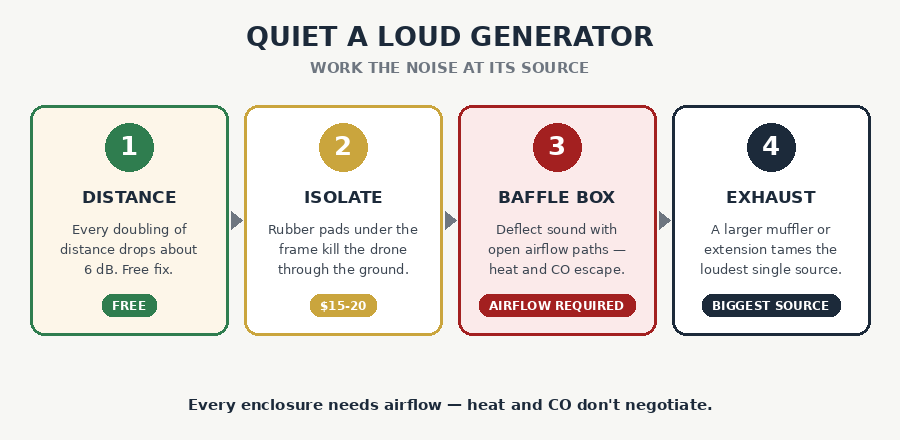
What you’ll notice: the generator seems twice as loud since you moved it closer to the patio for cord convenience. What’s happening: sound falls off hard with distance — figure about 6 dB quieter for every doubling — and exhaust noise is strongly directional besides. What to do: put the unit as far out as cords and the 20-foot CO minimum allow, exhaust aimed away from where people sit, and use structures legally between you and it — the far side of a shed does real acoustic work for free. Just don’t let “farther” become “tucked against the neighbor’s fence”; their bedroom window has opinions too, and aiming the exhaust at a wall three feet away just bounces the note right back.
Kill the Drone: Isolate the Frame
What you’ll notice: a hard droning hum, worse on concrete or a deck, that seems louder than the engine itself. What’s happening: the frame is hammering vibration into the surface under it, and the surface is performing as a soundboard — a deck can amplify a generator like a guitar body amplifies a string. What to do: break the connection. A set of rubber anti-vibration pads under the frame feet — $15 to $20, the same pads sold for washing machines — decouples the unit from the surface, and moving off the deck onto grass or dirt does half the job by itself. This is the highest satisfaction-per-dollar fix on the page: the tone changes immediately, from a drone you feel to an engine you merely hear. While you’re down there, snug the engine mounting bolts; a loose mount buzzes the whole frame and shows up again later as rattles and mystery noises.
The Baffle Box — Where People Cook Their Generators
What you’ll notice if you search around: plywood “generator quiet box” builds promising huge drops. What’s happening acoustically is legitimate — mass blocks sound, and lined baffles absorb it. The common mistake, and it’s the one that turns a noise project into an engine funeral: building the box tight. A sealed or under-vented enclosure traps engine heat until the unit overheats and shuts down — the failure covered in generator overheating — and it pools exhaust until a CO-sensor-equipped machine kills itself in self-defense, the exact shutdown pattern in the CO sensor guide. Newer units trip constantly in tight boxes, and the sensor is right.
What to do: build a baffle, not a coffin. Open bottom or generous low intake on one end, big high outlet on the other, so air flows through in one door and out the other; ducted exhaust exit; sound-deadening lining on the inside faces; and enough interior clearance that nothing radiant is near the walls. You’re deflecting and absorbing the sound path to your ears, not hermetically sealing the machine. Done right it’s worth a real 8 to 10 dB. Done tight it’s worth a melted air shroud — and one hard rule regardless: an enclosed generator is still an outdoor generator, full CO distance rules intact.
The Exhaust Itself
What you’ll notice: the sharp bark that carries across the neighborhood — that’s the muffler’s department, the single loudest source on the machine. What to do, in ascending effort: aim it away (free, already covered); add a clamp-on extension that redirects the outlet downward or away, worth a couple perceived dB for a few dollars; or fit a larger aftermarket small-engine muffler in place of the factory can — the generator crowd borrows quiet mufflers from the motorcycle and tractor world, and a well-matched one takes a genuine bite out of the bark. Keep any exhaust modification tight and leak-free (exhaust leaks are both louder and CO-dangerous), keep pipe runs short so you don’t build back-pressure the engine wasn’t designed for, and skip the internet’s water-bucket-on-the-exhaust trick — a splashy half-measure that risks water walking back up the pipe into the engine. Not worth it for the small change in note.
And the honest ceiling: stack every trick on this page to quiet a generator and a worked-over open frame lands in the mid-60s dB. If the mission is campground-polite or bedroom-window quiet, that’s what inverter generators are built for — 55 to 60 dB out of the box — and no plywood rescues a $350 open frame into that class. I say that as someone whose hearing spent two decades around machinery that made generators sound like wind chimes: buy the quiet if quiet is the requirement.
Every sound project on this page bends around the same two limits. Heat: the engine needs flowing air, and any enclosure without a clear in-and-out path is cooking it. Carbon monoxide: baffled or not, the generator lives outdoors, 20 feet from the house, exhaust pointed away — a quiet box that lets you forget the machine is running is exactly how CO complacency starts. Muffler work happens on a cold engine only.
And here’s a rundown of quieting methods that pairs well with the fixes above:
Frequently Asked Questions
How can I make my generator quieter for camping?
Distance and direction first — exhaust away from camp, unit as far as the cord allows. Rubber pads under the feet, and park it behind the vehicle so the truck eats some sound path. Past that, campground-quiet is honestly inverter territory; the open frame has a floor it won’t drop below.
How many decibels is a normal generator?
Open frames run about 70 to 76 dB at rated load from the standard 23-foot measuring distance; inverter units run 55 to 60. The scale is logarithmic, so that gap is enormous in the ear — a 10 dB drop reads as roughly half as loud. It’s why no amount of plywood makes an open frame impersonate an inverter.
Does a quiet box really work on a generator?
A properly vented baffle box is worth a real 8 to 10 dB — genuinely dramatic. The qualifier carries all the weight: airflow in, airflow out, ducted exhaust, clearance inside. I’ve seen the sealed version of this project end with a heat-wrecked shroud and a CO sensor that refused to stay running, and the sensor was doing its job.
Can I put a car muffler on my generator?
People do, and a small automotive or motorcycle muffler matched to the engine’s outlet size can quiet the bark noticeably. Keep the run short and leak-free so back-pressure and CO stay in bounds. It’s a tinkerer’s fix — worthwhile on a keeper unit, silly money and effort on a disposable one.
Why is my generator suddenly louder than it used to be?
New noise is a symptom, not a personality change — usually a cracked muffler or exhaust leak, a loosened engine mount, or debris in the fan shroud. A metallic new sound gets the machine shut down and inspected before it runs again; the noise-by-noise breakdown is in the knocking-and-rattling guide linked above.