
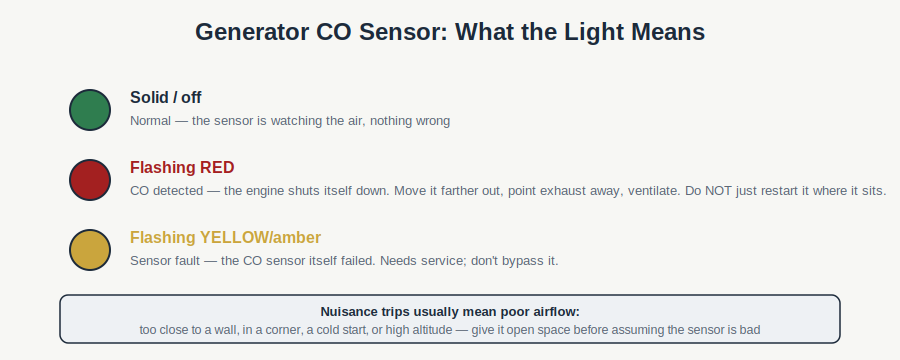
A generator that keeps shutting off with a flashing light is tripping its carbon monoxide sensor — flashing red means it detected CO, flashing yellow means the sensor itself failed. Most nuisance trips are an airflow problem, not a broken generator: move it into open space, away from walls and corners, with the exhaust pointed away. Cold starts and high altitude can also set it off. Never bypass the sensor — it’s there to keep you alive.
- Flashing red = CO detected, engine shut down. Flashing yellow = the sensor itself failed.
- Most repeat trips are poor airflow — too close to a wall, in a corner, or boxed in. Give it open space.
- Cold starts run rich and spike CO briefly; high altitude does the same. Both can nuisance-trip the sensor.
- Don’t restart it in the same spot — reposition it so its own exhaust isn’t drifting back over the sensor.
- Never bypass or disable the CO sensor. If it’s truly faulty, service it and keep a CO alarm in the house meanwhile.
Why Does My Generator Keep Shutting Off With a Flashing Light?
Because the carbon monoxide sensor is doing its job — or thinks it is. Generators built in the last few years carry a CO shutoff sensor that kills the engine when it reads dangerous CO in the air around the unit. A steady or off light is normal; a flashing pattern is the alarm. Flashing red means it actually sensed CO and shut down to protect you. Flashing yellow or amber means the sensor circuit itself has faulted. The part that catches most people off guard is that the generator can trip this even when it’s outside, because the sensor reads the air right at the unit, and a generator crammed against a wall or sitting in a corner lets its own exhaust eddy back and pool around the sensor. So the engine shuts off, you restart it, it shuts off again, and it feels like the generator is broken when it’s really telling you the placement is wrong. About 70% of the repeat-shutoff calls I see on these are airflow, not a bad sensor — the fix is moving the unit, not replacing parts.
The Real Cause Is Almost Always Airflow
If your light is flashing red and the generator keeps cutting out, look at where it’s sitting before you blame the sensor. Against the house, tucked in a corner, between a wall and a fence, under a low deck — any spot where air doesn’t move freely lets the exhaust hang around the unit and creep back over the sensor. Pull it out into open space, give it several feet of clearance on all sides, and point the exhaust away from the generator and the house. Nine times out of ten that’s the whole fix.
Cold Starts Trip It Too
Here’s one that gets people on a frosty morning. A cold engine runs rich on startup — extra fuel, more incomplete combustion, more CO for the first minute or two until it warms up. That brief spike can trip the sensor before the engine settles. If it shuts off right after a cold start, let it sit a moment, make sure it’s in open air, and try again once it’s had a chance to warm. The same cold-start richness is why some units are hard to start when cold in the first place.
Altitude Does the Same Thing
Running at high elevation? Thinner air means the engine runs richer for the same fuel setting, which raises CO output and can nudge the sensor over its threshold. There’s not much to “fix” here beyond making sure the unit has wide-open airflow, since you can’t change the altitude. Just know that a sensor that never tripped at sea level might get touchy up in the mountains, and that’s the engine running rich, not a fault.
How the Sensor Works — and Why It Nuisance-Trips Outdoors
It helps to understand what the sensor is actually watching, because it explains the “but it’s outside!” frustration. The CO sensor monitors the concentration of carbon monoxide in the air immediately around the generator, and it’s tuned to shut down before that air becomes dangerous to a person nearby. It does not know whether you’re standing next to it or a hundred feet away — it only knows the air at the unit. So when the generator is positioned where its own exhaust recirculates — a corner, against a wall, under a cover with poor ventilation, or in still air on a windless day — the CO concentration right at the sensor climbs even though the open yard ten feet away is fine. The sensor reads that local buildup and shuts the engine down. That’s not a malfunction; it’s the sensor correctly reading a genuinely bad micro-environment that careful placement would have prevented. The takeaway is that the sensor is a backstop, and good placement is what keeps it from ever needing to act. Position the generator far from the house in open air, exhaust pointed away, and the sensor stays quiet because there’s nothing for it to catch.
Do not bypass, disable, or “delete” the CO sensor. I know the nuisance trips are maddening, and there are forum threads telling you how to jumper around it — don’t. That sensor is the only thing on the generator actively watching for the gas that kills more people than any other generator hazard. If the sensor is genuinely failed (flashing yellow), get it serviced or replaced; in the meantime, place the unit carefully and rely on a battery-backup CO alarm in the house. Bypassing it trades a minor annoyance for a fatal risk.
If It’s a Real Sensor Fault
A steady flashing yellow that won’t clear even with the generator in wide-open air points to the sensor itself rather than the environment. That’s a service item — the sensor module gets replaced. It’s not a part most owners swap themselves, and it’s worth doing correctly rather than working around. While you sort it out, keep the generator placed conservatively and a CO alarm running indoors.
What It Costs
The good news: the common version of this problem is free to fix. If it’s airflow — and it usually is — repositioning the generator costs you nothing. A genuine sensor replacement is a service item, typically modest in parts but worth having done right. Compare that to the alternative some people choose, which is bypassing a life-safety device to save a few minutes — that’s a trade I’d never make. Before you run it this season, make sure you’ve sized the generator to your actual load so it isn’t straining (see how to size a generator), and keep airflow open, which also keeps it from overheating and shutting down for a completely different reason.
The Bottom Line
A flashing CO light means placement, not a paperweight — move it to open air, exhaust away, and it’ll usually run fine. And whatever you do, leave the sensor alone; it’s the cheapest life insurance you’ll ever own.
Frequently Asked Questions
Why does my generator keep shutting off with the CO light flashing?
It’s reading carbon monoxide buildup around the unit and shutting down to protect you. Usually that’s an airflow problem — it’s too close to a wall or in a corner and its own exhaust is drifting back over the sensor. Move it to open space with the exhaust pointed away and it normally stops.
What’s the difference between a flashing red and flashing yellow CO light?
Flashing red means the sensor detected CO and killed the engine — a real detection. Flashing yellow means the sensor circuit itself faulted. Red is usually fixed with better placement; yellow means the sensor needs service. Either way, don’t ignore it.
Can I bypass the CO sensor to stop the shutdowns?
No — and please don’t. That sensor is watching for the gas that kills the most generator owners every year, and bypassing it to stop nuisance trips is trading a small annoyance for a deadly risk. If it’s faulty, get it serviced; if it’s nuisance-tripping, fix the placement. I’d never disable one.
Why does it trip on a cold morning but run fine later?
A cold engine runs rich on startup and puts out more CO for the first minute or two until it warms up, and that brief spike can trip the sensor. Let it sit a moment, make sure it’s in open air, and restart once it’s warmed. It’s the cold-start richness, not a fault.
Does running at high altitude cause CO sensor trips?
It can. Thinner air at elevation makes the engine run richer for the same setting, which raises CO output and can push the sensor over its limit. There’s nothing to repair — just give the unit wide-open airflow. A sensor that never tripped at sea level getting touchy in the mountains is normal.