
Change generator oil with the engine warm so it drains clean: shut it off, pull the drain plug (or tip the unit), let it empty, then refill to the dipstick line with the right weight — SAE 30 or 10W-30 for warm weather, 5W-30 synthetic for cold. Most portables hold only about 0.6 quart, so add slowly and check the dipstick. Do the first change at 20 to 30 hours, then every 50 to 100 hours or once a season.
- Weight follows temperature: SAE 30 or 10W-30 warm, 10W-30 all-season, 5W-30 synthetic in the cold.
- Capacity is small — roughly 0.6 quart on most portables. Don’t overfill; the dipstick is the boss.
- The first change comes early, at 20–30 hours, to flush out break-in metal.
- After that, change it every 50–100 hours, once a season, and always before storage.
- Drain it warm — warm oil carries the gunk out; cold oil leaves it behind.
What Kind of Oil Does a Generator Take?
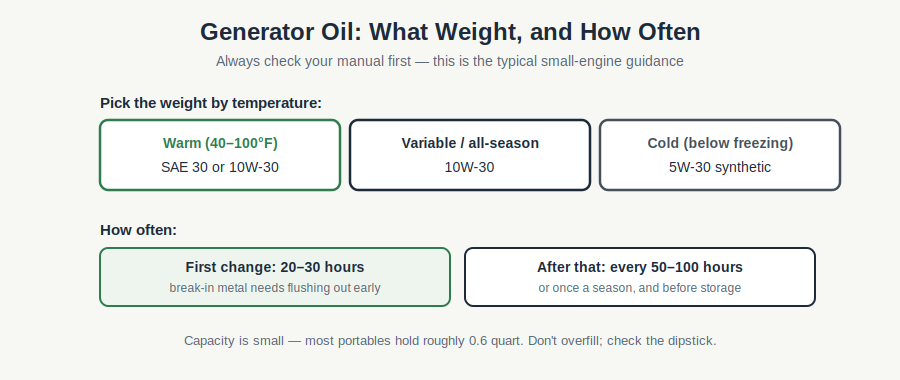
A small four-stroke generator engine takes ordinary detergent motor oil, and the weight you pick depends on the temperature you’ll run it in. For typical warm-weather use, 40 to 100°F, SAE 30 or 10W-30 is standard. If you run year-round or in swinging temperatures, 10W-30 covers the range. In genuine cold, below freezing, switch to 5W-30 synthetic so it flows on a cold start instead of pouring like molasses. The brand matters far less than the weight and the fact that it’s clean — I’ve run name-brand and store-brand oil in these engines for decades and what kills them is dirty or low oil, not the label on the bottle. Always check your manual for the exact spec, since a few engines call for something specific, but the chart below covers the vast majority of portable generators you’ll run into.
How Much Oil — and Why Overfilling Bites You
Generator engines hold surprisingly little oil. Most portables take somewhere around 0.6 quart, and some small ones less, so a single quart bottle does a couple of changes. Add it slowly and lean on the dipstick rather than dumping the whole bottle in. Overfilling isn’t harmless — too much oil gets churned by the crankshaft, can blow past seals, smokes on startup, and on units with a low-oil sensor it can throw weird readings. If you overshoot, drain a little back out until the dipstick reads right.
The Step-by-Step Oil Change
This is a 15-minute job and one of the highest-payoff things you can do for the engine. Here’s how I run it:
- Warm it up first. Run the generator a few minutes, then shut it off. Warm oil holds the contaminants in suspension and drains out clean; cold oil leaves them in the crankcase.
- Get a drain pan under it. Have a pan or a jug ready, plus a funnel for the refill — the fill hole is usually small.
- Pull the drain plug. Find the oil drain plug (or, on units without one, tip the generator to pour out the fill hole), remove it, and let it drain fully. Give it a few minutes to get the last of it.
- Reinstall the plug snug — not gorilla-tight, just sealed.
- Refill slowly with the right weight, checking the dipstick as you go. Stop at the full line. Don’t thread the dipstick in to read on most engines unless your manual says to — rest it or follow the manual’s method.
- Wipe up, run it briefly, shut it off, and recheck the level. Top off if needed.
While you’ve got it apart, glance at the air filter and spark plug — they’re the other two maintenance items, and the plug check is covered in how to check, gap, and replace a generator spark plug.
How Often to Change It
The first change comes early — at 20 to 30 hours — because break-in wears the new engine and you want that fine metal flushed out before it circulates. After that first change, every 50 to 100 hours of run time is the norm, or once a season if you don’t rack up many hours, and always change it going into storage so the engine isn’t sitting on acid-laden used oil for months. If you run the generator hard during a long outage, lean toward the shorter interval. Low or dirty oil is the fastest way to kill one of these engines, and it ties directly into a couple of other problems — a unit low on oil will trip its shutoff, and that same low level shows up in a low-oil shutoff that keeps tripping, while running low contributes to overheating.
Drained oil is hot and the exhaust area stays hot for a while — give it a minute and watch your hands. Don’t overfill; too much oil smokes, fouls the plug, and can confuse the low-oil sensor. And dispose of used oil properly — most auto parts stores take it free for recycling. Pouring it on the ground or in the trash is both illegal and a needless mess.
What It Costs vs. What Neglect Costs
This is about as cheap as maintenance gets. A quart of the right oil is $6 to $10 and does a couple of changes, and the only tool you need is a wrench for the drain plug and a funnel. Against that, a generator engine run low or on filthy oil can seize or score the cylinder — a repair that costs more than the generator on most portable units. I’ve never met anyone who regretted the fifteen minutes an oil change takes, but I’ve met plenty who wished they’d done it before the engine let go. There’s no pro to call here; it’s one of the simplest jobs on the machine.
Frequently Asked Questions
What kind of oil does a generator take?
Standard detergent motor oil, with the weight chosen by temperature: SAE 30 or 10W-30 for warm weather, 10W-30 all-season, and 5W-30 synthetic in the cold so it flows on a cold start. The brand matters far less than the weight and keeping it clean. Always confirm the spec in your manual, but those weights cover most portable generators.
How much oil does a generator hold?
Most portables hold only about 0.6 quart, and some small ones less, so a single bottle covers a couple of changes. Add it slowly and read the dipstick rather than dumping the whole quart in. Overfilling causes smoking and can confuse the low-oil sensor, so stop at the full line.
How often should I change generator oil?
Do the first change early, at 20 to 30 hours, to flush out break-in metal, then every 50 to 100 hours after that — or once a season, and always before storage. If you run it hard during a long outage, change it sooner. Low or dirty oil is the quickest way to ruin the engine.
Can I use car oil in my generator?
Yes — a small generator engine takes ordinary motor oil, so a standard 10W-30 or SAE 30 from the same shelf as your car oil works fine as long as the weight matches the temperature. There’s no special “generator oil” you have to buy. Just keep it clean and at the right level, which is what actually matters.
What happens if I overfill the oil?
Too much oil gets churned by the crankshaft, can push past seals, smokes on startup, fouls the spark plug, and on units with a low-oil sensor it can throw false readings. It’s not harmless. If you overfill, drain a little back out until the dipstick reads at the full line.