
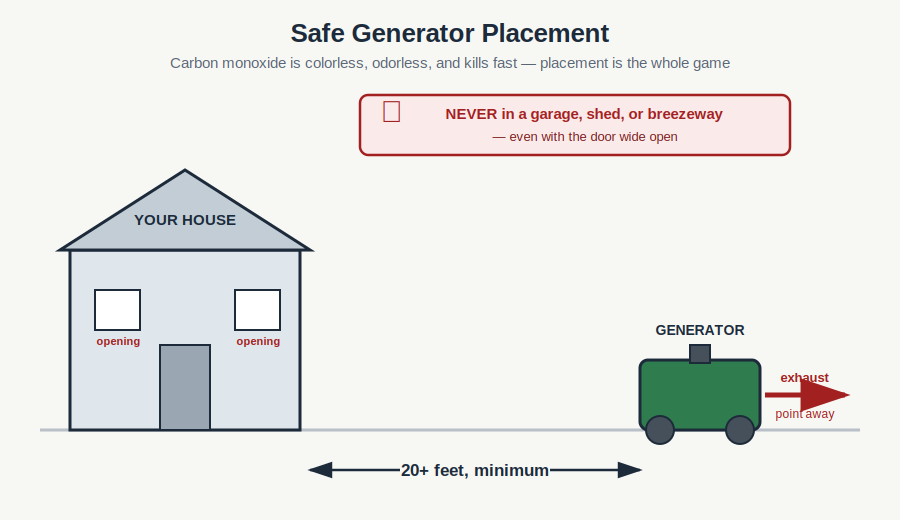
A running generator belongs at least 20 feet from the house, with the exhaust aimed away from every window, door, and vent. Never run one in a garage, shed, or breezeway — even with the door wide open. Generator exhaust is carbon monoxide, it’s colorless and odorless, and it can kill in minutes. A battery-backup CO alarm inside the house is the only thing that will warn you in time.
- 20 feet minimum from the house, doors, and windows — farther is better.
- An open garage door does not make a garage safe. CO pools and seeps into the living space anyway.
- Point the exhaust away from the house and away from where anyone is sitting or sleeping.
- Put a battery-backup CO alarm inside; it’s the only warning you get while you sleep.
- A built-in CO shutoff sensor on a newer generator is a backup, not a license to place it carelessly.
How Far Should a Generator Be From the House?
At least 20 feet, and I’d push it farther whenever the yard allows. That distance isn’t a round number someone made up — it’s the buffer that keeps the exhaust plume from drifting back through a window, a dryer vent, a soffit, or the gap under a door before it disperses. The exhaust has to point away from the house too, because 20 feet with the tailpipe aimed at an open window does you no good. And the same rule covers doors, windows, AC units, and any vent that breathes into the house. I’ve walked up on more than one setup where the generator was a “safe” distance out but parked right under a bedroom window with the exhaust pointed at the screen — that’s not safe, that’s just far. The single most dangerous habit is running it in an attached garage with the door open, figuring the opening lets the fumes out. It doesn’t. CO builds in that space faster than the door clears it and pushes straight into the living area through the shared wall. Outside, away from the building, exhaust pointed at open air — that’s the only version that’s actually safe.
The Open-Garage Myth That Keeps Killing People
I want to hit this one again because it’s the mistake that shows up in nearly every generator CO death I’ve ever read about. “I cracked the garage door” is not ventilation. A portable generator can put out more carbon monoxide than a few hundred idling cars, and a garage — attached or not — holds it like a cup. It seeps through the wall into the house, and the people inside breathe it without ever smelling a thing. If the only dry spot you’ve got is a garage or a shed, the answer is not “leave the door open.” The answer is move it outside and cover it with a running-generator tent, which I’ll get to below.
Which Way Should the Exhaust Face?
Away from the house, and away from people. Aim it at open yard, not at a wall that’ll bounce it back, not at the patio where the family’s sitting, not at a tent you’re camping in. On a calm, still night the plume doesn’t travel much, so it’ll sit right where the tailpipe points — make that somewhere nobody is.
The mistakes that kill, plainly: running it in a garage (open door or not), a shed, a basement, or a crawlspace; setting it next to or under a window, door, or vent; running it inside a tent or RV; and going to sleep with it running close to the house and no CO alarm inside. Any one of these can be fatal in a single night. You won’t wake up — CO makes you sleepier, not alarmed. Run it outside, far out, exhaust away, alarm inside. Every time.
Why Carbon Monoxide From a Generator Kills So Fast
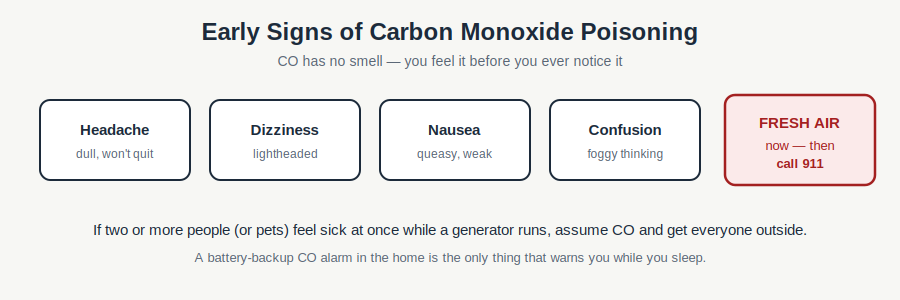
Here’s the part that makes this so dangerous, and it’s worth understanding because it explains why you can’t trust your own senses. Carbon monoxide binds to the hemoglobin in your blood somewhere around 200 times more readily than oxygen does. So even a small concentration in the air crowds oxygen out of your bloodstream fast. Your body doesn’t get a clean warning. There’s no choking, no burning, no smell — the first signs are a dull headache and feeling a little off, which people brush aside or blame on being tired.
From my Air Force days working around fuel and exhaust, this was drilled into us constantly: the symptoms sneak up, and by the time you realize something’s wrong, your judgment is already impaired enough that you might not act on it. It escalates from headache to dizziness to nausea to confusion to passing out, and the cruel part is that confusion stage — people are too foggy to understand they need to get out. That’s why two or more people feeling sick at the same time, while a generator runs, is a five-alarm signal. Don’t investigate. Get everyone, pets included, out into fresh air, then call 911.
The CO Alarm Is Non-Negotiable
You cannot smell CO and you cannot feel it coming in time, so you need something that can. A battery-backup carbon monoxide alarm inside the house — not plugged into the wall power that just went out — is the one device that warns you while you’re asleep. They run $20 to $40, they last years, and I consider one as essential as the generator itself. If you own a generator and don’t have a working CO alarm in the house, that’s the gap to close before the next outage.
Built-In CO Sensors: A Backup, Not a Pass
A lot of generators built in the last few years carry a CO shutoff sensor that kills the engine if it detects a dangerous buildup nearby. That’s a genuinely good feature and it has saved lives. But it is a last line of defense, not a reason to place the unit carelessly. The sensor reads the air around the generator — it can’t protect someone two rooms away if the unit’s in the wrong spot to begin with. Place it right, put an alarm inside, and treat the built-in sensor as the backup to your backup.
Running It in the Rain
This is where people get tempted to do the dangerous thing. You can’t run a bare generator in a downpour — water and electricity don’t mix — but the answer is never to move it into the garage or under a closed structure. Use a running-generator cover or tent, the kind built to shed rain while leaving the exhaust and airflow open. It keeps the unit dry without trapping the CO. Keeping airflow open also matters for the engine itself; a generator starved of cooling air runs hot, which ties into why generators overheat and shut down.
What the Safety Gear Costs
This is cheap insurance against the worst outcome there is. A battery-backup CO alarm is $20 to $40. A running-generator tent or cover is $40 to $100. Together that’s less than a tank of fuel for some units, and it’s the difference between a safe outage and a tragedy. There’s no pro to call here — placement and a couple of inexpensive items are the whole job. Before you run a generator this season, make sure you’ve sized it to what you actually need so it isn’t straining (see how to size a generator), and keep fuel handling away from the running engine, since a fuel leak near a hot generator stacks a fire risk on top of the CO risk.
The Bottom Line
Twenty feet out, exhaust away, alarm inside — that’s it. Get those three right and a generator is a tool; get them wrong and it’s the most dangerous thing in your yard.
Frequently Asked Questions
How far should a generator be from the house?
At least 20 feet, with the exhaust pointed away from windows, doors, and vents. I go farther whenever the yard allows. The distance is what keeps the exhaust from drifting back inside before it disperses, and 20 feet is the floor, not the target.
Can I run a generator in the garage with the door open?
No. An open door does not make a garage safe — CO builds up faster than it clears and seeps into the house through the shared wall. I’ve seen this exact setup end badly. If the garage is your only dry option, move the generator outside and cover it instead.
Can I run a generator in the rain?
Not uncovered. Use a running-generator tent or cover made to shed water while leaving the exhaust and airflow open. Never solve the rain problem by moving it into a garage or enclosed space — that trades a shock risk for a deadly CO risk.
Do I still need a CO alarm if my generator has a CO sensor?
Yes. The built-in sensor protects the air right around the generator; it can’t watch over someone sleeping two rooms away. I treat the on-board sensor as a backup and the indoor battery alarm as the real warning. Have both.
Which way should the generator exhaust face?
Away from the house and away from people — at open yard. On a still night the exhaust sits right where the tailpipe points, so aim it somewhere no one is sitting, sleeping, or camping. Pointing it at a wall just bounces it back.