
Before you start pulling panels, figure out which Predator 3500 problem you’ve actually got — the fix for each one is different:
- Runs but no power, or the overload light is on → start with Runs But No Power
- “AC under voltage” on the display → jump to The AC Under Voltage Code
- Surging, hunting, or won’t hold steady → see Surging and Hunting
- Cranks but won’t start → that’s a fuel/spark issue, covered in why a Predator won’t start
Most Predator 3500 “no power” complaints come down to three things, in order: a stuck overload that needs a full reset, a weak excitation field throwing an “AC under voltage” code on a unit that’s been sitting, or a failed AVR. Do the reset first — everything unplugged, power off five minutes, reset the breaker. If it still won’t put out power, the fault is in the voltage regulator or, less often, the inverter board.
- The 3500’s weak points are the electrical output side — the AVR and the inverter board — not the engine, which is a solid Honda-clone.
- An “AC under voltage” code on a unit that sat is usually a weak field — flashing the residual magnetism often brings it back.
- Surging is almost always stale fuel in the carb; the 3500’s carb gums up like any other.
- The AVR is cheap ($20–40) and worth replacing. The inverter board ($120–250) is the gut-check part.
- On a ~$900 unit, an inverter board is worth fixing — unlike a cheap $300 generator where it usually isn’t.
Runs But No Power (or the Overload Light Is On)
This is the most common Predator 3500 problem I see, and the good news is the first step is free. Start with a full reset: unplug everything, switch the generator completely off, let it sit five minutes so the protection circuit drops out, then restart and press the breaker back in. On a bare panel that clears a stuck overload latch a fair amount of the time. If the overload light is on with nothing plugged in, though, that’s not a real overload — it’s the electronics, and you’re heading into the diagnostic below.
The path from there is straightforward, and it goes in this order because it goes cheapest-and-most-likely first.
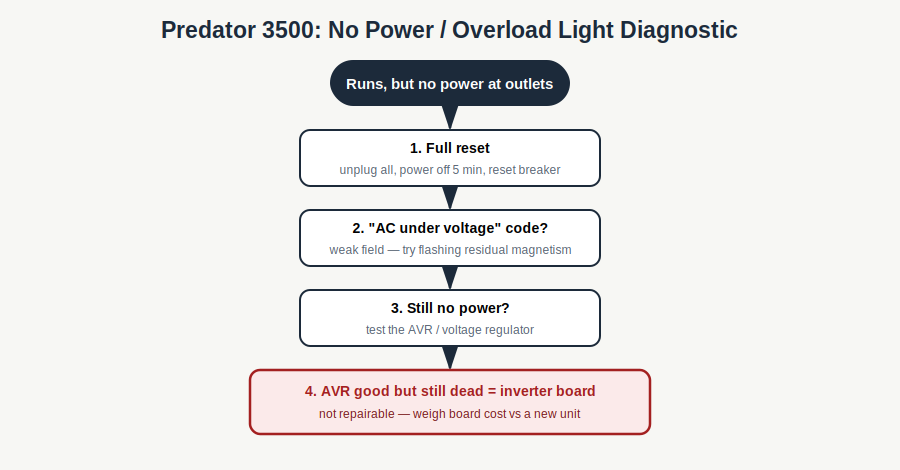
OK, so the reset didn’t do it and you’re still dark at the outlets. That points at the part of the generator that makes and regulates the voltage. On the 3500 that’s the AVR, and it’s a part worth chasing because it’s cheap — walk through how to test and replace the AVR with a multimeter. While you’re in there, a tired run capacitor can throw similar symptoms, so testing the capacitor takes two minutes. The deeper diagnostic — the residual-magnetism flash and the full no-power chain — lives in runs but no power at the outlets, and it applies directly here.
The “AC Under Voltage” Code
This one trips up a lot of owners, especially on a unit that’s been in storage. “AC under voltage” means the generator’s output is dropping below the threshold the control electronics expect. On a 3500 that’s been sitting, the most common cause is a weak excitation field — the generator lost some of its residual magnetism and can’t build full voltage. The fix is often to flash the field to restore that magnetism, which the no-power walkthrough covers step by step. If flashing brings the voltage back, you were lucky and it cost you nothing. If the code persists after that, the AVR is the next suspect, and a failing AVR is exactly the kind of part that drops voltage just enough to throw that code.
Flashing the field and probing the AVR means working around live AC voltage with the generator running. If you’re not comfortable with a multimeter on a live circuit, this is a stop-and-get-help point — generator output can shock you hard. And any time it’s running for these tests, it belongs outside, away from the house, exhaust pointed away. The 3500’s exhaust is carbon monoxide like any other.
Surging and Hunting
Now, if the power’s fine but the engine won’t hold a steady speed — revving up and down, hunting — that’s a different animal entirely, and it’s almost never electrical. On the Predator 3500, like nearly every small generator, surging is a fuel-delivery problem. Stale gas leaves varnish in the carburetor’s pilot jet, the engine can’t get a steady lean idle, and it hunts. The 3500’s carb gums up just like any other when fuel sits in it. The fix is cleaning that carb, and the same surging-and-hunting pattern and the pilot-jet cleanout are covered in why a generator surges. One Predator-specific note: make sure you’re not stuck in economy mode trying to run a load that needs full throttle — eco mode keeps the rpm low and can look like a power or surging problem when it’s working as designed.
A Word on the 3500 Specifically
I like the Predator 3500 for what it is — a Harbor Freight inverter with a Honda-clone engine that punches well above its price. The engine side is genuinely solid. Where these show their price is the electrical output components: the AVR and the inverter board are the parts that fail, and they fail more than they would on a Honda EU. The upside is parts are cheap and available — a carburetor is $20 to $35, an AVR is $20 to $40 — so most repairs stay affordable. If you own one, the maintenance that keeps it out of the shop is fuel discipline: fresh gas, stabilizer, and don’t let it sit full of untreated pump gas.
When It’s Worth Fixing
The repair math actually works in your favor on a 3500, which isn’t true of cheaper units. The AVR is $20 to $40 and a straightforward swap, so that’s always worth doing. Even the inverter board — the expensive failure at $120 to $250 — is worth replacing on a generator that runs around $900 new. That’s the opposite of my advice on a sub-$300 inverter, where a dead board means buy a new one. A small-engine shop will charge $90 to $150 just to diagnose the 3500, so if you can run a multimeter, doing the AVR and field work yourself saves real money. For anything where the breaker keeps cutting under normal load rather than the output being dead, a breaker that won’t hold sorts whether it’s the load or the breaker.
Frequently Asked Questions
Why does my Predator 3500 have no power after sitting in storage?
Usually a weak excitation field — it lost residual magnetism while it sat and can’t build full voltage, which often shows as an “AC under voltage” code. Flashing the field brings it back a lot of the time, and if it doesn’t, the AVR is next. I see this constantly on units that sat all winter with no run.
What does “AC under voltage” mean on a Predator 3500?
It means the output voltage dropped below what the control electronics expect. On a unit that’s been sitting it’s typically a weak field; on one that’s been running fine and suddenly throws it, suspect the AVR. Either way it’s an output-side problem, not the engine — the engine is running fine to even show you the code.
Can I fix the inverter board myself?
You can replace it, but you can’t repair it — the board is not a serviceable part, it’s a swap. On a 3500 a replacement board runs $120 to $250, and on a $900 unit that’s worth doing. I’d only replace it after confirming the AVR and field are good, though, because the board is the least likely and most expensive culprit.
Why does my Predator 3500 surge up and down?
Stale fuel in the carburetor, nine times out of ten. The gum clogs the pilot jet, the engine can’t hold a steady idle, and it hunts. Clean the carb and it usually settles right down — and check you’re not fighting economy mode while asking it to run a real load.
Is the AVR or the inverter the problem on my 3500?
Start by assuming the AVR, because it’s cheaper, more common, and easy to test. Flash the field, test the AVR with a meter, and only move to the inverter board if both check out and you still have no power. I’ve replaced a dozen AVRs for every inverter board on these units.