
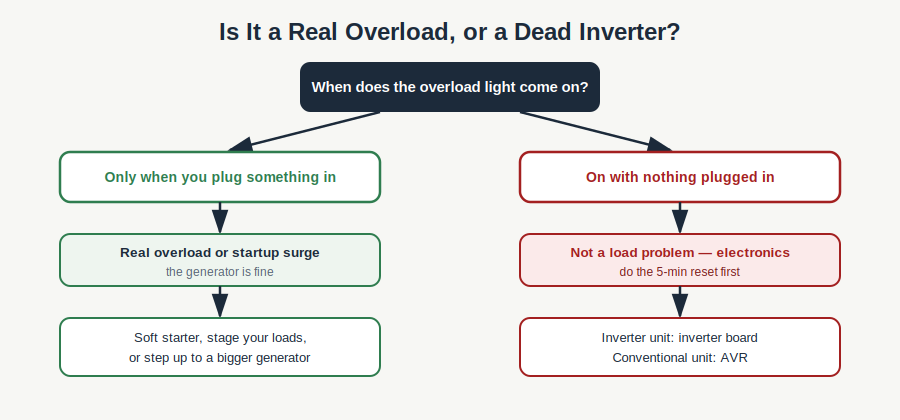
If the overload light is on with nothing plugged in, it isn’t really an overload — that light is lying to you. Unplug everything, switch the generator off, let it sit five minutes, and reset the breaker. If it lights up again on a bare panel, the fault is internal: a failed inverter board, a bad voltage regulator, or a tripped CO sensor on newer units, not too much load.
- An overload light that only comes on when you add load means a real overload or a high-surge appliance. An overload light that stays on with nothing connected is an electronics fault, not a load problem.
- Always do the free reset first: everything unplugged, power off, wait five minutes, reset the breaker. On a bare panel it clears about 1 in 5 times.
- On inverter generators, a steady bare-panel overload light is usually a dead inverter module — not repairable, and on a cheap unit often not worth fixing.
- A flashing red or yellow light on a newer unit is the carbon monoxide sensor, not an overload — different problem entirely.
- Hammering the reset button into an actual short or overload is how you cook the windings. That protection is there for a reason.
What the Generator Overload Light Is Actually Telling You
That little red light is the output-protection circuit, and it has exactly two stories to tell depending on when it lights. If it kicks on the second you plug something in, you’ve got a genuine overload — the load drew more than the generator can give, and the protection cut power before something melted. That’s the light doing its job. But if it’s glowing with the panel completely bare, nothing plugged into a single outlet, that is not an overload no matter what the label says. I’ve had a hundred of these on the bench, and a bare-panel overload light points one direction: the electronics. On an inverter unit that’s almost always the inverter module itself; on a conventional unit it’s the voltage regulator. Roughly 60% of the “overload light won’t go off” calls I see are inverter generators with a failed board, and the owner spent a week convinced they were overloading a generator that had nothing plugged into it. So before you do anything else, sort which light you’ve got — load-on or bare-panel — because the fix for one has nothing to do with the other.
First: Reset It the Right Way (Free, and It Works More Than You’d Think)
Before you condemn anything, do a full reset, because the overload latch can stick even after the real problem is gone. Unplug every cord. Switch the generator fully off — not just the breaker, the engine. Let it sit five minutes so the protection circuit drops out. Then start it back up, let it settle for a few seconds, and press the reset/breaker back in. On a truly bare panel this clears the light maybe one time in five, and it costs you nothing but five minutes. One catch most manuals bury: a lot of these units cap you at about five reset attempts per start cycle, then they lock out until you fully power down again. So don’t sit there stabbing the button — reset once, properly, and move on.
Is It a Real Overload or a Dead Inverter?
This is the question that decides everything, and you can answer it in about a minute. Start the generator with nothing plugged in. If the overload light is OFF on the bare panel and only trips when you add a specific device, you’ve got either too much load or one bad appliance — skip down to the load section. If the light is ON with the panel bare, the generator is faulting on its own output, which means the part that makes or regulates the electricity has failed.
On an inverter generator, that’s the inverter module. Inverter units don’t have a regulator and brushes like a conventional generator — they run a 3-phase alternator into an inverter board that converts everything to clean AC. When that board dies, the overload light comes on with nothing connected and stays on. It is not a repairable part. A replacement module runs anywhere from $120 to $300-plus depending on the unit, which is the gut-check moment: on a $450 inverter generator, a $200 board plus your time usually isn’t worth it.
On a conventional generator, the equivalent failure is the voltage regulator. If yours runs but the output is wrong and the breaker keeps cutting, work through how to test and replace the AVR — an AVR is only $20 to $60, so this one’s worth chasing. While you’re in there, a failing run capacitor throws similar symptoms on some brushless units; testing the capacitor takes two minutes with a meter.
The Flashing Light Is a Different Animal
Quick but important: if your light is flashing red or yellow rather than holding steady, that’s probably not the overload circuit at all. Newer generators built in the last few years carry a carbon monoxide shutoff sensor, and a flashing pattern is how it reports either a CO detection or a failed sensor. I’ve seen plenty of perfectly healthy generators dragged in for “the overload light” when it was a nuisance-tripping CO sensor the whole time. If the pattern is a blink, not a solid glow, treat it as a sensor issue, not a power problem.
Stop resetting into a short. If the light comes back the instant you add a load, something is drawing a fault — a shorted appliance, a damaged cord, or a real overload. Each time you force the reset and feed power into that, you’re heating the stator windings toward permanent damage. The overload protection is the only thing standing between a bad cord and a fried generator. And whenever the engine is running to test this, it belongs outside, away from the house — the exhaust puts out carbon monoxide that kills fast and silent, even in an open garage.
When the Light Only Trips Under Load
If the bare panel is clean and the light only fires when you plug something in, the generator is fine — the problem is what you’re asking it to do. The most common version, maybe 70% of load-side trips, is a startup surge. A refrigerator compressor or a window AC can pull three to five times its running watts for the half-second it kicks on, and that spike trips the overload even though the running load is well within range. A soft-start device on the appliance, or simply staging your loads so the big motor starts first on an empty generator, fixes it. If you’re regularly bumping the limit, you may just be undersized — walk through how to size a generator to your actual load before you blame the unit.
The other version is a single bad appliance. If the light only trips with one specific device plugged in, that device has an internal short. Test by elimination: plug things in one at a time and watch for the trip. One oddball I run into a lot — a refrigerator on a GFCI outlet will trip after a while for reasons that have nothing to do with overload, so try the fridge on a non-GFCI outlet before you panic. For anything where the generator runs but the outlets stay dead, the cause is usually upstream of the overload circuit entirely; no power at the outlets walks the residual-magnetism and breaker chain that catches most of those. And if the breaker itself keeps popping under normal load, a breaker that won’t hold covers when the breaker is the bad part.
When It’s Worth Fixing — and When It Isn’t
The repair math is brutal on the cheap units. A conventional generator’s AVR is $20 to $60 and a 30-minute job, so that’s almost always worth doing yourself. An inverter board is a different story: $120 to $300-plus, and on a budget inverter generator that’s most of what the unit is worth. A small-engine shop will charge $90 to $150 just to diagnose it, then parts on top. My honest rule: if it’s a name-brand unit (Honda, a higher-end Generac or Champion) the board is worth replacing; if it’s a sub-$500 import and the board is dead, I’d put the money toward a new generator and keep the old one for parts.
How to Keep the Overload Light Off
Most overload trips trace back to two habits. First, sizing — know your running watts and your surge watts, and leave headroom; a generator run flat-out at 100% all day is a generator that throws overload faults and dies young. Second, don’t run an inverter unit with no load for long stretches; a few cheaper models will fault if they idle bare too long. Keep the load between roughly 25% and 75% of rated capacity and the overload circuit mostly leaves you alone. The CPSC’s portable-generator safety guidance is worth a read on the load and placement side, since the same overload-and-surge habits tie straight into the carbon monoxide and fire risks.
Frequently Asked Questions
Why is my generator overload light on with nothing plugged in?
Because it isn’t an overload. On a bare panel that light means the electronics failed — a dead inverter module on an inverter unit, or a bad voltage regulator on a conventional one. I’ve never once found an actual overload on a generator with empty outlets.
Can I reset the generator overload light?
You can try, and you should: unplug everything, shut it fully off, wait five minutes, restart, then press the breaker in. It clears a stuck latch maybe one time in five on a bare panel. If it comes right back, resetting won’t help — the part behind it has failed.
How many times can I press the reset button?
On most units, about five times per start cycle before it locks out. Then you have to fully power down to try again. Honestly, if one proper reset doesn’t hold, more presses won’t fix it — you’re just buying time on a part that’s already gone.
Does the overload light mean my generator is broken?
Not always. If it only trips when you plug in a big motor like a fridge or AC, the generator is fine and you’ve got a startup surge — a soft starter or staging your loads handles it. If it’s lit with nothing connected, then yes, something internal failed.
Will a soft starter stop the overload light?
If the trip happens at the moment an air conditioner or refrigerator compressor kicks on, yes — a soft starter smooths that inrush spike and keeps it under the overload threshold. I’ve used them plenty to let a borderline-sized generator run an AC it otherwise couldn’t start. It won’t do a thing for a bare-panel light, though, since that’s not a load issue.