
Which version of this are you living? The generator trips or bogs the instant the fridge kicks on, even though the math says it should fit. Or everything runs beautifully until the AC or well pump tries to start, and down it goes. Or the overload light flashes with what should be a light load. All three have the same explanation, and it’s not a broken generator — it’s starting watts vs running watts, and once you see it you can’t unsee it.
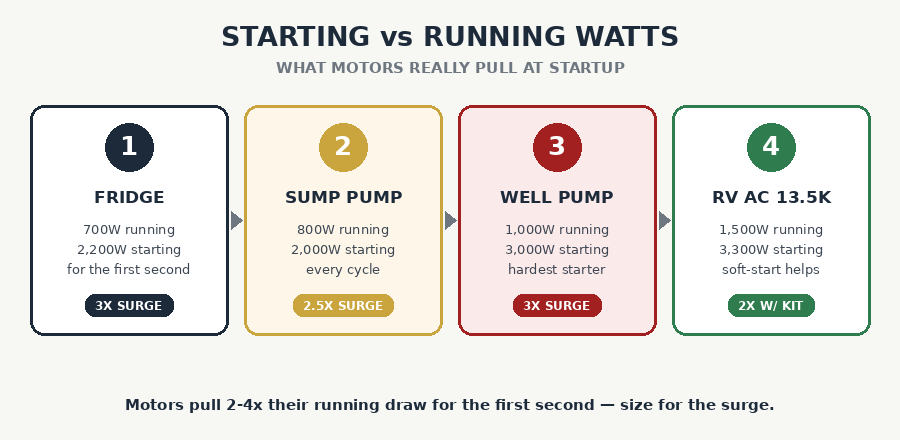
Running watts is what an appliance draws while operating; starting watts is the 2-4x larger surge an electric motor pulls for the first second as it spins up. A refrigerator that runs on 700 watts demands about 2,200 to start. Generators must be sized — and loads must be staggered — around those surges, not the steady numbers.
Why Does the Fridge Trip a Generator Twice Its Size?
Because for about one second, that fridge isn’t a 700-watt appliance — it’s a 2,200-watt one. Every electric motor pulls a locked-rotor surge getting itself spinning, typically 2 to 4 times its running draw, and compressor motors (fridges, freezers, AC units) and pumps are the worst offenders. In fact, around 80% of the “my generator overloads with almost nothing plugged in” complaints I field are surge math, not a machine fault. A 2,000-watt generator sees that 2,200-watt fridge surge and does exactly what it should: trips the breaker or stalls. Add up your loads using each motor’s starting number for the single largest motor plus running numbers for everything already on, and the mystery trips stop being mysterious. If the unit trips even with genuinely tiny resistive loads — lamps, a phone charger — then it isn’t surge at all, and you want the breaker-tripping diagnosis instead.
The Numbers for the Loads That Matter
Here’s the starting watts vs running watts gap for the household heavy hitters. A full-size refrigerator: roughly 700 running, 2,200 starting. A 1/3-hp sump pump: about 800 running, 2,000 starting. A 1/2-hp well pump: about 1,000 running, 3,000 starting — well pumps are the hardest starters in most homes because the motor spins up against water pressure. A 13,500 BTU RV air conditioner: around 1,500 running, 3,300 starting. Meanwhile the non-motor loads are honest: a 1,500-watt space heater is 1,500 watts, period — resistive loads like heaters, bulbs, and coffee makers have no surge at all. Your own appliances print their truth on the data plate (amps × volts = watts), and the full add-it-up worksheet lives in what size generator do I need.
So the picture’s forming: it’s not the total load, it’s the timing of the biggest surge. Which means you can work around it.
Staggering: the Free 1,000 Watts
The surge only lasts a second, and only one motor has to start at a time — so sequence them. Fridge on first, let it settle for thirty seconds, then the freezer, then the sump pump, then the rest. Staggered starts let a mid-size generator carry a load list that would flatten it if everything hit at once; it’s effectively free capacity. The reverse matters too: after any refueling shutdown, unplug everything before restarting, or every compressor in the house tries to start simultaneously the moment power returns. I treat load sequencing the way I was trained to treat any power-up on equipment that mattered — a deliberate order, not a light switch. It takes two minutes and it’s the difference between a 3,500-watt unit feeling cramped or comfortable. One caution flag while you’re at it: a generator that used to carry these same surges and now bogs on them didn’t shrink — something slipped, and the bogging-under-load guide finds it.
When the Surge Just Doesn’t Fit: Soft Starts
Sometimes no sequencing helps — classically the RV crowd trying to run a 13,500 BTU AC off a 2,000-watt inverter, or a home well pump versus a modest portable. A soft-start kit wired into the motor ramps the spin-up over a couple seconds instead of slamming it, cutting that 3,300-watt AC surge down to something like 1,800 — suddenly the small quiet generator carries it. Kits run $100 to $150 for the popular RV AC soft start units and install in an afternoon. That’s real money, but it’s a fraction of stepping up a whole generator class, and it’s kinder to the motor besides.
If the surge concept clicks better watching than reading, this explains it cleanly:
Frequently Asked Questions
What does starting watts vs running watts actually mean?
Running watts is the continuous draw; starting watts is the brief surge — 2 to 4 times higher — that an electric motor pulls for about a second while spinning up. Generators advertise both numbers for the same reason: the surge is what actually trips them.
Why does my generator trip when the refrigerator starts?
The fridge’s compressor is momentarily demanding around 2,200 watts from a machine that may only have 2,000 to give. The steady 700-watt draw was never the problem. Fixes, in order of cost: start the fridge first before other loads, shed something else, or size up.
How many starting watts does a refrigerator need?
Figure about 2,200 for a typical full-size fridge against 700 running, and add margin for big French-door units. Your fridge’s data plate inside the door frame gives amps — multiply by 120 for running watts, then roughly triple it for the start.
Do LED lights and heaters have starting watts?
No — that’s the split that makes the math easy. Resistive loads (heaters, bulbs, toasters, coffee makers) draw the same watts start to finish. Only motors and compressors surge. A 1,500-watt heater is the rare appliance that’s exactly as hungry as it claims, no more.
Can I run two things with big starting watts on one generator?
Usually, if they don’t start at the same moment — stagger them and the generator only ever eats one surge at a time. What I won’t promise is two automatic compressors never syncing up by chance; if the combined surge exceeds the surge rating, expect the occasional trip and plug the priority load in first.