
A generator that won’t stay running under load almost always has a fuel supply problem — the carb can’t deliver enough flow at high demand. Check the fuel valve flow, clean the carb’s main jet, and confirm you’re not overloading the machine before suspecting electrical or mechanical causes. The load is what reveals what idle masks.
Generator Won’t Stay Running Under Load — What’s Actually Happening
An engine that runs perfectly at idle and dies when you plug in a load is telling you something specific: the idle circuit works but the main circuit doesn’t. In a carburetor, the idle circuit feeds fuel at low throttle and the main jet takes over at high throttle. Varnish and deposits almost always hit the main jet first and hardest because the higher flow velocity through it carries more contamination. So the idle runs clean, the main jet can’t supply enough fuel under load, the engine leans out, and it bogs or dies. This pattern — runs great at idle, dies or stumbles under load — is diagnostic for either a dirty main jet or a fuel supply restriction upstream of the carb. The other possibilities: actual overload (too many watts), low oil sensor trip, and air restriction.
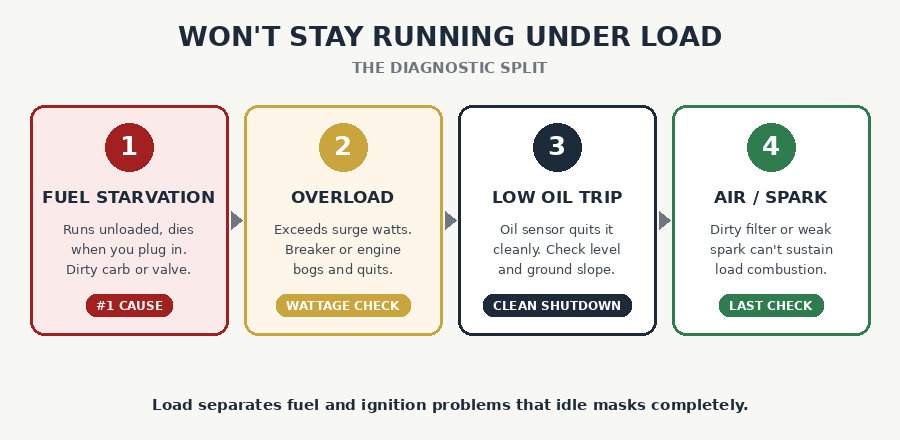
Fuel Starvation — the 70% Cause
Start at the supply end: pull the fuel line at the carb and confirm strong flow from the valve. A trickle starves the engine the moment it tries to pull full-load fuel demand — the fuel valve and outlet screen diagnosis is in the fuel valve guide. If flow is strong, the restriction is inside the carb. Remove the bowl and look at the main jet — it’s the brass fitting in the center of the carb body with a small hole. If you can’t see light through it, it’s clogged. A 0.028-inch passage doesn’t take much varnish to restrict. Spray it with carb cleaner, let it soak, and use a thin wire or a strand of copper from a wire brush to clear it — never drill it larger. The full carb cleaning procedure is at clean a generator carburetor.
Overload — Check the Math Before the Carb
If the generator trips its breaker or the engine bogs hard the instant you connect a load, check the wattage math first. Motors pull 2 to 4 times their running watts for the first second of startup — a refrigerator that runs on 700 watts needs 2,200 to start. If you’re starting a fridge, sump pump, and window AC simultaneously on a 3,500-watt generator, you’re asking for 7,000 surge watts on startup. The generator does the honest thing and quits. The starting versus running watts breakdown is at starting watts vs running watts. Stagger your loads and the generator that “can’t handle anything” suddenly runs everything.
Low Oil Sensor and Air Restriction
A low oil shutdown gives a clean cutoff — not a bog, not a stumble, a clean stop. If that’s your symptom, check oil level and make sure the unit is on level ground before anything else. The low oil sensor diagnosis is at low oil shutoff with oil full. An air filter that’s been in service more than a season without cleaning causes a rich-running condition under load — the engine can’t pull enough air to match the fuel delivery. Fifteen seconds to pull the filter and look at it; if it’s gray or brown, clean or replace it.
This shows a real-world load-drop diagnosis on a common generator:
Frequently Asked Questions
Why does my generator run fine with no load but die when I plug something in?
The idle circuit in the carb works but the main jet can’t supply enough fuel at high throttle. Varnish from stale fuel clogs the main jet first. Clean the bowl and main jet and it’ll run under load again. Confirm the fuel valve flows freely first — a restricted valve causes the same symptom.
Can too much load cause a generator to shut off?
Yes — the breaker trips on overload, or the engine bogs and stalls. Calculate your running watts plus the largest surge watt draw you’re expecting. If that exceeds the generator’s surge rating, something has to give. Stagger your starts so only one motor inrushes at a time.
Why does my generator keep shutting off after a few minutes of use?
A timed shutdown (same interval every time) usually means thermal overload — the engine is overheating and the thermal protection is cutting it off. Check coolant flow, clean the cooling fins, and make sure airflow around the engine isn’t blocked. A random shutdown usually means fuel starvation — the bowl empties and refills slowly. A clean cutoff with no bog usually means the low-oil sensor.