
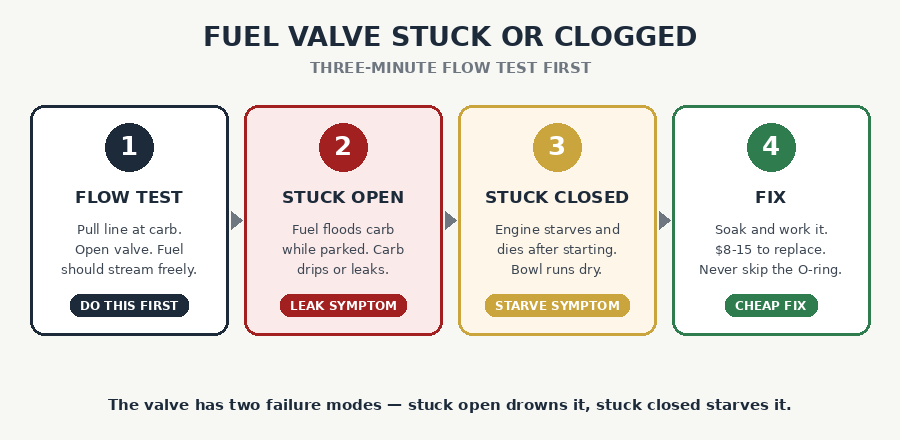
A generator fuel valve stuck closed starves the engine — it fires and dies within seconds. Stuck open, it floods the carb while parked. The three-minute flow test tells you which you have: pull the fuel line at the carb, open the valve, and watch the flow. A strong stream means the valve works. A trickle or nothing means it doesn’t.
Generator Fuel Valve Stuck — Two Failure Modes, Two Symptoms
The fuel valve (petcock) sits between the tank and the carburetor and does one thing: open and close the fuel supply. It fails in two opposite directions. Stuck closed: the valve won’t open fully even in the ON position, so the engine starves. The generator starts normally, runs fine for 30 seconds to a few minutes as the carb bowl empties, then dies. Crank it again — it starts, runs 30 seconds, dies again. This pattern is almost diagnostic. Stuck open: the valve can’t shut off fuel flow even in the OFF position. Fuel drains past a failing inlet needle in the carb and floods the bowl while the machine sits. You find a fuel smell, a wet carb, or fuel that’s gotten past the rings into the oil. Both failures have the same cheap fix: the valve soaks free or gets replaced for $8 to $15.
The Flow Test
Engine off, fuel valve OFF. Pull the fuel line off the carb inlet — have a rag ready. Open the valve to ON and watch what comes out of the line. A strong stream that fills a cup in under a minute: the valve is fine, your problem is downstream in the carb or filter. A weak trickle: the valve is partially blocked or stuck. Nothing at all with fuel in the tank: the valve is stuck closed or the outlet screen is packed with sediment. The outlet screen — a small mesh filter on the inside of the tank at the valve fitting — is the first thing to check on a low-flow result. It’s usually removable with pliers and cleans out in thirty seconds. Sediment from the tank bottom packs it solid, especially after the tank runs dry.
How to Free a Stuck Valve
Most petcocks that are stuck from non-use or varnish buildup can be freed without replacement. Close the valve, spray carb cleaner or penetrating oil into the valve body where the handle shaft enters, and work the handle back and forth firmly. Give it a few minutes to soak and try again. On vacuum-operated petcocks (common on Hondas and some Yamahas), the diaphragm inside can fail — these need replacement, not cleaning, because the diaphragm material hardens and cracks. If working the valve doesn’t free it or if it works but won’t fully seal in OFF, replacement is the right call. A replacement petcock for most common generators runs $8 to $15; always replace the O-ring on the tank fitting, not just the valve — the O-ring is what seals against fuel leaks and they harden with age.
What a Stuck-Open Valve Does to the Engine
If the valve can’t shut off and the carb’s inlet needle is also leaking, fuel can reach the crankcase by draining past the rings — a problem covered in detail in generator leaking gas or oil. Check the oil level on a machine that sat with a suspected open valve — if the level is high or the oil smells like gas, change the oil before running. Fuel-thinned oil doesn’t protect bearings. This is a ten-dollar oil change preventing a hundred-dollar engine repair.
This shows a clogged fuel system component diagnosis that applies directly:
Frequently Asked Questions
How do I know if my generator fuel valve is bad?
Do the flow test: line off the carb, valve open, watch the stream. No flow with a full tank means the valve or outlet screen is blocked. If the generator starts and dies on a repeating 30-second cycle, the valve is starving it. If you smell fuel around a parked generator, the valve isn’t sealing and fuel is flooding into the carb.
Can I replace a generator fuel valve myself?
Yes — it’s two fittings and a clamp. Drain the tank or crimp the fuel line to stop flow, unscrew the old valve from the tank fitting, thread in the new one with a fresh O-ring, reconnect the line. Ten minutes. Match the thread size on the tank fitting; most common sizes are 1/4-inch NPT or M10x1.0.
Why does my generator start then die after 30 seconds?
The carb bowl empties and the valve can’t refill it fast enough, or at all. Could be a stuck or partially blocked fuel valve, a packed outlet screen, or a kinked fuel line. Run the flow test first — it takes three minutes and tells you immediately whether the valve or something downstream is the problem.
What is a vacuum petcock on a generator?
A vacuum-operated petcock only opens fuel flow when the engine creates intake vacuum — it’s a safety feature that prevents flooding if the carb needle fails. The diaphragm inside is the wear item. If the engine cranks fine but acts like it’s out of fuel, test whether the vacuum port is clear and the diaphragm still flexes. Replacement is the only fix when the diaphragm fails.