
A failing AVR (automatic voltage regulator) shows up as output voltage that’s consistently high, consistently low, or fluctuating under a steady load. Before condemning the AVR, test voltage with a meter and check engine speed — a slow engine fakes AVR failure perfectly. If speed is correct and voltage is wrong, the AVR is the suspect.
Generator Voltage Regulator Symptoms — What a Bad AVR Actually Does
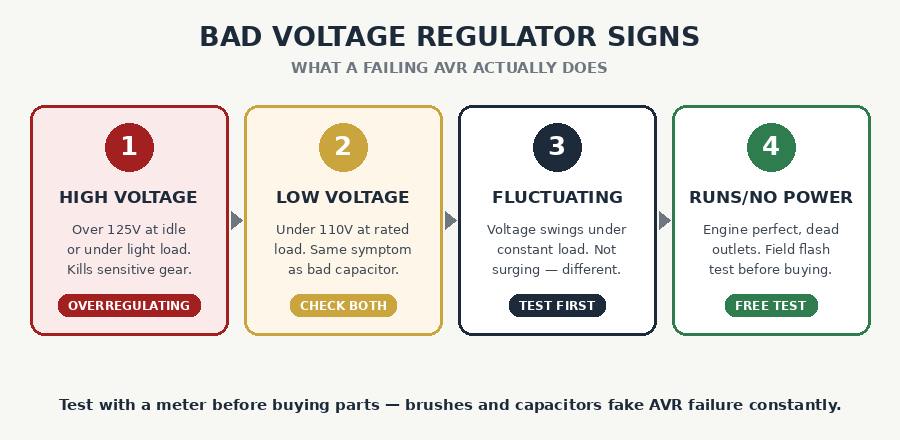
The AVR’s job is simple: sense the generator’s output voltage and adjust the excitation current to the rotor to keep it at 120V regardless of load. When it fails, it either over-excites (too much voltage) or under-excites (too little), or it loses control entirely and the voltage wanders. Here’s what each mode looks like: consistently high voltage (130V or more) at light or no load — the AVR is failing open, sending too much excitation. Consistently low voltage (under 110V) at rated load — under-exciting, or the AVR is failing closed. Voltage that’s correct unloaded but drops badly under even light loads — AVR is marginal and can’t respond fast enough. Voltage that wanders under constant load — AVR feedback loop is breaking down. What the AVR does NOT do: cause surging (that’s the governor), or cause a complete loss of power from a running engine (that’s usually lost residual magnetism — free fix, covered in generator runs but no power).
Test Engine Speed Before Touching the AVR
This is the step that saves the most money on AVR replacements that weren’t actually needed. Voltage and frequency are directly linked — if the engine is running slow (low Hz), voltage will be low regardless of AVR condition. Set your multimeter to Hz and probe the outlet: 59–61 Hz means the engine is turning at the right speed and the problem is truly electrical. Anything below 58 Hz means the engine is slow — fix the speed first. A governor adjustment, a partially clogged air filter, or a carburetor issue can all cause low engine speed that perfectly mimics a bad AVR. I’ve replaced voltage regulators that were perfectly fine because the tech before me didn’t own a meter with a Hz function. The full testing sequence with a multimeter is in testing generator output with a multimeter.
Brushes and Capacitors Fake AVR Failure
On brushed units, worn brushes or glazed slip rings cause the same low-voltage or no-voltage symptom as a dead AVR. The brush check takes five minutes and costs nothing — if you find brushes under 1/4 inch or glazed rings, that’s your fix. The brush diagnosis is at generator brushes and slip rings. On capacitor-excited units (no brushes, no AVR — common on cheaper open-frame generators), the capacitor is the AVR equivalent. A weak capacitor causes low voltage that looks exactly like AVR failure; the two-minute capacitor test is at generator capacitor test and replace. Know which type of excitation your generator uses before ordering parts — the parts diagram or the manual will tell you.
When It Really Is the AVR
You’ve confirmed correct engine speed, good brushes, and functional slip rings, and voltage is still wrong. Now it’s the AVR. Replacement units run $15 to $35 for the common brick-style regulators used on Chinese-built generators; genuine Generac and Honda AVRs are $60 to $150. Match it by the part number on the old unit if you can find it, or by the generator model. The full replacement procedure with wiring notes is in AVR test and replace.
This shows the AVR adjustment and test process clearly:
Frequently Asked Questions
What are the symptoms of a bad generator voltage regulator?
High output voltage (over 125V), low output voltage (under 110V under load), or voltage that wanders under a steady load. Confirm engine speed is correct first — low Hz mimics AVR failure constantly and costs you a $30 part you didn’t need.
Can I run a generator with a bad voltage regulator?
Briefly, but not on anything you care about. High voltage kills sensitive electronics fast. Low voltage damages motors by making them draw excess current. If you need to run it short-term, run it with nothing plugged in except a basic load like incandescent work lights and replace the AVR as soon as possible.
How long do generator voltage regulators last?
Properly loaded units in normal conditions: a decade or more. Units that run heavily overloaded, or that see voltage spikes from bad connections, burn out faster. Heat is the main enemy — AVRs in tight compartments with poor cooling fail earlier. Keep the generator clean and don’t run it overloaded, and the regulator will outlast most of the rest of the machine.
How much does it cost to replace a generator voltage regulator?
$15–35 for common budget-brand generators, $60–150 for OEM parts on Generac, Honda, and commercial units. The part is usually a 15-minute swap once you identify the correct replacement — two or three wires and a mounting screw.