
A generator low oil pressure alarm means one of three things: the oil is actually low, the unit isn’t level so the sensor reads incorrectly, or the sensor itself has failed. Check oil level and ground slope before assuming anything is wrong with the engine — those two checks solve about 80% of oil pressure alarms on otherwise healthy generators.
Generator Oil Pressure Problems — Alarm vs Real Failure
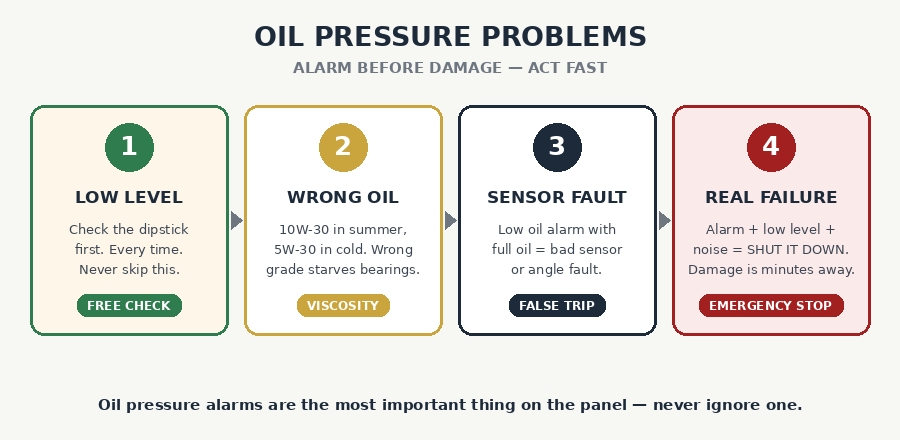
Small generators don’t have actual oil pressure gauges — they have oil level sensors, not pressure sensors. When the manual says “low oil pressure alarm,” it means the engine detected that the oil level sensor tripped, which can happen for four reasons: oil genuinely low, unit on a slope so the oil pools away from the sensor pickup, sensor failed, or — rarely — a real engine oil circulation problem. The last one is the one you don’t want. In twenty years of working on small engines, I’ve seen real oil circulation failure maybe a handful of times. I’ve seen the sensor trip on a sloped driveway hundreds of times. Work through the cheap explanations in order before you worry about bearing damage.
Check Oil Level and Unit Level First
Pull the dipstick, wipe it, dip it again, and read it properly. The engine should be off and on flat ground for an accurate reading — oil measurement on a running engine or a sloped surface is meaningless. If it’s low, fill it to the full mark with the correct weight oil and restart. If it’s at the full mark but the alarm still fires, move the unit to the flattest ground you have and try again. I’ve seen a four-degree slope fool the sensor on units that were absolutely full of oil. If the alarm clears on flat ground, you found your problem — the sensor works fine, the unit just needs level placement. The low oil sensor behavior is covered more in low oil shutoff trips with oil full.
When It’s the Sensor
If oil is at the correct level, the unit is on flat ground, and the alarm keeps tripping — suspect the sensor. Oil level sensors are a float switch in the crankcase; they can fail stuck-open (alarm always fires) or stick partially (alarm fires intermittently). Testing it: unplug the sensor wire and try to start — if the engine runs normally with the sensor disconnected, the sensor is bad. Replacement sensors run $10 to $20 for most common engines; they’re usually a single bolt or threaded fitting in the crankcase. Don’t run without the sensor long-term — it exists because running a low-oil engine destroys it in minutes.
If It’s a Real Oil Problem
Real oil circulation failure shows up differently: the alarm fires and the engine starts making noise — a knock, a rattle, or a new metallic sound that wasn’t there before. Or oil consumption has jumped dramatically and you’re adding oil every few hours. Those symptoms together with a low oil alarm mean you shut it down immediately and figure out where the oil is going before running it again. Burning oil (blue smoke) points to rings or valve seals; losing oil with no smoke points to an external leak. Either way, this machine needs proper diagnosis before it runs again.
An oil pressure alarm combined with a new engine noise is an emergency stop situation. Running a low-oil engine even for three minutes can wipe a bearing or score a cylinder. The repair cost difference between catching it at the alarm and catching it after the noise has been there for an hour is the difference between an oil change and an engine replacement. Shut it down and find the problem.
This shows a real Generac oil pressure alarm diagnosis:
Frequently Asked Questions
Why does my generator keep shutting off due to low oil when the oil is full?
Almost always the unit isn’t sitting level — a slope sends oil away from the sensor pickup. Move to flat ground and retry. If it still trips, unplug the sensor wire; if the engine runs normally without it, the sensor has failed and needs replacement.
Can I bypass the low oil sensor on a generator?
Temporarily, to diagnose whether the sensor is the problem — yes. Permanently, as a running configuration — absolutely not. The sensor is the only protection against destroying the engine on a low oil condition. Bypass it for the diagnostic test, confirm the sensor is bad, replace it the same day.
What oil does a generator use?
Most small four-stroke generators use 10W-30 in normal temperatures, 5W-30 below 32°F. Check the dipstick tube or the manual for the fill quantity and type — overfilling is also a problem, causing oil to push past the rings and into the combustion chamber. The full oil change guide with viscosity recommendations is at generator oil change guide.
Also relevant: oil pressure alarm.