
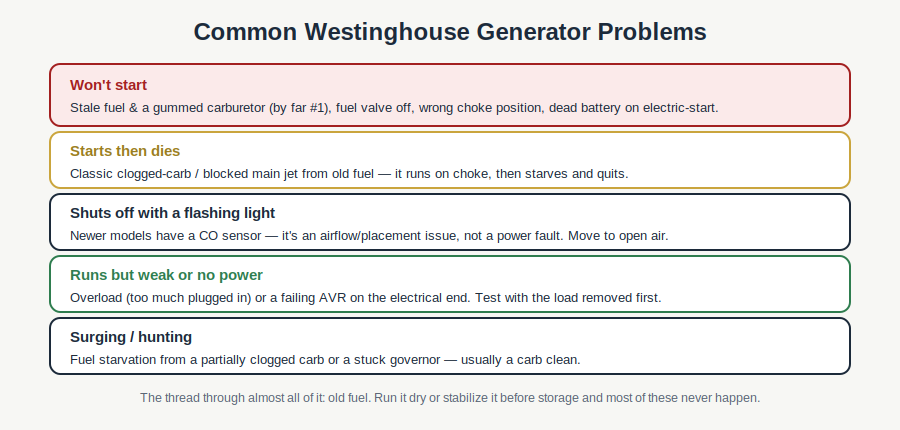
Most Westinghouse generator problems trace back to one thing: old fuel. A WGen or iGen that won’t start, starts then dies, or surges is almost always a gummed carburetor from stale gas — clean the carb and treat fuel before storage and you’ve solved the majority. Beyond that: a flashing-light shutdown on newer models is the CO sensor (a placement/airflow issue, not a power fault), weak or no output is usually an overload or the AVR, and an electric-start no-crank is the battery or solenoid. Run it dry before storage and most of this never happens.
- Stale fuel is the #1 Westinghouse issue — it gums the carburetor and causes most no-start, dies, and surge complaints.
- Won’t start: check the fuel valve, choke, and gas freshness first; then the carburetor.
- Starts then dies: classic clogged carb / blocked main jet — it runs on choke, then starves.
- Flashing light shutdown on newer models is the CO sensor — move it to open air, it’s not a power fault.
- Weak or no power: overload or a failing AVR. Electric start won’t crank: battery or solenoid.
- carb rebuild vs replace
- voltage regulator symptoms
- generator runs rough
How Westinghouse Generators Fail — the Short Version
Westinghouse builds a solid line of portables — the WGen and dual-fuel models, plus the iGen inverter series — around conventional OHV engines, and like every gas generator on the market, the thing that takes them down most often isn’t a design flaw, it’s the fuel left sitting in them. Gasoline goes stale in a few months, varnishes the tiny passages in the carburetor, and the engine that ran fine last fall won’t start this spring. That single fact explains the bulk of what I see on these units, which is why this guide is organized by symptom but keeps circling back to fuel. The newer Westinghouse models add a carbon monoxide shutoff sensor, which introduces one symptom that looks like a failure but isn’t, and the electric-start models add a battery and solenoid that bring their own quirks. Work the symptom you actually have, and you’ll find the cause is usually cheaper and simpler than you feared.
It Won’t Start
Run the basics before assuming the worst. Confirm there’s fresh fuel and the fuel valve is open, set the choke fully closed for a cold start, and make sure any engine switch and the kill controls are in the run position. On electric-start models, a dead or weak battery is a common no-crank cause. If it cranks but won’t fire after all that, you’re almost always looking at a carburetor gummed by old fuel — the single most common Westinghouse no-start — and the fix is a carb clean, walked through in how to clean a generator carburetor. If it cranks and won’t start and you want the full fuel-and-spark checklist, that’s in why a generator won’t start.
It Starts, Then Dies After a Few Seconds
This is the most diagnostic symptom on these units, because it points almost straight at the carburetor. When a Westinghouse fires up on choke and then quits the moment you open the choke, it’s running on the raw fuel the choke pulls in and starving once it has to draw through a clogged main jet. That’s varnish from old fuel blocking the carb’s normal fuel passage. The fix is cleaning the carburetor — particularly the main jet — and the full walkthrough of this exact pattern is in starts then dies after a few seconds. Treating fuel and running the unit dry before storage keeps it from coming back.
It Shuts Off With a Flashing Light
Newer Westinghouse generators carry a carbon monoxide shutoff sensor, and this trips up owners because it looks like the generator is failing when it’s actually protecting you. If your unit shuts down and flashes a warning light, that’s usually the CO sensor reacting to exhaust buildup around the generator — not a power or engine fault. The fix is placement: get the unit into open air, away from walls and corners, with the exhaust pointed away, and don’t just restart it where it sits. A flashing light shutting it off is an airflow problem the large majority of the time, and bypassing that sensor is never the answer.
It Runs but Has Weak or No Power
If the engine runs fine but the outlets are weak or dead, you’ve moved from the fuel side to the electrical side. The first thing to rule out is an overload — too much plugged in, or a tripped breaker — so pull the load and reset the breaker, then re-check. If it’s still down with nothing connected, the suspect is the AVR on the electrical end, which regulates output and is a common cause of low or no power when it weakens or fails. That’s a testable, replaceable part, and the procedure applies to these units the same as any conventional generator.
It Surges or Hunts
A Westinghouse that revs up and down instead of holding a steady speed is usually starving for fuel — a partially clogged carburetor or a governor issue letting the RPM wander. On these engines it’s most often the carb, and the same stale-fuel varnish that causes the no-starts causes the surge by restricting the idle and main circuits. A carburetor clean usually settles it. The broader rundown of surge causes is in the surging guide, but on a Westinghouse specifically, start with the carb and the fuel.
Don’t bypass the CO sensor on newer Westinghouse models to stop a flashing-light shutdown — it’s a life-safety device, and the real fix is placing the unit in open air. Run any generator outdoors only, well away from the house with the exhaust pointed away. When working on the carburetor or fuel system, shut the fuel valve and let the engine cool, and keep spilled gas away from anything hot. Stale fuel is also a fire and starting hazard — store the unit empty or stabilized.
What These Repairs Cost
The most common Westinghouse fixes are inexpensive. A carburetor clean is free if you do it yourself, and a replacement carb — often the easier route on a badly varnished one — is typically $15 to $40. A fresh battery for an electric-start model is a modest cost. An AVR, if the output problem is there, runs roughly $20 to $60. The CO-sensor “fix” costs nothing but repositioning the unit. In other words, the overwhelming majority of what goes wrong on these generators is cured with cheap parts and a carb cleaning, and almost all of it is prevented by not leaving fuel to rot in the tank.
Frequently Asked Questions
Why won’t my Westinghouse generator start?
Most often a carburetor gummed by stale fuel, after you’ve confirmed fresh gas, an open fuel valve, and the choke closed for a cold start. On electric-start models, check the battery too. If it cranks but won’t fire with the basics right, clean the carburetor — that’s the number-one Westinghouse no-start cause.
Why does my Westinghouse generator start then die?
It’s running on the choke and starving once the choke opens, because varnish from old fuel is blocking the carburetor’s main jet. Clean the carb, focusing on the main jet, and treat or drain fuel before storage. This start-then-die pattern points almost directly at the carburetor on these units.
Why is my Westinghouse generator shutting off with a flashing light?
Newer models have a carbon monoxide sensor that shuts the engine down and flashes when it detects exhaust buildup around the unit — it’s protecting you, not failing. Move the generator to open air, away from walls and corners, with the exhaust pointed away, and don’t restart it in the same spot. Never bypass the sensor.
My Westinghouse runs but has no power — what’s wrong?
First rule out an overload or a tripped breaker by pulling the load and resetting. If the outlets are still dead with nothing plugged in, the likely cause is the AVR on the electrical end, which is a testable, replaceable part. The engine running fine while the outlets are dead points you to the electrical side, not the fuel side.
How do I keep my Westinghouse generator from having these problems?
Mostly by managing fuel: run it dry or add stabilizer before storage so the carburetor doesn’t varnish, which prevents the bulk of no-start, die, and surge issues. Beyond that, keep it in open air so the CO sensor stays happy, check the oil, and exercise it occasionally. Stale fuel is the root of most of it, so beating that beats most of the trouble.