
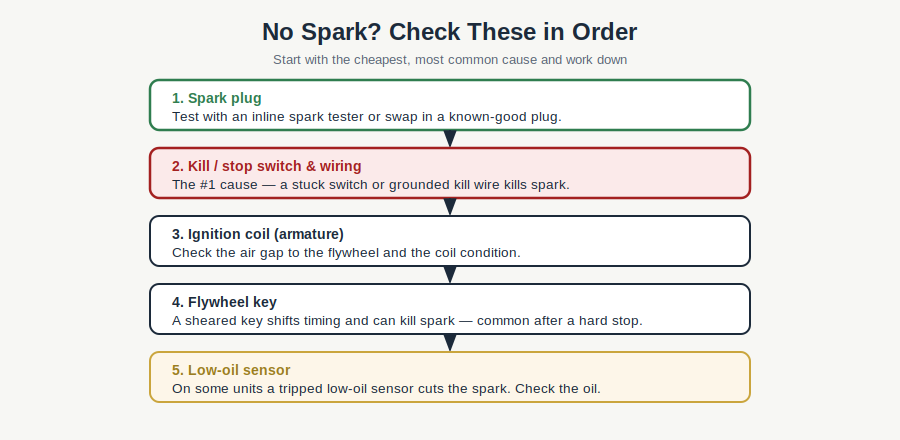
When a generator has no spark, check the cheap, common causes in order: the spark plug (test with an inline tester or a known-good plug), then the kill/stop switch and its wiring — a stuck switch or grounded kill wire is the number-one cause — then the ignition coil and its air gap, the flywheel key (a sheared key kills timing and spark), and finally the low-oil sensor, which cuts spark on some units. Most no-spark problems are a bad plug or a kill-switch fault, not the coil.
- Test for spark first with an inline spark tester — it tells you instantly whether you have spark or not.
- Kill/stop switch and wiring is the #1 cause. A stuck switch or grounded kill wire grounds out the spark.
- Spark plug is the cheapest swap — rule it out with a known-good plug before going deeper.
- Sheared flywheel key shifts timing and can kill spark — common after a hard stop or hitting something.
- On some units a tripped low-oil sensor cuts the spark, so check the oil level too.
Why Does My Generator Have No Spark?
Because somewhere in the ignition path the circuit is broken or grounded out — and the good news is the most likely spots are the cheapest and easiest to check. The ignition is a short chain: the magnet in the flywheel passes the coil, the coil generates the high voltage, the kill switch can ground that voltage to stop the engine, and the spark plug fires it. A no-spark condition means one of those links failed, and they fail in a predictable order of likelihood. People tend to assume the worst — a dead coil — but in my experience it’s usually a fouled or failed plug or, even more often, a kill-switch problem grounding the spark before it ever reaches the plug. So you work the chain from cheap to expensive: confirm there’s actually no spark, swap the plug, rule out the kill switch and its wiring, then check the coil gap, the flywheel key, and the low-oil sensor. Following that order keeps you from buying a coil when a $2 plug or a stuck switch was the answer.
First, Confirm There’s No Spark
Before chasing parts, prove the problem. Put an inline spark tester between the plug wire and the plug, or ground a known-good plug against the engine block and pull it over, and look for a crisp blue spark. This one test splits the whole diagnosis: if you have spark, your no-start is fuel or compression, not ignition, and you’re in the wrong guide. If you have no spark, you’ve confirmed it and can work the chain below. Don’t skip this step — it’s quick and it stops you from tearing into the ignition when the real issue was fuel.
The Spark Plug
Start with the cheapest link. A fouled, cracked, or worn-out plug can quit firing, and they’re a couple of dollars, so swap in a known-good plug before anything else. While it’s out, read it — a wet, black, or oil-fouled plug tells you about how the engine’s running, and the full rundown on reading, gapping, and replacing one is in checking and replacing the spark plug. If a fresh, properly gapped plug still won’t spark, the plug isn’t your problem and you move down the chain.
The Kill Switch and Its Wiring — the Usual Culprit
This is where no-spark problems hide most often. The engine’s stop function works by grounding the ignition — the kill switch, the key switch, the low-oil sensor, and the engine on/off all tie into a single kill wire, and if any of them sticks “on” or that wire chafes and grounds against metal, the spark is grounded out and the engine can’t fire. Disconnect the kill wire at the coil and test for spark again; if spark comes back with the kill wire disconnected, the fault is in that circuit — a bad switch, a stuck control, or a grounded wire — not the coil. This single check solves a huge share of no-spark cases, and it’s why I always rule out the kill circuit before condemning the coil.
The Ignition Coil and Flywheel Key
If the plug is good and the kill circuit is clean and you still have no spark, now the coil earns a look. Check the air gap between the coil and the flywheel — too wide and it won’t fire well — and inspect the coil for damage; a failed coil produces no spark and gets replaced. Also check the flywheel key, the small soft-metal key that locks the flywheel to the crankshaft in the correct position. If the engine stopped hard or hit something, that key can shear, shifting the flywheel’s timing relative to the coil and killing the spark. A sheared key is a cheap part but easy to overlook, and it’s a common cause after an abrupt stop.
Don’t Forget the Low-Oil Sensor
On many generators the low-oil shutoff works by cutting the ignition, so a low oil level — or a faulty oil sensor — can leave you with no spark and a no-start that looks like an ignition failure. Check the oil level on flat ground before you go deep into the coil. If the sensor itself is misbehaving even with oil present, that’s the same circuit covered in a low-oil shutoff that trips with oil full. It’s a quick thing to rule out and it ties right into the kill circuit you already tested.
Whenever you’re testing for spark, keep the plug or tester grounded to the engine and your hands clear of the terminal — ignition voltage is high enough to give you a real jolt, and a wet engine makes it worse. Work with the fuel system buttoned up and no spilled gas around, since you’re deliberately making sparks. If the engine cranks but won’t start and you’ve confirmed spark is present, the problem is fuel or compression instead, and that path is in why a generator won’t start.
What It Costs
Most no-spark fixes are cheap. A spark plug is a couple of dollars, a flywheel key is a few dollars, and a kill switch or a length of wire to repair a grounded kill circuit is inexpensive — and those three cover the large majority of cases. An ignition coil is the priciest common part at roughly $15 to $40, still a reasonable repair on most units, but you only get there after ruling out the cheaper links. The whole point of working the chain in order is that you rarely have to spend much: the answer is usually a plug, the kill circuit, or a sheared key long before you reach the coil.
Frequently Asked Questions
Why does my generator have no spark?
Most often a bad spark plug or a kill-switch/wiring fault grounding the spark — not the coil, despite what people assume. Confirm there’s no spark with a tester, swap the plug, then disconnect the kill wire and test again. If spark returns with the kill wire off, the fault is in that circuit. Work from cheap to expensive.
How do I test a generator for spark?
Use an inline spark tester between the plug wire and plug, or ground a known-good plug against the engine block and pull it over, looking for a crisp blue spark. This single test tells you whether your no-start is ignition or fuel. Keep the plug grounded and your hands clear of the terminal while you crank it.
Can a kill switch cause no spark?
Yes — and it’s the most common cause. The stop function works by grounding the ignition, so a stuck kill switch or a grounded kill wire grounds out the spark before it reaches the plug. Disconnect the kill wire at the coil and test again; if spark comes back, the kill circuit is your problem, not the coil.
Will low oil cause no spark on a generator?
It can. Many generators use a low-oil shutoff that cuts the ignition to protect the engine, so a low oil level — or a faulty oil sensor — can leave you with no spark. Check the oil on flat ground first. If the sensor misbehaves with oil present, it’s a sensor-circuit issue rather than a true ignition failure.
How much does it cost to fix a generator with no spark?
Usually very little. A plug is a couple of dollars, a flywheel key a few, and a kill-switch or wiring repair is inexpensive — and those cover most cases. An ignition coil runs about $15 to $40 if it comes to that, but you check it last because it’s the least likely culprit. Working in order keeps the cost down.