
If a generator is putting out the wrong voltage, the direction tells you where to look. Low voltage (below about 110V) points to a weak AVR, low engine RPM, an overload, worn brushes, or lost residual magnetism that needs the field “flashed.” High voltage (above about 130V) usually means a failed AVR or the engine running too fast. A steady wrong reading is typically the AVR; a wandering one is engine speed. High voltage can destroy electronics fast — unplug sensitive gear until it’s fixed.
- Normal is ~120V at a standard outlet (or ~240V across both legs). Measure with no load first.
- Low voltage: weak AVR, low engine RPM (often a dirty carb/governor), overload, worn brushes, or lost residual magnetism.
- High voltage: a failed AVR (overvoltage) or the governor set too fast — and it can fry electronics.
- Steady wrong = AVR; wandering = engine speed. That one distinction narrows it fast.
- Lost output with a brushless unit can sometimes be restored by flashing the field (residual magnetism).
Why Is My Generator Putting Out Low or High Voltage?
Because either the part that regulates voltage has drifted or failed, or the engine isn’t turning at the right speed — and which one it is depends on whether the voltage is too low or too high, and whether it’s steady or wandering. The voltage a generator makes is tied to two things: how fast the engine spins the alternator, and how the AVR (automatic voltage regulator) trims the output to hold it at 120 volts. If the engine runs slow, voltage sags; if the governor lets it run fast, voltage climbs. If the AVR weakens, voltage falls; if it fails shorted, voltage can spike high. So the first move is always to measure the voltage at the outlet with no load and note two things — the number and whether it holds steady or drifts. A rock-steady wrong number points at the AVR; a number that wanders up and down with engine note points at speed. I’ve fixed plenty of “no power” and “weird voltage” complaints with a cheap AVR, and a few more just by cleaning a carb so the engine held its RPM.
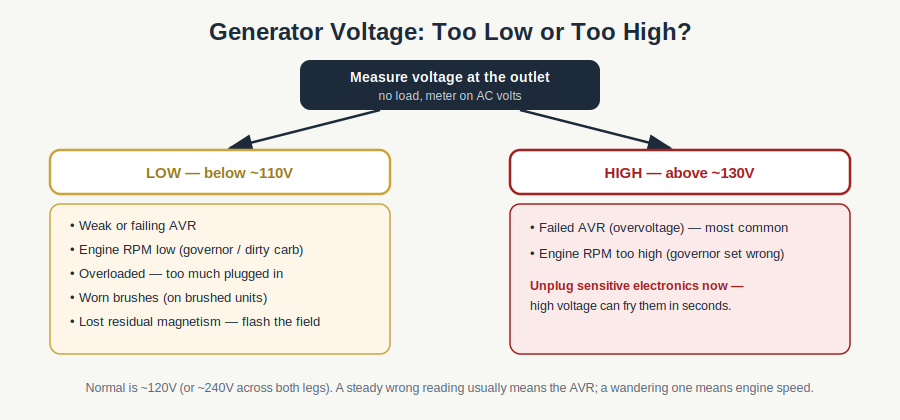
Measure It First
Set a multimeter to AC volts and read the outlet with nothing plugged in. Around 120 volts (or about 240 across both hot legs on a 240V outlet) is normal. Write down the number and watch whether it sits still or drifts. That no-load reading removes the load from the equation, so you’re seeing what the generator makes on its own — which is what you need before you can tell an AVR problem from an overload or an engine-speed problem.
When the Voltage Is Low
Low voltage has more suspects than high. Start with the obvious: if it only sags when you plug things in, you may simply be overloading the unit — pull the load and re-measure. If it’s low even unloaded, look at engine speed, because a dirty carburetor or a tired governor that won’t hold RPM drops the voltage right along with it. From there it’s the electrical end: a weakening AVR is a common cause of chronically low output, worn brushes on brushed units can do it, and a brushless generator that’s lost its residual magnetism can read very low until you “flash the field” to re-energize it. If you’ve got low or no output and want to test and replace the regulator, that’s walked through in testing and replacing the AVR, and the full no-output procedure including flashing the field is in runs but no power.
When the Voltage Is High
High voltage is usually simpler — and more dangerous. The most common cause is a failed AVR that’s lost regulation and is letting the alternator overvolt; the other is the governor set too fast so the engine overspeeds and pushes voltage up. The distinction matters: a steady high reading is almost always the AVR, while a high reading that wanders points at engine speed. What makes this urgent is that overvoltage can destroy anything sensitive plugged in — electronics, chargers, appliances — in seconds, so the moment you see high voltage, unplug the good stuff before you chase the cause.
Steady vs. Wandering Is the Tell
This is the shortcut worth remembering. If the wrong voltage is rock-steady, the engine speed is fine and the regulator is the problem — replace or test the AVR. If the voltage wanders up and down, and especially if the engine note rises and falls with it, the issue is engine speed: a governor or carburetor problem letting RPM drift, which often shows up as the engine hunting. That surging behavior is covered in a generator that surges. Sorting steady from wandering before you buy parts keeps you from replacing an AVR when the real fix was a carb clean.
High output voltage can destroy electronics in seconds — unplug anything sensitive the moment you measure it high, and don’t run good gear on a generator with unstable voltage. Testing on the output side means working around live AC with the engine running, which carries a real shock risk; if you’re not comfortable there, that’s a stop-and-get-help point. Set the meter correctly to AC volts before probing, and keep your hands clear of terminals while it’s running.
What It Costs
The good news is the most common fix is cheap. An AVR is frequently a $20 to $60 part and a straightforward swap, which is why it’s worth testing before assuming anything worse. Flashing the field to restore residual magnetism costs nothing but a drill battery and a few minutes. Brushes are inexpensive on units that use them. A carburetor clean to restore engine speed is also low-cost. The expensive scenarios — a damaged stator or rotor — are rare and usually push you toward replacing the unit, but you should rule out the cheap regulator and engine-speed causes first, since they cover the large majority of wrong-voltage complaints.
Frequently Asked Questions
Why is my generator putting out low voltage?
Common causes are a weak AVR, low engine RPM from a dirty carburetor or tired governor, an overload, worn brushes, or lost residual magnetism on a brushless unit. Measure with no load first — if it’s only low under load, you may just be overloading it. If it’s low unloaded, check engine speed, then the AVR and brushes.
Why is my generator putting out high voltage?
Usually a failed AVR that’s lost regulation, or the engine governor set too fast so it overspeeds. A steady high reading points at the AVR; a wandering one points at engine speed. High voltage is dangerous to electronics, so unplug sensitive gear immediately and fix the cause before running anything on it.
What voltage should a generator put out?
About 120 volts at a standard outlet, or roughly 240 volts across both hot legs on a 240V outlet, measured with no load. Some small variation is normal, but a reading well below ~110 or above ~130 means a problem. Always check with nothing plugged in to see what the generator makes on its own.
How do I know if it’s the AVR or engine speed?
Watch whether the wrong voltage is steady or wandering. A rock-steady wrong number means the engine speed is fine and the AVR is the culprit. A number that drifts up and down, especially with the engine note changing, means an engine-speed problem like a governor or carburetor issue. That one observation usually tells you which to fix.
Can low voltage from a generator damage things?
Yes — running motors and electronics on low voltage makes them draw more current and overheat, which can burn them out over time. It’s not as instantly destructive as overvoltage, but it’s still hard on equipment. Fix the cause rather than running gear on a generator that won’t hold proper voltage.