
Yes — a portable AC on solar works, and I run one every day. My setup is four panels feeding a PV combiner box, into a 3,840Wh LiFePO4 power station (an Aferiy P310), which runs a refurbished Midea 12,000 BTU portable air conditioner in the Arizona heat. The array pushes right around 500 watts into the battery while the sun’s up, the AC pulls about 1,000 watts once the compressor settles, and the battery bridges the difference. No fuel, no noise, no exhaust.
- A 12,000 BTU portable AC pulls roughly 1,000 to 1,200 watts running — well within reach of a mid-size power station with a real inverter.
- Battery capacity matters more than inverter size. My 3,840Wh unit gives 3+ hours of AC on battery alone; solar input stretches that all afternoon.
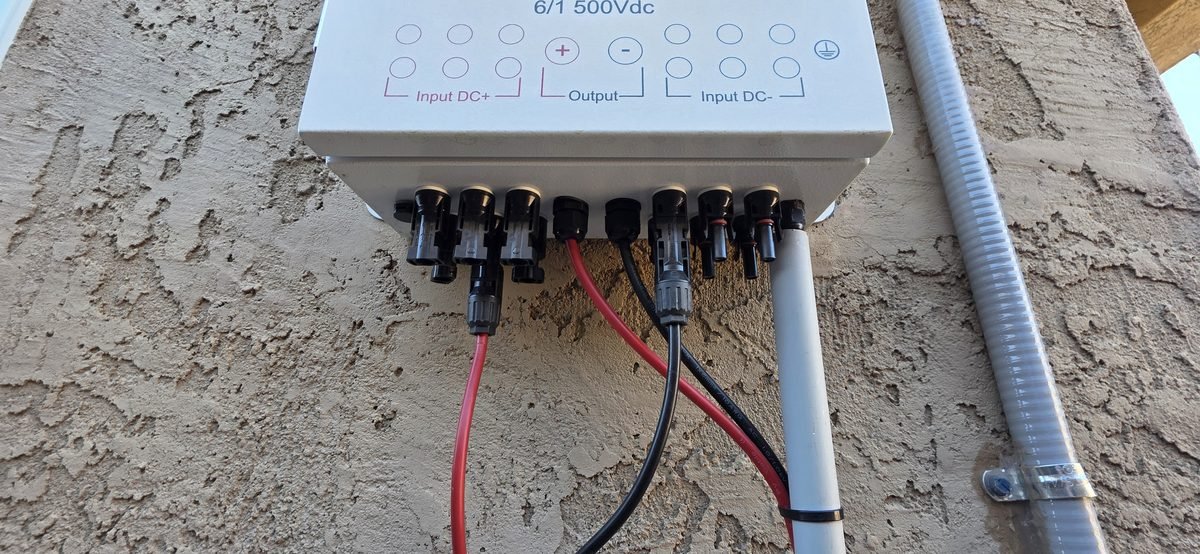
- A combiner box cleans up a multi-panel install. Mine takes up to 6 strings in and sends one pair of leads out — one cable run into the house instead of four.
- Panels lose output in extreme heat. Don’t expect nameplate wattage on a 110°F Phoenix afternoon.
- Solar beats gas for this job — zero carbon monoxide, zero refueling stops, and it’s silent next to the bedroom door.
Can You Really Run a Portable AC on Solar?
You can, and it’s less exotic than it sounds. A portable AC on solar needs three things: enough panel wattage to make a dent in the load, a battery big enough to carry the compressor through clouds and evenings, and an inverter that won’t flinch at the compressor’s startup surge. My setup checks all three boxes with four panels on the house, a CNL 500Vdc PV combiner box on the wall, and an Aferiy P310 power station sitting inside by the sliding door. The P310 carries a 3,840Wh LiFePO4 battery and a 3,600W pure sine wave inverter — way more inverter than a 12,000 BTU Midea needs, which is exactly how I like it. Compressors are hard on cheap inverters; oversizing means the startup surge is a non-event.
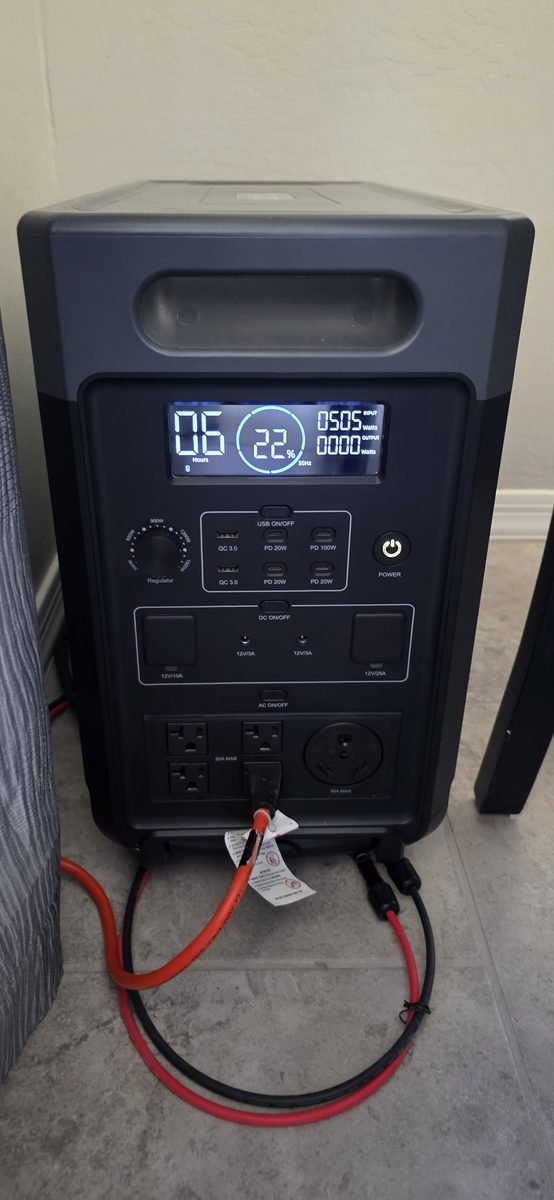
The photo above tells the whole story in one screen. That’s 505 watts of solar input flowing in from the four-panel array, battery sitting at 22%, and the unit calculating roughly 6 hours to a full charge on nothing but sun. I snapped that in the morning before the AC kicked on for the day. By the time the Arizona afternoon gets serious, the battery’s full and the panels are directly offsetting the compressor.
The Setup: Four Panels, a Combiner Box, and One Cable Into the House
After 19 years keeping F-16 fuel and hydraulic systems tight, I have strong opinions about cable runs and connection points. Four panels means four positive leads and four negative leads coming off the roofline, and I wasn’t about to snake eight separate wires through a door. The fix is a PV combiner box — mine’s a CNL 6/1 rated to 500Vdc, meaning it accepts up to six strings on the input side and combines them into a single output pair. The panels land on the Input DC+ and Input DC- ports through MC4 connectors, and one clean positive/negative pair comes out the bottom headed for the power station.
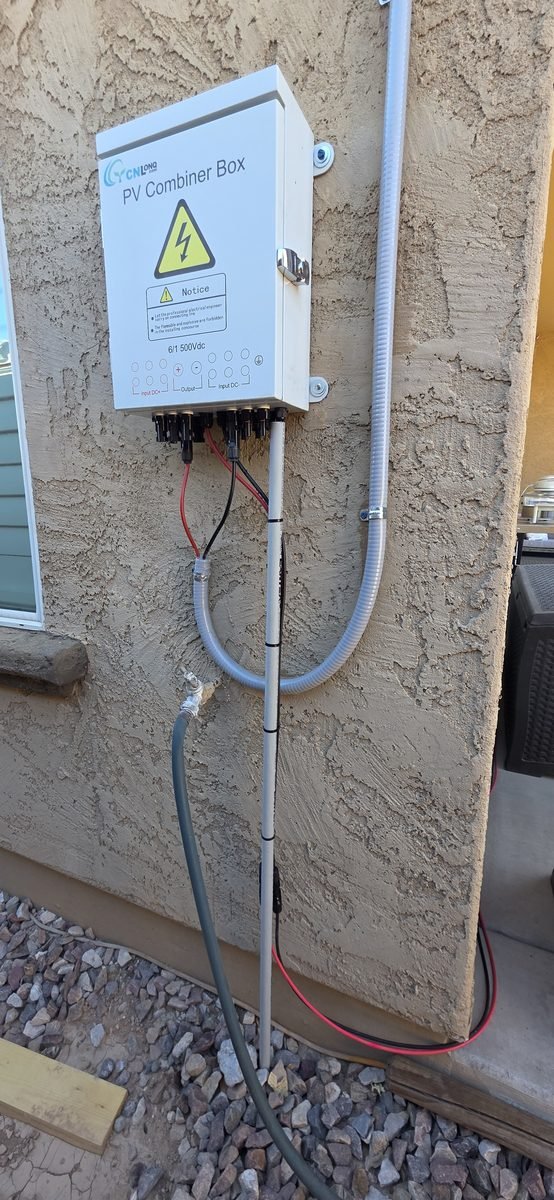
The panel wiring drops from the roof inside flexible conduit strapped to the wall — Arizona sun destroys exposed insulation in a couple of summers, so everything that lives outside rides inside conduit. From the combiner output, the pair runs along the base of the house to the patio door.
Getting the Cable Inside Without Drilling the House
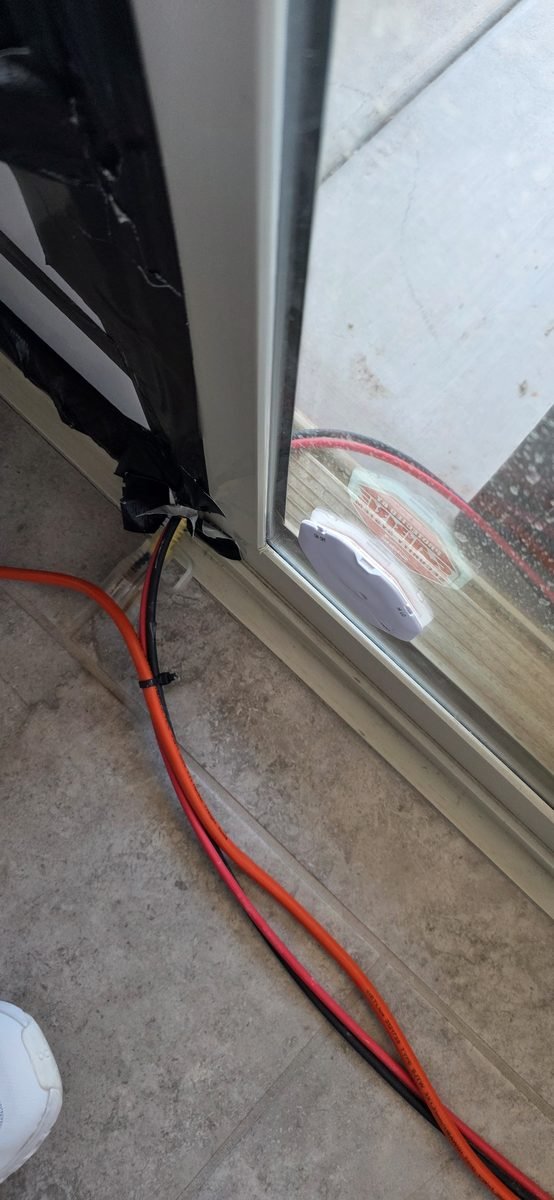
The combined pair enters through the sliding glass door track. I ran the two PV leads through the gap where the fixed panel meets the frame, sealed it with tape against dust and bugs, and the door still locks. It’s not a permanent penetration — if I ever move the station or sell the house, I peel the tape and there’s no hole in the wall. For a setup built around a portable power station rather than a hardwired inverter, I’d rather keep the install reversible.
The Load: A Refurbished Midea 12,000 BTU Portable AC
The whole point of this rig is cooling. The AC is a refurbished Midea 12,000 BTU portable unit — buying refurbished knocked a healthy chunk off the price, and after nearly a decade repairing commercial food service equipment, a factory-refurbished compressor appliance doesn’t scare me one bit. Once the compressor settles in, it draws right around 1,000 watts, spiking briefly at startup. The P310’s inverter doesn’t even register the surge as an event.
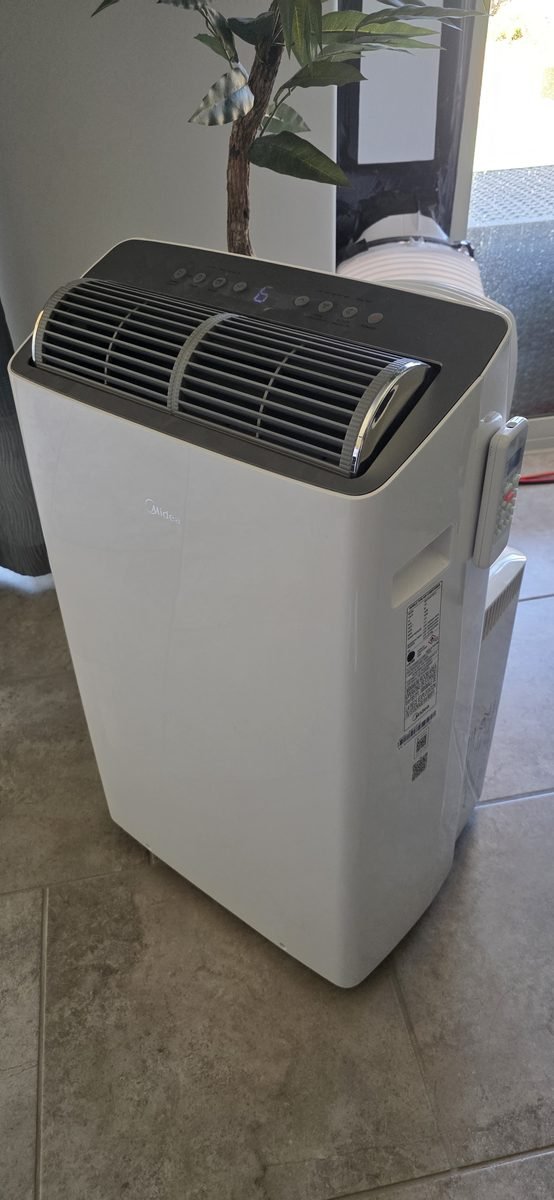
Run the numbers and the setup makes sense. With the compressor pulling about 1,000 watts and the panels feeding 500 back in, the net drain on the battery during peak sun is only around 500 watts. Against 3,840Wh of storage, that’s most of an afternoon of cooling before the battery even gets nervous — and the compressor cycles off once the room hits temperature, which stretches things further. On battery alone, no sun at all, I get a bit over 3 hours of continuous compressor time.
Why Panels Don’t Hit Their Sticker Number in Arizona
Here’s the counterintuitive part of desert solar: the same sun that gives the Phoenix area well over 300 sunny days a year also costs you panel output. Solar panels lose efficiency as cell temperature climbs — typically a few tenths of a percent for every degree Celsius above the 77°F test standard. On a 112°F July afternoon, panel surfaces can run 150°F or hotter, and output sags noticeably below the nameplate rating. That 505 watts in my photo is honest, heat-derated Arizona production. If you’re sizing a system, plan around real-world numbers like that, not the sticker on the back of the panel.
PV wiring bites. Solar panels make voltage the moment light hits them — there’s no off switch on the sun. Never connect or disconnect MC4 connectors under load; kill the load side first, and cover the panels or work early morning if you have to open a connection. A combiner box rated for 500Vdc exists because series strings stack voltage fast, and DC arcs don’t self-extinguish the way AC does. Treat every PV conductor as live. The one upside over a gas generator here is what’s missing: no carbon monoxide, ever. If you’re still running gas for backup, read my guide on generator carbon monoxide safety — placement mistakes with gas units kill people every summer.
Solar Station vs. Gas Generator for Running an AC
I own gas generators and I’ll never be without one — but for this specific job, daily supplemental cooling, the solar station wins on every line. A gas unit running a 1,000-watt load burns fuel all day, needs oil checks on long runs, and can’t sit next to the living room door. This thing is silent, sits three feet from the couch, and refuels itself off the roof. There’s no run-time ceiling to manage the way there is when you’re running a generator continuously through an outage, and no tank-burn-cool-refuel cycle. The P310 also doubles as backup: it switches to battery in about 10 milliseconds when grid power drops, so it covers the fridge or the modem during an outage without me touching anything — a job that would otherwise mean rolling out a gas unit and connecting it to the house properly.
What a Setup Like This Costs
The power station is the big line item — a 3,800Wh-class LiFePO4 unit like the Aferiy P310 runs well north of a grand, though sales knock that down hard. Four panels, a combiner box, MC4 cabling, and conduit add a few hundred more. Buying the AC refurbished instead of new saved real money with zero downside so far. The payback isn’t just the electric bill — it’s a cooling system and a whole-house-essentials backup in one box, with a LiFePO4 pack rated for 4,000+ charge cycles. At a cycle a day, that’s a decade of Arizona summers.
Frequently Asked Questions
How many solar panels do you need to run a portable air conditioner?
It depends on whether you want solar to carry the load outright or just stretch a battery. My four panels deliver about 500 real-world watts, which covers roughly half the Midea’s draw while the sun’s up — the battery handles the rest. To run a 12,000 BTU unit on panels alone you’d want 1,200+ watts of array after heat derating.
How long will a 12,000 BTU portable AC run on battery power?
Figure the battery’s watt-hours divided by the AC’s running draw. My 3,840Wh station against a 1,000-watt compressor gives a bit over 3 hours of continuous run time with no sun — more in practice, because the compressor cycles off once the room’s cool, and solar input during the day cuts the net drain roughly in half.
Will a power station handle an AC compressor’s startup surge?
A quality unit with a real pure sine wave inverter will. Compressors surge to several times their running wattage for a split second at startup, which is why I run a 3,600W inverter on a 1,000-watt load. Undersized or modified-sine inverters are where people get into trouble with compressor loads.
Do I need a combiner box for a small solar setup?
With one or two panels, no — Y-branch MC4 connectors do the job. At four panels, a combiner box earns its keep: one clean output pair instead of a fistful of leads, a tidy mounting point on the wall, and one place to open the circuit when you need to work on the system.
Is solar better than a gas generator for running an AC?
For daily use, yes — silent, no fuel, no exhaust, and it can sit inside the house. Gas still wins for multi-day cloudy-weather outages and big surge loads, which is why I keep both. For more on when gas makes sense and how to run it safely, browse the rest of the generator repair guides.