
When a generator only runs on choke, it’s starving for fuel — not getting too much air. Drain the stale gas from the tank and carb bowl first (free, fixes about 20% of cases), then clean the varnish out of the main jet. A clogged main jet is the cause roughly 60% of the time, and clearing it costs a few dollars and about 45 minutes.
- It’s a lean condition. The choke restricts air to richen the mixture — if the engine needs that to stay alive, the fuel side can’t keep up.
- A varnish-clogged main jet is behind about 60% of choke-only generators — clean the jet before you buy a single part.
- Start free: drain the tank and float bowl and refill with fresh gas. That alone solves about 20% of cases.
- Spraying carb cleaner through the intake isn’t enough. The jet has to come out and be physically cleared.
- Brand-new units do this too — factory test fuel leaves varnish in the carb the same way your old gas does.
Why Does My Generator Only Run With the Choke On?
A generator only runs on choke for one underlying reason: the fuel circuit can’t deliver enough gas once normal airflow opens up. The choke blocks air, which forces a richer fuel-to-air mixture — so a partially clogged carburetor that starves the engine at full airflow will run just fine choked. Most people assume the opposite, that choke problems mean an air problem or “too much fuel.” It’s backwards. The engine is running lean, and the choke is masking it. About 60% of the time the blockage is varnish in the main jet from gas that sat too long, another 20% is simply stale fuel that fixes itself with a drain and a fresh fill, and the last 20% splits between a clogged pilot jet and an air leak at the carb gaskets. Work those in order — cheapest first — and you’ll almost never spend more than the price of a can of carb cleaner.
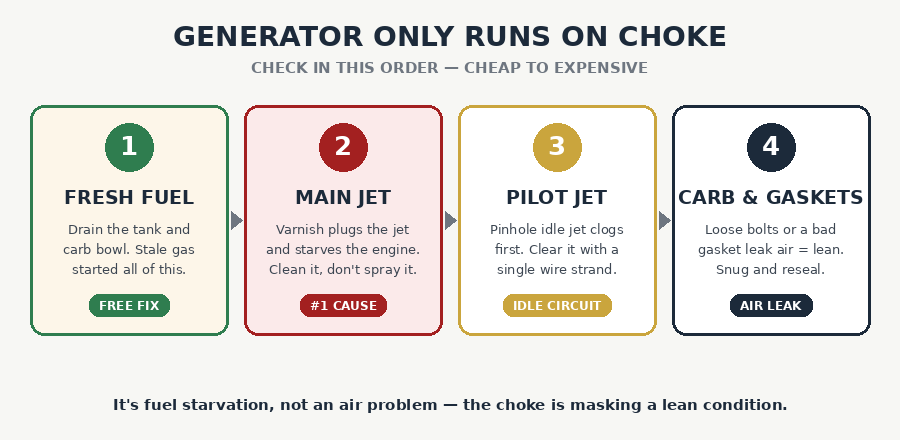
One quick diagnostic before you touch anything: ease the choke off slowly instead of flipping it. If the engine smooths out at half choke and only dies fully open, the blockage is partial — usually the pilot jet or a lightly varnished main jet. If it dies the moment the choke cracks open at all, the main jet is nearly sealed shut. Either way you’re going into the carb, but now you know how bad it is in there.
Start Free: Drain the Old Gas
Think back to when that fuel went in the tank. If it’s been more than a couple of months without stabilizer, it’s gone stale — it loses volatility and burns poorly, which shows up as exactly this symptom. Shut the fuel valve, drain the tank into a container, then open the drain screw on the bottom of the float bowl and let the carb empty too (the bowl is where the worst of it sits — give it a sniff, and if it smells sour like old paint thinner instead of gas, you’ve found your trigger). Refill with fresh fuel, ideally ethanol-free, and try it. This costs nothing and ends the job right here about 20% of the time. If it still dies off choke, the stale gas already left varnish behind and you’re going one step deeper.
The Main Jet — Where 60% of These End
Gasoline that sits oxidizes into a gummy varnish, and the first place it chokes off is the smallest passage in the fuel path: the main jet, a brass fitting with a metered hole that feeds the engine at running speed. Varnish narrows that hole until the engine can’t pull enough fuel through it at full airflow. The engine surges, hunts, then dies as you open the choke — that stumble-and-fade is the sound of a lean engine giving up.
Shut the fuel valve, pull the air filter housing out of the way, and drop the float bowl — one bolt on the bottom, usually a 10mm. Here’s the part almost everybody misses: on the Huayi-style carbs that Champion, Predator, and most other Chinese-built generators use, that bowl bolt IS the main jet. It’s drilled through with metering holes. People wipe out the bowl, put the “bolt” right back in, and wonder why nothing changed — they just reinstalled the clog. Hold it up to the light: you should see clean daylight through the center passage and the small cross-drilled holes. If you don’t, soak it in carb cleaner for ten minutes, then push a single strand of copper wire from a wire brush through every hole until light passes. Spray alone won’t cut hardened varnish; the passages have to be physically cleared. While the bowl’s off, hit the emulsion tube and the needle seat with cleaner too. The full teardown, including the ultrasonic-cleaner shortcut, is in cleaning a generator carburetor step by step.
I spent a lot of years on fuel systems — aircraft first, then commercial kitchen equipment — and the lesson transfers straight down to a 4-gallon generator: fuel starvation is fuel starvation, and it’s almost always at the smallest orifice in the circuit. My first instinct early on was to blame the air side and start adjusting screws whenever an engine wouldn’t take full air. I chased my tail that way more times than I’d like to admit before it sank in that a lean engine is a delivery problem, not a tuning problem. Now the float bowl comes off first, every time, and I stopped being surprised. Budget 45 minutes your first time in the carb; it’s a 15-minute job once you’ve done one.
Video walkthrough
The Pilot Jet (If It Runs on Half Choke)
The pilot jet is a pinhole passage that feeds the engine at idle, and because it’s even smaller than the main jet, it clogs first. The tell: the generator idles rough or only holds together at half choke, and it hunts up and down at low speed. Pull the pilot jet (on most carbs it’s under a small plastic plug or beside the idle screw), and clear the hole with that same single wire-brush strand — anything thicker can widen the orifice and ruin the metering. If the engine also surges rhythmically under no load even when it stays running, that’s the same circuit, and the full fix is in the generator surging pilot jet repair.
Loose Carb or Bad Gaskets
The remaining cases aren’t a clog at all — they’re extra air sneaking in downstream of the carburetor, which leans the mixture the same way a starved jet does. Check that the carb mounting bolts are snug (they loosen from vibration on open-frame units more than people expect), and inspect the gaskets between the carb, the insulator block, and the intake for cracks or crush damage. A torn $2 gasket will make a freshly cleaned carb act exactly like a dirty one, which is a maddening thing to discover after you’ve had the bowl off twice (ask me how I know).
You’re working with raw gasoline on a machine with a hot muffler — let the engine cool completely, work outdoors, and keep the drained fuel in a sealed container away from anything that sparks. Carb cleaner comes back at your face when you blast it through small jets, so wear safety glasses. And if the engine will only stay alive choked, don’t just leave it running that way “for now” — running rich washes oil off the cylinder wall and fouls the plug, and you’ll trade a $5 problem for a bigger one.
What It Costs
This is one of the cheapest fixes on the whole machine. A can of carb cleaner is $5 to $8 and handles most cases. If the carb is badly varnished or corroded, a complete replacement carburetor for Champion, Predator, and similar Chinese-built units runs $15 to $25 on Amazon — at that price I don’t rebuild them, I replace them. OEM Honda and Yamaha carbs are the exception at $50 to $80, and those are worth cleaning properly. A small-engine shop will charge $90 to $150 for the same job, so even buying the new carb you’re keeping $75 or more in your pocket.
Keep It From Coming Back
Every choke-only carb I’ve opened traces back to the same thing: fuel that sat untreated. Two habits end it for good. First, treat every can of gas with stabilizer the day you buy it, and use ethanol-free fuel if you can get it — ethanol pulls moisture out of the air and accelerates the varnish. Second, when you shut the generator down for more than a few weeks, close the fuel valve and let the engine run until it dies. That empties the float bowl so there’s nothing left in the carb to oxidize. The complete off-season routine, including the run-it-dry versus stabilizer question, is in storing a generator for the off-season.
Frequently Asked Questions
Why does my generator only run on choke?
Because the engine is running lean — the fuel circuit can’t keep up once full airflow opens. Roughly 60% of the time it’s a varnish-clogged main jet, about 20% is stale fuel, and the rest is a clogged pilot jet or an air leak at the carb gaskets. Drain the fuel and clean the jets before buying anything.
Is it bad to run a generator with the choke on?
Yes, as anything more than a limp-home measure. Running choked forces a rich mixture that fouls the spark plug, washes oil off the cylinder wall, and dilutes the crankcase oil with fuel. It’ll keep the lights on tonight, but fix the carb this week.
Will Sea Foam fix it if my generator only runs on choke?
Sometimes, if the varnish is light. Run a strong mix through and give it 20 or 30 minutes under load. But I’ve watched plenty of people run three tanks of treated fuel through a hard-varnished jet and get nowhere — once the passage is nearly sealed, additives can’t reach enough of the deposit. Ten minutes with the jet in your hand beats three tanks of hoping.
Why does my brand-new generator only run with the choke on?
Factory test fuel. Every unit gets run before it ships, and the trace of gas left in the carb turns to varnish while it sits in the box and on the shelf — sometimes for a year or more. The fix is the same main jet cleaning, and yes, it’s worth doing even on a warranty unit before you haul it back to the store.
Can a dirty air filter cause this?
Almost never, despite showing up on every parts-list article. A clogged filter restricts air, which makes the mixture richer — the same direction as the choke — so it can’t create the lean condition that needs choke to survive. If your engine wants the choke, look at fuel delivery, not the filter. Check the filter anyway while the housing’s off, but don’t expect it to be the answer.
For more on this topic, see the rebuild or replace the carb guide.