
When a generator won’t start after sitting for months, it’s stale fuel until proven otherwise. Crack the drain screw on the bottom of the carb bowl — if what comes out is dark and smells sour, drain everything, refill with fresh gas, and clean the carb if it still won’t fire. That’s the fix about 60% of the time, and it costs almost nothing.
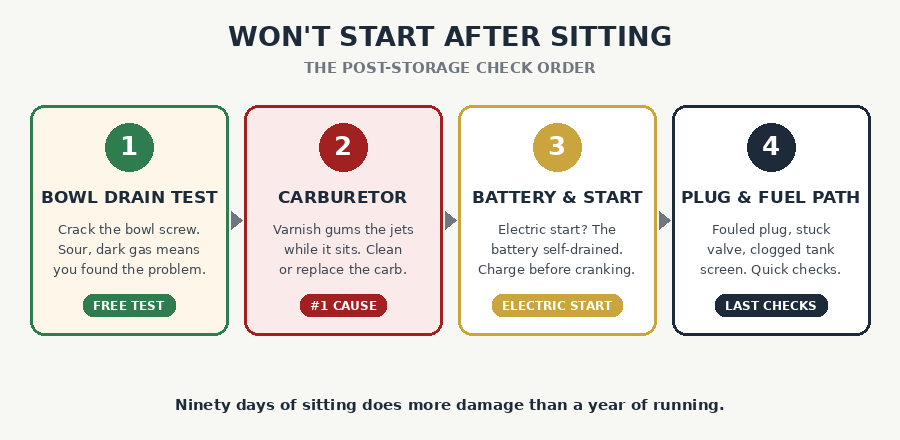
- The 30-second bowl drain test diagnoses most of these before you touch a tool — sour, dark fuel out of the bowl screw tells the whole story.
- A gummed carburetor from stale fuel causes about 60% of post-storage no-starts — gas starts breaking down in as little as 30 days without stabilizer.
- Electric start? The battery self-discharged while it sat. Charge it before you crank — and don’t crank more than 5 seconds at a time.
- Fouled plug, stuck fuel valve, and a clogged tank screen make up most of the rest.
- Ninety days of sitting does more damage than a year of regular running.
Why Won’t My Generator Start After Sitting?
A generator won’t start after sitting for one dominant reason: the gasoline left in it broke down. Untreated gas starts oxidizing in about 30 days, and what it turns into — a sticky varnish — settles exactly where you can least afford it, in the tiny metered jets of the carburetor. That gummed carb accounts for roughly 60% of the post-storage no-starts I deal with. Another 15% is a self-discharged battery on electric-start units, about 10% is a fouled spark plug, 10% is a fuel path problem like a stuck petcock or clogged tank outlet screen, and the last 5% is mechanical — a rusted-stuck recoil or, in garages and sheds, rodent damage to the wiring. Start with the free bowl-drain test below, work down the list in order, and you’ll usually be running again inside an hour without buying anything but fresh gas.
The 30-Second Bowl Drain Test
Before you pull anything apart, put a rag under the carburetor and crack the small drain screw on the bottom of the float bowl. Fresh gas runs out nearly clear and smells like gas. Stale gas comes out darker — amber to brown — and smells sour, closer to old paint thinner than fuel. That smell is your diagnosis. I do this before any other check on a unit that’s been sitting, because it tells me in half a minute whether I’m dealing with a fuel problem or something rarer.
Stale Fuel and the Gummed Carb — the 60% Fix
If the bowl test came back sour, drain the tank and the bowl completely and refill with fresh fuel — the whole procedure is in draining old gas from a generator. Sometimes fresh fuel alone does it, especially if the unit only sat over one season. Give it a fair shot: full choke, several pulls, then ease the choke off as it catches.
If it fires but only stays alive choked, the varnish already claimed the main jet — that exact symptom and fix is covered in why a generator only runs on choke. If it won’t fire at all on fresh fuel, the carb is coming off: drop the bowl, clean the main jet and pilot jet until you can see light through them, and hit the passages with carb cleaner. The full teardown is in cleaning a generator carburetor. Budget an hour your first time. And here’s the thing I tell everybody about badly varnished carbs on the common Chinese-built units: a complete replacement carburetor runs $15 to $25, so if the old one is crusty inside, I don’t fight it — I swap it and keep the old one for parts. I used to spend two hours rescuing $18 carburetors out of stubbornness. I stopped. The math never worked.
Electric Start: the Battery Died in the Dark
Generator batteries self-discharge just sitting there, and most portable units barely charge their own battery even when running — so a generator stored in October is often stone dead by March. If the starter clicks or barely grunts, put the battery on a 2-amp smart charger overnight before you condemn anything else, and keep your cranking bursts to 5 seconds or so with a rest between; those little starter motors aren’t built for long cranks. If it still won’t spin up after a proper charge, the diagnosis path for the starter circuit is in electric start won’t crank. The pull cord still works either way — a dead battery never has to stop you.
The Plug, the Valve, and the Tank Screen
Three quick checks close out the list. Pull the spark plug and look at it — months of sitting plus repeated failed starts leaves it wet and fouled, and a $4 plug is cheaper than your time (the reading-and-gapping rundown is in checking the spark plug). Confirm the fuel valve actually flows: pull the line at the carb end, open the valve, and watch for a steady stream. No flow with fuel in the tank means the valve is stuck or the little filter screen on the tank outlet is packed with sediment that settled while it sat. Both are ten-minute fixes.
While You’re In There
Sitting is hard on rubber too. Give the fuel line a squeeze — if it’s stiff or cracked, replace it now instead of chasing a leak later. And if the unit lived in a shed or barn, look for chewed insulation before you burn more time on fuel. I’ve lost count of the “mystery” no-starts that turned out to be a mouse that ate the kill wire.
You’ll be handling drained gasoline through most of this — work outdoors on a cool engine, keep the old fuel in a sealed container, and get it to household hazardous waste, not the ground. If the engine’s been cranked a lot while flooded, let it sit 15 minutes with the plug out before you keep going, so the raw fuel can evaporate out of the cylinder.
Keep Next Season From Repeating This
One habit prevents nearly all of it: never park the generator with untreated gas in the carb. Either run stabilizer in every tank from the day you buy the fuel, or shut the fuel valve and let the engine run itself dead so the bowl empties. The full shutdown-for-storage routine — including the run-dry versus stabilizer argument — is in storing a generator for the off-season. Do that, and “generator won’t start after sitting” stops being an annual spring tradition at your house.
If you’d rather see the revival sequence run start to finish before you pick up a tool, this one covers it well:
Frequently Asked Questions
Why won’t my generator start after sitting for 6 months?
Stale fuel, most likely — gas breaks down in about 30 days untreated, and six months is plenty of time for it to varnish the carburetor jets. Drain the tank and float bowl, refill with fresh gas, and clean the carb if it still won’t fire. Check the battery too if it’s electric start.
Will old gas ruin a generator permanently?
No. It gums the fuel system, but nothing about stale gas destroys the engine itself. The worst case I’ve ever had to do because of old fuel was a carburetor replacement — $15 to $25 on most units. Drain it, clean or swap the carb, and the engine doesn’t know anything happened.
Should I use starting fluid on a generator that sat all winter?
One short burst into the intake is fine as a diagnostic — if it fires and dies, you’ve proven spark and compression are good and fuel delivery is the problem. Don’t lean on it as a crutch, though. An engine that only starts on ether still has a clogged carb waiting for you.
How long can a generator sit without being run?
With the carb run dry or the fuel stabilized, a year or more without drama. With untreated gas left in it, you’re rolling the dice past 30 days and almost guaranteed problems past 90. The sitting isn’t what hurts it — it’s what’s sitting inside the carb.
Do I need to change the oil after storage?
Check it, at minimum. Oil doesn’t go bad sitting the way gas does, but condensation collects in the crankcase over a winter, and if the level rose or it smells like gas, fuel leaked past the float and diluted it — change it before running under load. Oil’s cheap. Rod bearings aren’t.
For more on this topic, see the cold weather starting guide guide.