
An inverter generator that runs but won’t put out power fails differently than a conventional one — no AVR, no brushes, different parts. Match your symptom first:
- Overload light steady on a bare panel → start at The Free Reset, then the inverter board
- A light that’s flashing red or yellow → that’s the CO sensor, not a power fault
- Breaker popped → reset it; if it keeps tripping see a breaker that won’t hold
- It’s actually a conventional generator (has an AVR/brushes) → the fix is different; see runs but no power at the outlets
When an inverter generator runs but has no power, do the full reset first — unplug everything, shut it off five minutes, reset the breaker. If a light is flashing rather than steady, that’s the carbon monoxide sensor shutting the engine down, not a power problem. And if the panel stays dead after a clean reset, the fault is the inverter board itself — inverter units have no voltage regulator or brushes to test, so once the reset and CO sensor are ruled out, the board is the answer.
- Inverter generators have no AVR and no brushes — so the usual “flash the field / test the regulator” steps don’t apply here.
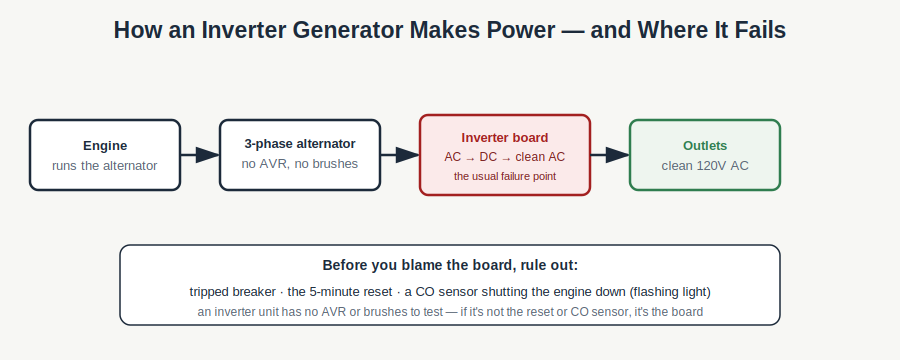
- Power flows: engine → 3-phase alternator → inverter board → outlets. The board is the part that fails.
- A flashing light is the CO sensor; a steady overload light on a bare panel is the electronics.
- The inverter board is not repairable — it’s a replacement, and on a cheap unit it’s often not worth it.
- Don’t confuse an inverter unit with a conventional one; the no-power fixes are completely different.
First, the Free Reset
Before anything else, clear a stuck protection latch. Unplug every cord, switch the generator completely off, let it sit five minutes so the output circuit drops out, then restart and press the breaker back in. On a bare panel this clears the overload light a fair amount of the time and costs you nothing. Most units cap you at about five reset attempts before they lock out, so reset once properly rather than stabbing the button. If it holds and power comes back, you’re done. If the light’s right back on with nothing plugged in, keep going.
Is the Light Flashing? That’s the CO Sensor
Here’s a fork that trips up a lot of people. If the warning light is flashing rather than glowing steady, you’re probably not looking at a power problem at all. Newer inverter generators carry a carbon monoxide shutoff sensor, and when it detects CO buildup nearby it kills the engine and flashes — red for a detection, yellow for a sensor fault. So if your “no power” is really the engine shutting itself off with a blinking light, the fix is airflow and placement, not the inverter. Get it into open space, exhaust pointed away, and don’t just restart it where it sits. A steady, non-blinking overload light is the one that points at the electronics below.
Inverter Generators Don’t Have an AVR or Brushes
This is the key thing to understand, because it changes the whole diagnosis. A conventional generator regulates its output with an AVR and, on some designs, brushes — parts you can test and replace. An inverter generator works completely differently. The engine spins a 3-phase alternator that puts out raw high-voltage AC; that feeds an inverter board, which rectifies it to DC and then synthesizes clean, stable AC for the outlets. There’s no regulator to test and no brushes to inspect. So when the reset doesn’t fix it and the CO sensor isn’t the issue, the diagnosis funnels down to one part: the board.
When It’s the Inverter Board
OK, so you’ve reset it cleanly, the light’s steady not flashing, and there’s still nothing at the outlets. That’s the inverter board, and I’ll be straight with you: it’s not a repairable part. It’s a sealed assembly — you replace it, you don’t fix it. A replacement board runs anywhere from $120 to $300-plus depending on the unit, which is the moment to do some honest math. On a name-brand inverter like a Honda EU or a higher-output Predator that cost $900-plus new, a board swap is worth it. On a $300 import inverter, the board is most of what the unit’s worth, and I’d put that money toward a new generator and keep the old one for parts. If yours is a Predator specifically, the model-by-symptom breakdown in the dedicated Predator guide lines up directly with this.
Testing anything on the output side means working around live AC with the engine running — inverter alternators put out high voltage on the way to the board. If you’re not comfortable with that, it’s a stop-and-get-help point. And whenever it’s running for these checks, it belongs outside, away from the house, exhaust pointed away. The exhaust is carbon monoxide and it kills fast — which is exactly what that CO sensor exists to catch.
Make Sure It’s Actually an Inverter Unit
One more check worth doing before you order a board: confirm you’ve actually got an inverter generator and not a conventional one. If your unit has a voltage regulator (AVR) and brushes, none of the above applies — your no-power fix is to flash the field and test the regulator, walked through in runs but no power at the outlets. Conventional Predator units, for instance, follow that path; the inverter models follow this one. Knowing which architecture you’re holding saves you from chasing the wrong part. And whatever the type, if the engine itself is the problem and it won’t even start, that’s a fuel-and-spark issue covered in why a generator won’t start.
What It Costs to Fix
The decision is almost entirely about the unit’s value. An inverter board is $120 to $300-plus, and unlike a conventional generator there’s no cheap $30 AVR fallback to try first — the board is the part. A repair shop will charge $90 to $150 just to confirm the diagnosis. So the rule I give people is simple: name-brand or high-output inverter, replace the board; budget import inverter, replace the generator. There’s no in-between repair to limp it along, because the board is the whole electrical heart of the machine.
Frequently Asked Questions
Why does my inverter generator run but produce no power?
Usually a stuck overload that needs a full reset, or — if the panel stays dead after that — a failed inverter board. Inverter units have no AVR or brushes, so once the reset and the CO sensor are ruled out, the board is the answer. I always do the free reset before condemning anything.
Does an inverter generator have an AVR?
No. That’s the big difference from a conventional generator. Inverter units run the alternator output through an inverter board that handles voltage regulation electronically — there’s no separate AVR and no brushes to test or replace. If your unit has an AVR, it’s a conventional generator, not an inverter.
Can I repair the inverter board myself?
You can replace it, but you can’t repair it — it’s a sealed assembly, not a serviceable part. On a $900-plus unit a $120 to $300 board is worth swapping; on a cheap import it usually isn’t. I only replace the board after confirming the reset and CO sensor aren’t the cause, since the board is the most expensive and least common culprit.
Why is my inverter generator’s light flashing?
A flashing light is almost always the carbon monoxide sensor, not the overload circuit. Flashing red means it detected CO and shut the engine down; flashing yellow means the sensor itself failed. Move the generator to open space with the exhaust pointed away — and never bypass that sensor, it’s a life-safety device.
Is a Honda inverter board more reliable than a Predator?
In my experience, yes — the premium units like Honda EU rarely lose a board, while cheaper inverters fail there more often. That’s a big part of what you’re paying for with the name brand. It also changes the repair math: a Honda board is worth replacing, where a no-name unit’s board often costs more than the generator’s worth.