
What does your setup look like? That question decides everything about grounding, so sort yourself first. Running extension cords from the generator straight to appliances or tools → you almost certainly don’t need a ground rod. Feeding the house through a transfer switch or interlock → the rod is usually still unnecessary, but the neutral bond location becomes the thing that actually matters. Getting a “no ground” error from an RV surge protector on an inverter generator → that’s a floating neutral, not a grounding problem at all. Three setups, three different answers, and the manual’s vague “ground the unit” warning covers none of them well.
You don’t need to ground a portable generator with a rod for most home use. When you plug equipment directly into the generator with cords, the frame itself serves as the ground per OSHA — no rod required. The rod question only gets real when codes or unusual setups demand it; what matters far more is the neutral-to-ground bond, which must exist in exactly one place in your system.
Cords Only: the Frame Is Your Ground
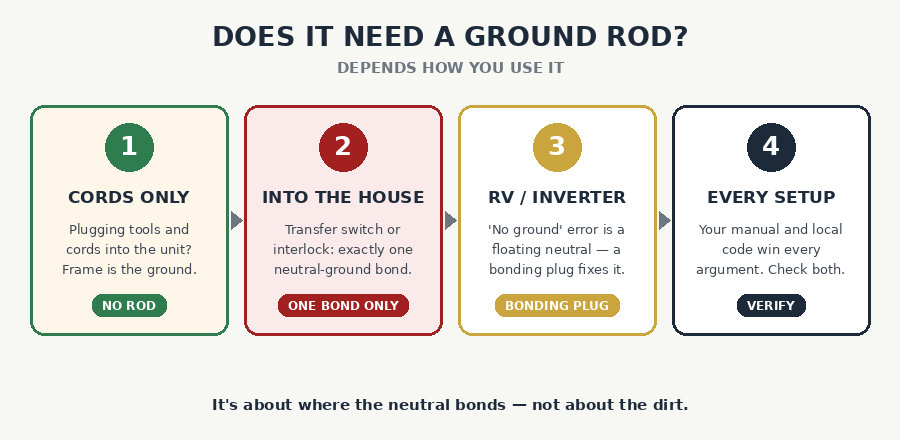
This is about 60% of the grounding questions I get, and it has the cleanest answer. If the generator only powers things plugged into its own receptacles — extension cords to the fridge, tools on a job site — the unit is what the code calls a separately derived system where the frame serves as the grounding point, as long as everything (tank, engine, housing) is bonded to that frame, which factory portables are. OSHA says it plainly in its portable generator grounding fact sheet: the frame of a portable generator used this way need not be connected to earth. No rod, no copper wire, nothing to buy. The grounding lug on the frame exists for the situations where a code authority requires earthing — its presence doesn’t mean your setup needs it.
Feeding the House: One Bond, Exactly One
Once the generator connects to your electrical panel through a transfer switch or interlock — the setups covered in connecting a generator to your house — the question changes shape. Your house already has a grounding electrode system, and the generator ties into it through the connection. What matters now is that the neutral-to-ground bond exists in exactly one place. Most homes carry that bond in the main panel, which means a generator with a bonded neutral (neutral tied to frame — typical of open-frame units) creates a second bond when connected, and doubled bonds put normal current on paths that were never meant to carry it. Generac’s own grounding guidance spells out the one-bond rule and even notes that adding an unnecessary earth rod can worsen lightning exposure rather than help.
So here’s the honest boundary of a repair article: whether your generator is bonded or floating is in its manual (or a two-minute continuity check between neutral and frame, unit off and unplugged), but reconciling that with your panel and your local code is licensed-electrician territory, and permanent connections need a transfer switch installed to code anyway. I hold a lot of opinions loosely; “get the interlock or transfer switch wired by someone licensed” isn’t one of them. The good news — the answer usually costs a conversation, not a trench and a rod.
The RV “No Ground” Error and the Floating Neutral
Now the third crowd — you plugged the RV’s surge protector into a quiet little inverter generator and it refuses to pass power, flashing an open-ground error. Nothing is broken. Inverter generators typically ship with a floating neutral: neutral isn’t referenced to the frame, so your protector sees no neutral-ground relationship and assumes the worst. The accepted fix is a neutral-ground bonding plug — a $10 to $15 dummy plug with an internal jumper that clicks into one of the generator’s spare 15-amp outlets and gives the protector the reference it wants. Search generator bonding plug and you’ll find a dozen. No rod, no rewiring — and pull it back out if that generator ever feeds a house connection where the bond already exists, because then you’d be double-bonded again. Same logic, opposite direction.
If You’re Told to Drive a Rod Anyway
Some jurisdictions, job sites, and event venues require you to ground a portable generator with an earth rod regardless — their site, their rules. Done right it’s an 8-foot copper-clad rod driven to full depth (angled up to 45 degrees where you hit rock), tied to the frame lug with 6 AWG copper and a proper clamp. Two things before the sledgehammer swings: call 811 first, because that rod doesn’t care whether it hits dirt or your gas line, and understand you’re satisfying a requirement, not fixing an electrical problem — the rod doesn’t make outlets safer or make breakers trip faster. That work is done by the bonding you already checked.
Grounding confusion never electrocuted anyone half as fast as the classic mistakes do: never backfeed a house through a dryer outlet with a double-male cord — it can kill a lineman down the block and it bypasses every protection this article discussed. Keep the generator outdoors, 20 feet out, exhaust away from openings. And leave the internal bonded/floating neutral conversion to someone licensed; a jumper moved wrong turns the frame you touch into a conductor.
This breakdown of when a ground rod is and isn’t needed matches the use-case logic above:
Frequently Asked Questions
Do I need to ground my generator if I’m just using extension cords?
No. Cord-and-plug use with the equipment bonded to the frame — which factory portables are — makes the frame the grounding point, and OSHA’s guidance says a rod isn’t required. This covers the great majority of home backup and job-site use.
What happens if you don’t ground a portable generator?
In a normal cords-only setup, nothing — it’s operating exactly as designed. Real risk appears with improper house connections (backfeeding, doubled neutral bonds), not from the absence of a rod. I’ve never once seen a properly used portable cause a problem for lack of an earth rod.
What’s the difference between a bonded and floating neutral?
Bonded means the neutral is tied to the frame at the generator — common on open-frame units, and correct when the generator stands alone. Floating means it isn’t — common on inverters, and correct when something downstream provides the bond. The whole grounding topic basically collapses into knowing which one you own; it’s in the manual.
Why does my inverter generator show “no ground” on my RV surge protector?
Floating neutral — the protector can’t find a neutral-ground reference and errors out on purpose. A $10 to $15 bonding plug in a spare outlet supplies the reference. It’s the single most common “grounding” complaint I hear, and it isn’t a grounding problem.
How deep does a generator ground rod need to be?
Where one’s actually required: 8 feet of rod in contact with earth, driven vertically or up to a 45-degree angle in rocky ground, clamped to the frame with 6 AWG copper. Call 811 before driving anything. And confirm you need it at all first — most portable setups don’t.
For more on this topic, see the GFCI outlet won’t reset guide.