
The right extension cord for a generator depends on length and load: thicker wire (a lower gauge number) for longer runs and heavier loads. For most uses, a 12-gauge cord handles medium loads at 50 feet, a 10-gauge covers heavier loads or 100-foot runs, and step up to 8-gauge for heavy loads at long distance. Always use a heavy outdoor-rated cord, keep it as short as you can, and uncoil it fully. An undersized cord drops voltage, runs hot, and can damage your tools and motors.
- Lower gauge number = thicker wire = more power over more distance. 10-gauge is heavier-duty than 12-gauge.
- Rough guide: 12 ga for medium loads to 50 ft, 10 ga for heavy loads or 100 ft, 8 ga for heavy loads at long runs.
- Use an outdoor-rated cord (look for a “W” rating) — indoor cords aren’t built for it.
- Keep the cord short and fully uncoiled; coiled cord traps heat and a long run drops voltage.
- An undersized cord causes voltage drop — weak, hot-running tools and burned-out motors.
What Gauge Extension Cord Do I Need for a Generator?
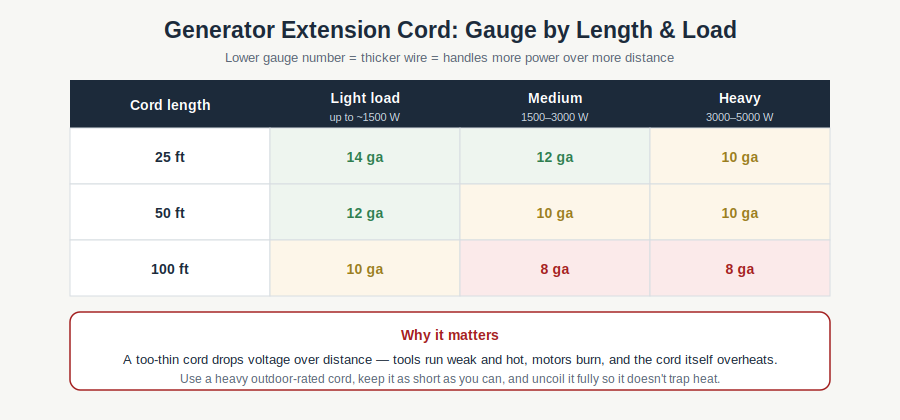
You match the gauge to how far the power has to travel and how much you’re pulling — and because wire gauge runs backward, the bigger the load and the longer the run, the lower the gauge number you want. A 14-gauge cord is fine for a light load over a short distance, but as you add watts or feet you move to 12, then 10, then 8 gauge to keep the voltage from sagging on the way to your tools. The reason is simple physics: every foot of wire has resistance, and a thin wire over a long run drops more voltage, so what leaves the generator at 120 volts can arrive noticeably lower. Tools and especially motors hate low voltage — they run weak, draw more current to compensate, and overheat. The chart below is the quick reference I use; when you’re between two sizes, go thicker, since a heavier cord never hurts and a too-thin one can cook a motor.
Match the Cord to the Outlet, Too
Gauge isn’t the only thing — the plug has to match the generator outlet and your load. A standard 120-volt 15- or 20-amp outlet takes an ordinary heavy-duty cord, but the 120-volt 30-amp (TT-30) and 120/240-volt (L14-30) outlets need their own matching cords and connectors. Don’t adapt your way around the right plug; use the cord built for that outlet. If you’re feeding a lot of gear, it’s usually better to run one heavy cord to a powered outlet or a small distribution setup near the work than to daisy-chain several light cords, which only stacks up resistance and trip hazards.
Why an Undersized Cord Bites You
Run too thin a cord and the symptoms look like a generator problem when they’re really a cord problem. Tools run weak or won’t come up to speed, motors hum and overheat, the cord itself gets warm to hot along its length, and in bad cases you’ll pop a breaker. If your generator seems to “lose power” only at the far end of a long cord, suspect voltage drop before you suspect the machine — the fix is a thicker, shorter cord. If the breaker is tripping when you connect a load, that can be overload or a fault rather than the cord, and that’s covered in a generator that keeps tripping its breaker. And if there’s genuinely no output at the outlets regardless of cord, that’s an electrical-end issue walked through in runs but no power.
Size the Generator First
The cord only matters once the generator itself is sized to the job. If you’re not sure your unit can carry what you’re plugging in, work that out first — the wattage math for portables, inverters, and standby units is in what size generator you need. Once the generator is right, a properly sized cord delivers that power cleanly to where you’re working.
Use only outdoor-rated cords (marked with a “W”) for generator duty, and inspect them for cracked insulation or bent prongs before each use. Never run a cord through standing water, and never coil a cord that’s carrying a heavy load — coiled wire traps heat and can melt the insulation. And don’t try to power your whole house by back-feeding a cord into a wall outlet; that’s a deadly shortcut, and the safe way to feed a panel is covered in the guide on connecting a generator to your house.
What It Costs
A good heavy outdoor cord is $30 to $80 depending on gauge and length, and it’s a buy-once item if you treat it right. That’s cheap insurance against the alternative: a burned-out tool motor or a melted cord from chronic voltage drop, either of which costs far more than the cord. My advice is to buy one cord a size heavier than you think you need in the length you actually use — you’ll never regret the thicker copper, and you won’t be stacking thin cords end to end during an outage.
Frequently Asked Questions
What size extension cord do I need for a generator?
Match it to length and load: roughly 12-gauge for medium loads up to 50 feet, 10-gauge for heavy loads or 100-foot runs, and 8-gauge for heavy loads at long distance. Remember the lower number is the thicker wire. When you’re between two sizes, go thicker — a heavier cord never hurts.
Is a lower gauge extension cord better for a generator?
For carrying power over distance, yes — a lower gauge number means thicker wire, which drops less voltage and runs cooler under load. A 10-gauge cord is heavier-duty than a 12-gauge. You only “pay” for it in a slightly heavier, pricier cord, which is well worth it to protect your tools.
Can I use a regular extension cord with a generator?
Only if it’s a heavy outdoor-rated cord of the right gauge — not a thin indoor household cord. Indoor cords aren’t built for the load or the weather and can overheat. Look for an outdoor “W” rating and the correct gauge for your run, and match the plug to your generator’s outlet.
How long can a generator extension cord be?
As long as you need if you size the gauge up to match — but longer runs drop more voltage, so keep it as short as practical. A 100-foot run typically needs 10-gauge or heavier for anything but a light load. If you must go far, use thicker wire and keep it fully uncoiled to limit voltage drop and heat.
Why do my tools run weak on a generator extension cord?
Almost always voltage drop from a cord that’s too thin or too long for the load. The thin wire’s resistance pulls the voltage down before it reaches the tool, so it runs weak and the motor overheats. Switch to a thicker, shorter cord and it usually clears right up.