
The 30-second answer: Hourly cost is simple: the gallons (or pounds, for propane) the generator burns per hour, times the fuel price. The hard part is the first number. A generator burns more fuel as the load goes up, so check the fuel-use chart in your manual and read the figure for the load you actually run.
Watch: “Generator Fuel Efficiency: Gas consumption at 50% Vs. 100% load” by Solar Solution on YouTube. A short look at how fuel use changes between half load and full load, which is the main driver of the hourly cost.
Most people ask this question during a storm, when the power is out and the gas station line is long. It’s a fair question, because a generator that runs for two days can cost more in fuel than people expect. The math is not hard once you know which numbers to use.
The Formula
Cost per hour equals fuel used per hour, multiplied by the price of the fuel. For gasoline, the fuel used is in gallons per hour. For propane, most owners use pounds per hour or the gallon equivalent. Check the units on your price before you multiply.
Fuel use is the part that changes. A generator at light load sips fuel. At full load it burns much more. Running a unit at a steady 50 percent load is usually cheaper per watt-hour than running it flat out, and the unit also runs cooler and quieter. The owner’s manual has a run-time or fuel-consumption table for each load level, and that table is the most reliable source for your model.
Read the Fuel Table
Look for a table that lists run time on a full tank at 25, 50, 75, and 100 percent load. You can work backward from it. If a 4-gallon tank runs the unit for 8 hours at half load, the unit uses about half a gallon an hour at that load. Use the number for the load you expect to run, then multiply by your local price.
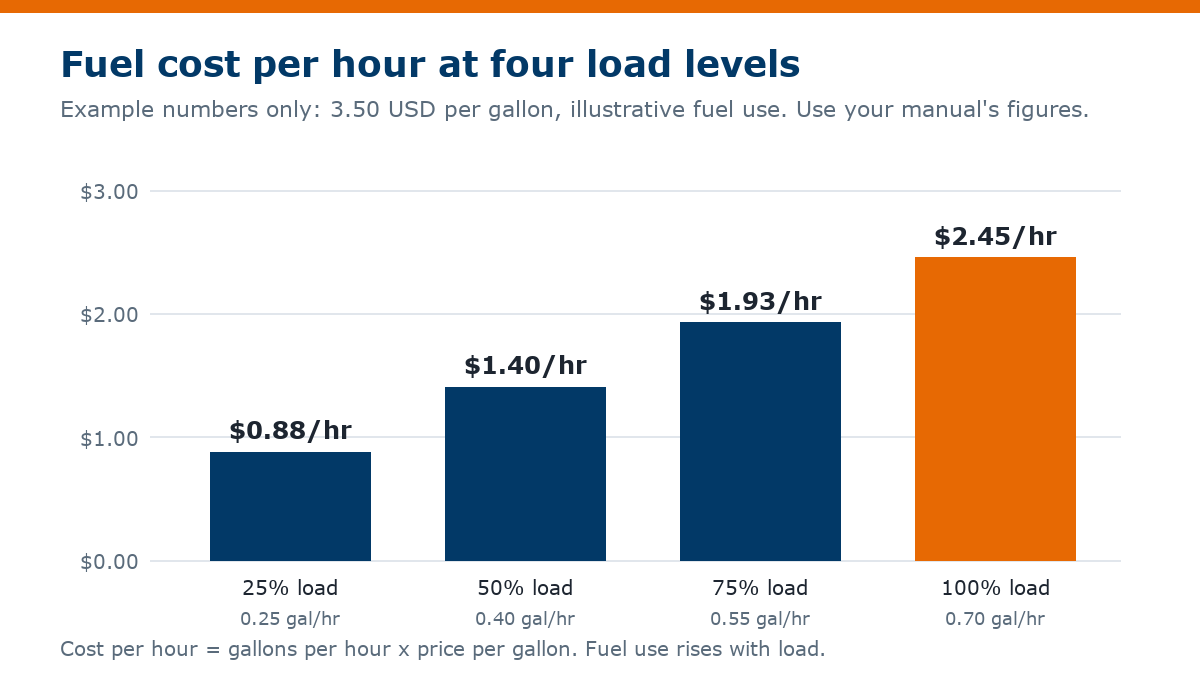
The chart below shows how the cost changes with load. The numbers are illustrative. They are not the figures for any specific model, and they assume gasoline at $3.50 a gallon. Your own table will give different values.
A Worked Example
Suppose your manual says a unit burns 0.5 gallons per hour at the load you run, and gasoline costs $3.50 a gallon. The cost is 0.5 times $3.50, or $1.75 per hour. A 12-hour overnight run would cost about $21 in fuel. If the load goes up to a full 1 gallon per hour, the same run costs about $42.
Running a generator in short bursts, such as to run the fridge for a few hours a day, usually costs less than running it all night. Cycling the fridge through a generator run is a common way to stretch a tank.
Things That Add to the Bill
- Warm-up and cold starts. Engines burn more fuel while they warm up.
- Overloading. A unit pushed to its limit burns more fuel and wears faster.
- Old or wet fuel. Bad gas can cost you a repair, which is more expensive than any fuel bill.
- Propane changes. Propane burns differently from gasoline, so do not compare the two by price alone. Compare the cost per hour at your load.
Keep Your Own Log
Write down the date, the hours run, the load, and the fuel added on each run. After a few runs you’ll know your real cost per hour, which is better than any estimate. It also helps with the maintenance schedule, since the hour count tells you when the oil is due.
Cut the Cost Without Cutting Power
- Run the big loads first, then add the small ones, so the unit doesn’t stay at peak load longer than it needs to.
- Turn off loads you don’t need. A fridge and a few lights use far less than a space heater.
- Use the eco or economy setting on inverter models that have one, if your load allows it.
- Keep the air filter and spark plug clean. A clean engine burns fuel more efficiently. The air filter guide covers the check.
Sizing Affects the Bill Too
A generator that is far too big for your loads runs at a low load, which is efficient per watt, but it costs more to buy and store. A generator that is too small runs at its limit, which burns more fuel and wears the engine. The wattage sizing guide helps you match the unit to what you actually run.
Frequently Asked Questions
How much gas does a generator use per hour?
It depends on the size and the load. Check your manual’s fuel table. Many portables burn well under a gallon an hour at moderate load, but a large unit at full load burns more. Use the table, not a rule of thumb.
Is propane cheaper than gasoline to run?
Not always. Compare the cost per hour at your load, using your local prices and your unit’s propane figures. Propane has advantages in storage, which can matter more than the hourly cost.
Does a generator use fuel when it’s not running?
No. A stopped generator burns no fuel. The cost of a stored fuel supply comes from fuel going stale, which is a separate problem covered in the storage guide.