

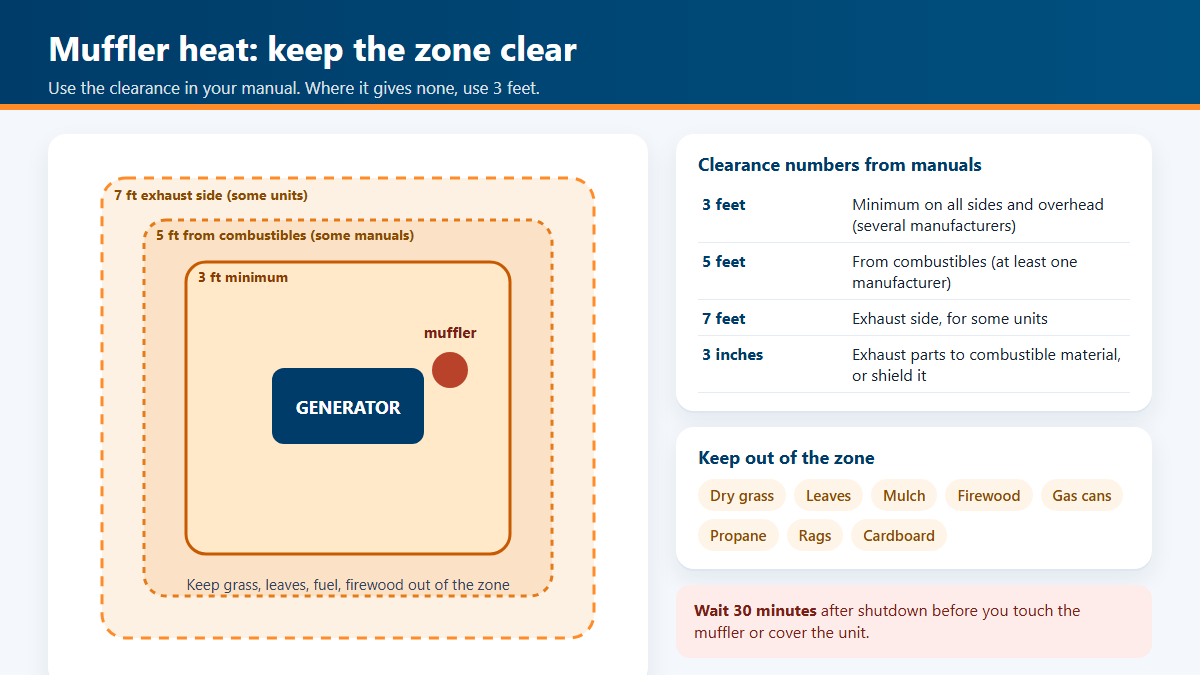
The 30-second answer: Treat the muffler and exhaust outlet as hot for the whole time the engine runs and for a long time afterward. Keep the unit on bare or non-combustible ground, with clear space around it. Keep dry grass, leaves, fuel cans, and stored materials well away. Check that the muffler and heat shield are intact, and that the spark arrestor is clean. Use the clearance in your manual, and where it gives none, keep at least 3 feet on every side and overhead.
Most people think about carbon monoxide when they set up a generator, and rightly so. Fire is the other hazard. The exhaust system on a small engine can reach temperatures high enough to start a fire in dry grass, pine needles, or loose debris. A unit that runs for hours on a hot afternoon, close to a wall or a stack of firewood, is a real fire risk, and it is avoidable.
Step One: Know Where the Heat Is
The muffler is the main hot spot, along with the exhaust outlet and the pipe between them. Some heat also comes off the engine shroud and the area around the spark arrestor. Those surfaces stay hot for a long time after shutdown. As a working rule, wait at least 30 minutes after the engine stops before you touch the muffler or cover the unit, and check the manual for a longer wait if it gives one.
Heat does not only come from the muffler. Hot exhaust gas leaves the outlet at speed, and it can scorch paint, plastic, and anything soft within reach. Keep the outlet pointed away from people, walls, and anything that can burn.
Step Two: Clear the Ground
Set the generator on bare, packed earth, gravel, or concrete. Do not set it on a wood deck, a dry lawn, or a pile of mulch or leaves. Clear dry grass and debris within several feet of the muffler and the exhaust outlet. A few steps of cleared ground is not enough on a windy day, because embers and hot particles can drift farther than you expect. If you are in a campground or on a property with dry brush, the clearance matters more than anything else on this list.
Look at the ground after the unit has run for a while, too. An RV owner in one forum thread reported that a generator running for about an hour turned the grass dark under the exhaust, and other owners disagreed about whether it was the exhaust or the air-cooled engine. Either way, the lesson is the same: check the ground, not just the unit.
Step Three: Keep Fuel and Storage Away
Keep gasoline cans, propane tanks, firewood, straw, rags, and cardboard away from the unit. A spilled fuel can that touches a hot muffler can ignite. Keep the exhaust outlet pointed away from walls, windows, vents, and anything that can burn.
The clearance numbers vary by manufacturer, so use the one in your manual. The published figures from manuals that cover this topic include:
- At least 3 feet (about 1 meter) on all sides and overhead, which several manufacturers list as the minimum for running and storing the unit.
- 5 feet from combustibles, which at least one manufacturer specifies for the unit.
- 7 feet from the exhaust side for some units, measured to combustible surfaces.
- At least 3 inches between exhaust system parts and any combustible material, and shielding or insulation where that gap cannot be kept.
Where your manual gives more than one number, use the larger one. Where it gives none, keep at least 3 feet of clear space on every side and overhead.
Step Four: Check the Spark Arrestor
A spark arrestor screen that is clogged with carbon raises exhaust temperature and restricts flow. A restricted exhaust runs hotter, and a damaged screen can let sparks out of the outlet. Pull the screen and clean it on a regular schedule, using the steps in the spark arrestor cleaning guide. A screen that is burned through needs replacing. Do not run the engine without the screen in place, even for a short test, because the sparks are exactly what the screen is there to stop.
Step Five: Check the Muffler and Heat Shield
Look at the muffler with the engine cold. Check for rust holes, cracks at the welds, and a loose or missing heat shield. A hole in the muffler lets hot exhaust escape at the wrong place, and a leak at the joint can blow exhaust gas into the cabinet or the engine area. A loose heat shield rattles and can rub against wiring or fuel lines. Replace a damaged muffler, and secure the shield before the next run. The exhaust smoke guide covers the signs that the exhaust path itself is restricted or worn.
Look for soot or black staining around the muffler joints. Carbon at a joint usually means exhaust is leaking there. Tighten or replace the gasket, and check the mounting bolts, before the next run.
Watch: “Muffler Glowing Red Hot? Do THIS Epic Trick” by Taryl Fixes All on YouTube. A troubleshooting video on what can make a muffler run hotter than normal. An unusually hot muffler can point to an engine problem, so check the engine as well.
Before Each Run: A Five-Minute Check
- Ground under and around the unit is clear of dry grass, leaves, and debris.
- Nothing combustible is within the clearance zone: fuel cans, firewood, rags, or stored items.
- The exhaust outlet points away from walls, windows, vents, and people.
- The heat shield is secure, and the muffler has no visible holes or cracks.
- The spark arrestor screen is clean and in place.
- The unit is on a solid, level, non-combustible surface.
Do not run a generator under a tarp, in a shed, or inside a canopy that traps heat, unless it is an approved enclosure with proper ventilation. Do not drape towels, covers, or cords over a hot muffler. Keep children and pets back from the unit while it is running and cooling. Do not add ductwork to the muffler, because the trapped heat can damage the unit and start a fire.
What to Do If the Ground Catches Fire
If dry grass or debris under the unit starts to smoulder, shut the engine off first if it is safe to reach the switch. Then put out the fire with water, a fire extinguisher rated for the material, or soil. Do not use gasoline or fuel-soaked rags to put out anything, and keep a hose or extinguisher nearby whenever a generator runs in dry conditions.
Frequently Asked Questions
How hot does a generator muffler get?
Hot enough to cause a burn on contact and to ignite dry material. Treat it as hot whenever the engine has been running, and for a while after it stops.
Can I put a generator on a wood deck?
It is not a good idea. A wood deck is combustible, and heat from the muffler and exhaust can scorch or ignite it. Use a non-combustible base, and keep the clearance described above.
Does a clean spark arrestor reduce fire risk?
Yes. A clean screen lets the exhaust flow freely, which keeps the temperature down, and a sound screen stops sparks from leaving the outlet. A clogged or damaged screen works against you on both counts.
Can I move the generator while the muffler is still hot?
Let it cool first. Moving a hot unit can burn you and can drag hot parts across dry ground, which can start a fire. Once it has cooled, check the clearance again at the new spot before you start it.