The 30-second answer: Frequency is how many times per second the AC power changes direction. Standard US and Canadian power is 60 Hz. Many countries use 50 Hz. Most US portable generators make 60 Hz, so they suit US appliances. Check the label on the generator and on the device before you connect them, since motors and clocks depend on frequency.
Watch: “How Generator Frequency is Generated? 50Hz vs 60Hz Explained.” by IK LECTURES on YouTube. A clear explanation of how a generator sets its frequency, which matches the chart above.
Most people never think about frequency until they buy a generator from abroad, or plug in a motor-driven device that runs at the wrong speed. The number is printed on labels, but it rarely gets explained. This explains what it means and what to do about it.
What Hertz Means
Hertz (Hz) is the number of complete cycles per second. In 60 Hz power, the current reverses direction 120 times each second, which is two reversals per cycle. In 50 Hz power, it reverses 100 times each second. The number is set by how fast the generator’s engine and alternator turn, or by the inverter’s electronics.
Why the Speed Matters
Many appliances use motors, and motors run at a speed that follows the frequency. A 60 Hz motor on a 50 Hz supply runs slower. A 50 Hz motor on a 60 Hz supply runs faster. Fans, pumps, and compressors may run hotter, louder, or less efficiently on the wrong frequency. Clocks that count with the power line will run slow or fast on the wrong frequency.
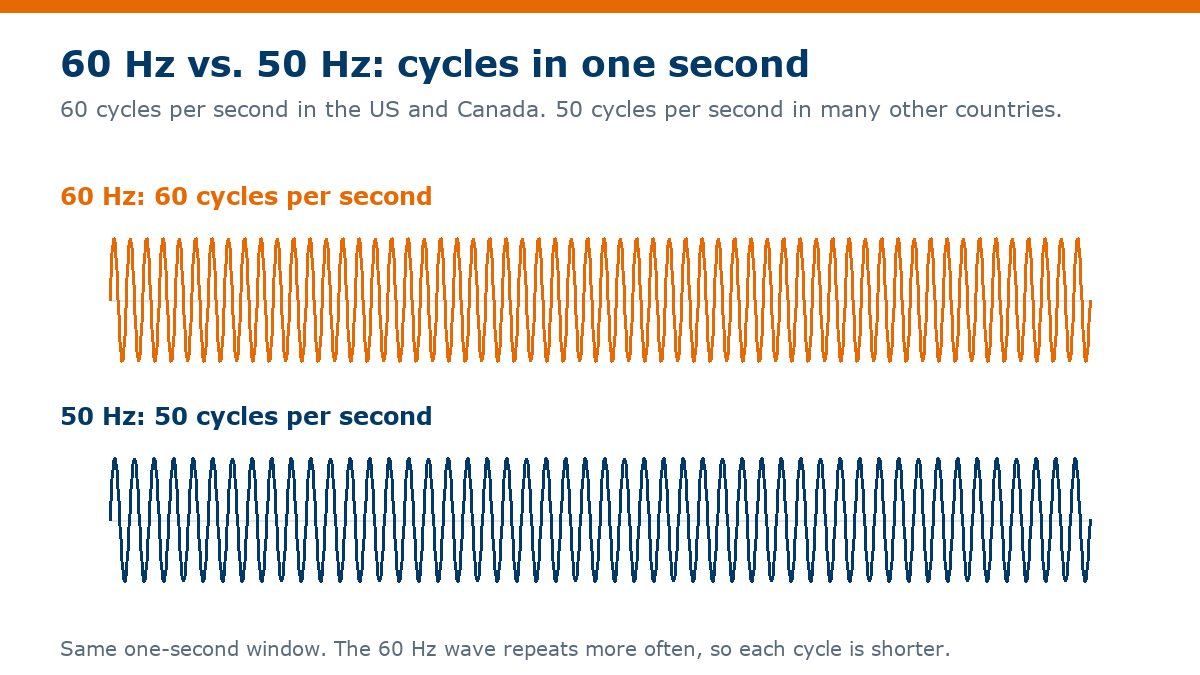
The chart shows the same one-second window of power at both frequencies. In 60 Hz power, you get 60 full cycles per second. In 50 Hz power, you get 50. The 50 Hz wave is stretched wider, and the 60 Hz wave is tighter.
How Frequency Is Set on a Generator
A conventional generator ties frequency to engine speed. The alternator has a fixed number of poles, and the engine has to turn at a set speed to make 60 or 50 Hz. Engine speed is usually set at the factory, and a governor holds it steady under load. Changing that speed to shift the frequency is not a home adjustment, and the manual warns against it.
An inverter generator works differently. It makes a high-frequency output, then converts it to clean AC with electronics. Many inverter units can be set to 60 Hz or 50 Hz, or they are sold for one region only. Check the specification for your model.
Check the Labels
- On the generator, look for the rated frequency next to the voltage on the rating plate.
- On the appliance, look for the frequency on the nameplate, usually near the voltage and amps.
- If the appliance says 50/60 Hz, it will run on either. If it says only one, match that number.
What About Dual-Frequency Equipment?
Some equipment, such as certain motors and power supplies, is rated for both. Those run without trouble on either frequency. Electronics with switching power supplies are usually more tolerant than motor-driven equipment. Still, check the label before you assume.
When It Matters Most
- Importing a generator or buying a used unit from another country.
- Connecting a well pump or an air compressor, since motors depend most on frequency.
- Running clocks, timers, or appliances that track time through the power line.
A frequency mismatch can damage motors and can overheat equipment. If you’re not sure what the labels mean, ask a qualified electrician before you connect the generator to a motor-driven load or to house wiring.
Frequently Asked Questions
Can I run a 50 Hz appliance on a 60 Hz generator?
Some can, but many will run faster or hotter than intended. Check the appliance label. If it is rated for 50 Hz only, use a generator that makes 50 Hz.
Does frequency change the power a generator makes?
Not directly. The wattage rating is set separately, but a motor that runs at the wrong speed may draw more current and heat up. Keep the load within the rating.
Is 60 Hz the same everywhere in North America?
The standard across the US, Canada, and most of Mexico is 60 Hz. Check the label on your equipment and the generator, since the rules are set by the equipment and the power system you use.