
Let’s sort by what’s actually falling on you. Light drizzle and you need an hour of power? Manageable with real protection. A genuine storm — the kind that caused the outage? The generator runs under a purpose-built cover or it doesn’t run. Standing water creeping toward the unit? That’s a full stop no cover fixes. Rain questions are really placement-and-protection questions, and the answers below hold for all three.
You shouldn’t run a generator in the rain unprotected — water in the outlets and controls creates a shock risk and does the machine real damage. With a canopy-style running cover built for the job, an elevated dry spot, and the unit 20 feet from the house with exhaust pointed away, running through wet weather is done safely every storm season.
Can You Run a Generator in the Rain?
Not bare, no — but the reason is more specific than “water bad.” A portable generator’s weak points in the rain are its receptacles, breakers, and control panel: water in those creates a path for current that can shock whoever touches the unit, and it corrodes the electricals into future failures. Water down the air intake is the other route, and enough of it will stop or damage the engine outright. What rain is NOT is a reason to move the generator into the garage — that trade kills people every storm season, because carbon monoxide in an enclosed space is lethal in minutes while rain on a covered generator is merely inconvenient. Of the rained-on units I’ve seen afterward, roughly 60% of the damage is corroded outlets and controls, 25% is water ingestion through the intake, and 15% is cord-connection shorts. Every bit of it preventable with a real cover and smart placement — and that’s what lets people run a generator in the rain safely every storm season.
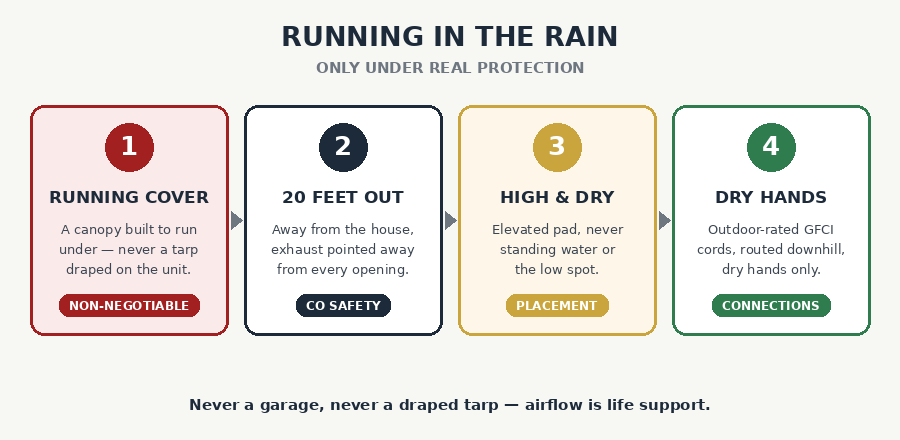
A Cover Built to Run Under — Never a Tarp
The right tool is a canopy-style running cover — GenTent is the name brand, with several imitators — that clamps to the frame, sheds rain off the top and sides, and leaves the bottom open so cooling air flows and exhaust heat escapes. Sized right, they handle genuinely ugly weather and run $100 to $180 in the generator running cover listings. What the right tool is not: a tarp draped over a running machine. A tarp traps engine heat against fuel and plastic, blocks cooling intake, sags into hot surfaces, and turns into a sail in storm wind — I’ve seen the melted aftermath, and it’s a machine-killer that markets itself as protection. A DIY canopy can work if it follows the same physics as the bought one: solid roof high above the unit, open sides, nothing touching, staked against wind. And if you’re going the permanent-enclosure route instead, build it with real airflow — the ventilation math is the same one covered in quieting a generator, because a box that muffles sound also traps the heat.
Placement: the 20-Foot Rule Still Runs the Show
Rain doesn’t relax the carbon monoxide rules — outages are when people die of CO precisely because weather tempts them to shelter the generator near the house. It stays 20 feet out, exhaust aimed away from every window, door, and vent, and it never runs in a garage, carport, or covered porch, open door or not; the CPSC’s portable generator safety center is blunt about the body count behind that rule. Within those constraints, pick ground that stays dry: an elevated pad, patio pavers, or simply the high spot of the yard — never the low corner where water pools, because no canopy protects a generator standing in a puddle. Rising water reaching the unit ends the session, full stop. The full distance-and-direction rundown lives in generator CO safety.
Cords, Connections, and Your Hands
The electricity has to travel from the dry-ish generator to the dry house, and the trip is where shocks actually happen. Outdoor-rated cords only, sized per the extension cord guide, with the plug-to-cord connections kept up off the wet ground — under the canopy, on a paver, or wrapped in a cord-connection cover. Route cords so water can’t follow them downhill into a connection. Touch the generator only with dry hands; refuel only after the engine’s off and cooled, under the canopy, with the can kept capped against the rain. None of it is exotic. All of it is the difference between a wet-weather outage being a story or an incident.
Two absolutes worth repeating because storms compress judgment: carbon monoxide indoors kills faster than anything rain will ever do to you — the generator stays outside and 20 feet out no matter how hard it’s coming down. And a generator standing in or splashed by pooling water doesn’t get approached while running; if water’s rising, kill it from the cord side if you can and let the situation drain before touching the frame.
After the Storm
Once the weather clears, give the unit five minutes before storage: pop each outlet cover and look for moisture, run it dry-day long enough to bake off condensation, and check that the controls click like they should. A generator that ran wet and got put away wet is how this storm’s success becomes next storm’s no-power mystery — corrosion does its work in storage, not in service.
This one covers wet-weather generator running and the cover setups that make it safe:
Frequently Asked Questions
Can a generator get rained on while not running?
Sitting outside uncovered is still bad for it — water finds outlets, controls, and the tank vent, and corrosion starts immediately. Store it dry, or at minimum under a fitted storage cover (those snug covers are fine on a COLD, off machine — that’s their actual job, as opposed to running under one).
What happens if my generator gets wet while running?
Light spray on the frame, usually nothing — water in the receptacles or intake, real trouble: shock risk at the panel, corroded electricals, or a stalled engine. Shut it down safely, dry it out thoroughly, and test outputs before trusting it again. If it took real water, check the outlets with a meter before plugging anything valuable in.
Can I run a generator in the garage with the door open?
No — and this is the one that fills the news after every hurricane. An open door doesn’t clear carbon monoxide from an enclosed space; it pools and drifts inside. Rain is never a reason to bring exhaust near your family. Canopy outside, 20 feet, exhaust away. Every time.
Are generators waterproof at all?
No portable generator is waterproof — weather-resistant frames, maybe, but the receptacles and controls are open to the world by design. Treat every unit as a machine that needs a roof. The brands’ own running covers exist because the brands know it.
What about snow — same rules?
Same playbook, two additions: keep the intake and exhaust clear of drifting snow, and watch that melting snow off the canopy doesn’t pool where the unit sits. Cold starts are their own topic — hard starting in the cold covers the choke-and-oil side of winter running.