
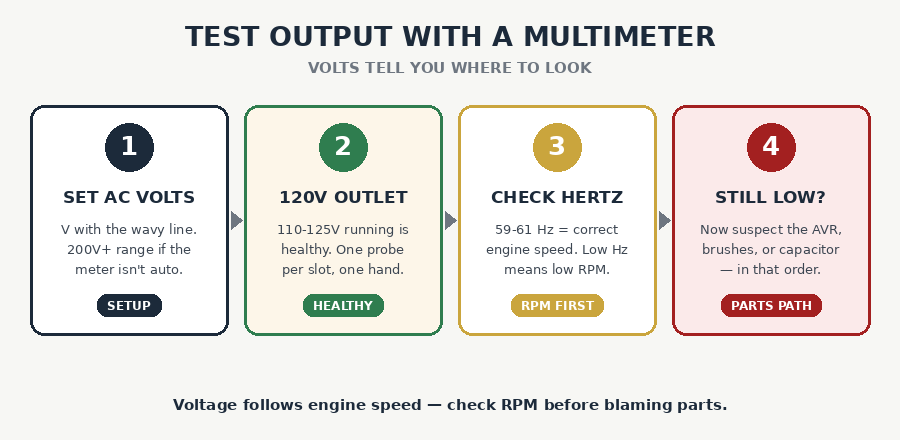
To test generator output with a multimeter, set the meter to AC volts, start the generator, and put one probe in each slot of a 120V outlet — a healthy unit reads 110 to 125 volts. If your meter reads frequency, 59 to 61 Hz confirms correct engine speed. Low readings point to engine RPM first, then the AVR; zero points to lost residual magnetism, brushes, or the capacitor.
- AC volts, one probe per outlet slot, one hand: 110-125V running is healthy on the 120V side.
- Check Hz before condemning parts — voltage follows engine speed, and 59-61 Hz means the engine’s turning right.
- When output tests low, it’s engine speed about 40% of the time, the AVR 30%, brushes or slip rings 15%, and the capacitor 15%.
- Zero volts with a smooth-running engine usually means lost residual magnetism — free fix.
- Resistance and continuity tests happen with the engine OFF, always.
How Do You Test Generator Output With a Multimeter?
Testing generator output with a multimeter takes two minutes and sorts nearly every no-power or weak-power complaint into the right repair. Set the dial to AC voltage (the V with the wavy line — pick a 200V-or-higher range if your meter isn’t auto-ranging), start the generator, let it settle, and probe a 120V receptacle with one lead in each vertical slot. You’re looking for 110 to 125 volts. Get that, and the generator head is doing its job — any problem is downstream in cords or connections. Read low, and the cause splits by frequency: about 40% of low-output units are just running slow, 30% have a failed voltage regulator, 15% have brush or slip ring trouble, and 15% a weak capacitor, depending on which excitation style your unit uses. Read zero on an engine that sounds perfect, and you’re most likely looking at lost residual magnetism — the cheapest fix on the machine. The sections below walk that exact fork.
The 120V and 240V Checks
On the household outlets: probe tip into each vertical slot, hands on the insulated probe bodies, and read. Test every receptacle on the panel while you’re there — one dead outlet with the rest healthy is that outlet or its breaker, not the generator (push-to-reset breakers on the panel catch people constantly). On a 240V twist-lock: the two hot legs together should read 230 to 250 volts, and each hot to neutral should read its half, 110 to 125. One leg healthy and one leg dead on a 240V outlet is a legitimately useful clue — that’s a connection or winding issue on the dead leg, not a machine-wide failure.
The Reading Everyone Skips: Frequency
If your meter has a Hz setting — most $30-and-up digital meters do — flip to it right after the voltage check, same probe position. A generator makes 60 Hz power at its governed speed (3,600 RPM on nearly every portable), and voltage tracks speed. So 59 to 61 Hz with low voltage means the engine’s fine and the regulation side is guilty; 55 Hz with low voltage means the engine is slow, and the “electrical problem” is actually a governor adjustment or a surging carb. My first instinct for years was to go straight at the AVR whenever output ran low — swapped a few that tested fine before the pattern sank in, and the pattern is: slow engines fake AVR failures perfectly. Thirty seconds on the Hz setting would have saved me every one of those parts. Speed first. Always.
Following a Bad Reading to the Part
Zero volts, smooth engine: start with the field flash for lost residual magnetism in generator runs but no power — free, ten minutes, and it’s the answer more often than any component. Low volts at correct Hz: the regulator diagnosis in testing and replacing the AVR, a $15 to $30 part on most units. Output that flickers or wanders with vibration: brushes and slip rings. Weak output on a capacitor-excited unit (no brushes, no AVR — common on cheaper open frames): the capacitor test. Voltage that’s genuinely high or swinging both directions gets its own workup in low or high voltage output. With the engine OFF, your meter’s resistance mode can also ohm out windings and brushes — but continuity work on a running generator is how meters and knuckles get destroyed, so the rule is absolute: volts running, ohms off.
Meter-buying note, since it decides how useful this all is: any auto-ranging digital multimeter in the $25 to $40 range with a Hz function covers everything you need to test generator output with a multimeter, receptacles to windings. The $8 specials work for volts but usually lack frequency, and frequency is the reading that saves you from buying parts.
You’re probing live outlets on a running machine, so the rules aren’t optional: one hand on the probes, the other hand nowhere on the frame, so current has no path across your chest. Fingers stay behind the probe guards. Dry hands, dry ground, meter leads with intact insulation. And never probe the generator’s internals — receptacles only — while it’s running; the windings and regulator work happens engine-off with the plug wire pulled.
What It Costs
The meter is the whole investment — $25 to $40 buys one that does everything here. Compare the path without it: a shop’s diagnostic fee runs $90 to $150 before any repair, and the guess-and-swap path at home burns $20 to $30 per wrongly accused AVR. The meter pays for itself the first time frequency tells you the engine’s just running slow — which, at 40% of low-output cases, it probably will.
Here’s the outlet-probing sequence done on camera, worth two minutes before your first live test:
Frequently Asked Questions
What should a generator outlet read on a multimeter?
110 to 125 volts AC on the 120V receptacles, 230 to 250 across the two hots of a 240V outlet, at 59 to 61 Hz. A no-load reading a few volts high — say 125 — is normal and settles under load. Outside those windows, the article’s diagnostic fork applies.
Why does my generator read only 60 volts?
Half-voltage readings usually mean the excitation side is limping — a weak capacitor on capacitor-excited units, or a failing AVR or brush contact on regulated ones. Confirm frequency is right first so you’re not chasing a slow engine, then work the excitation chain. I’ve seen tired capacitors park a unit at almost exactly half output.
Can I check generator output without a multimeter?
Crudely — a plug-in outlet tester proves presence of power, and a corded incandescent work light gives a rough brightness gauge. Neither tells you 105 versus 122 volts, and running equipment on unknown voltage is how boards die. A real meter costs less than one service call; get the meter.
What setting on the multimeter tests a generator?
AC volts (V~) for every live output test, 200V+ range if it’s not auto-ranging. Hz for engine speed through the same probes. Ohms/continuity only with the engine off, for windings, brushes, and the capacitor. DC volts has exactly one job here: the starting battery.
How do I test the generator’s frequency?
Same probes, same outlet, dial to Hz — you want 59 to 61. It’s the most underrated reading on the meter: low Hz plus low volts acquits every electrical part and points straight at engine speed. I check Hz before I so much as look at a regulator now.