
A generator battery keeps dying mostly because portable generators barely charge their own batteries — the built-in charging circuit is a trickle at best, and months of sitting between outages drains the battery flat. A $25 battery maintainer between uses prevents most of it; a battery reading under 12 volts rested needs a proper overnight charge, and one under 10.5 volts is usually done for.
- The dirty secret: most portables don’t meaningfully charge their own battery. Running it for an hour a month isn’t maintaining anything.
- When a generator battery keeps dying, half the time it’s just sitting-drain — a small battery self-discharges to dead over a storage season.
- Test before you shop: 12.6V rested is healthy, under 12.0V needs charging, under 10.5V is likely sulfated junk.
- Generator batteries live about 3 years no matter what you do — replacements run $25 to $40.
- The pull cord always works. A dead battery is an inconvenience, never a stranding.
Why Does My Generator Battery Keep Dying?
A generator battery keeps dying for a reason most owners never suspect: the generator was never really charging it. About 50% of these cases are nothing but storage drain — the small 12V battery on an electric-start unit self-discharges a few percent every week, and the charging winding on most portables puts back so little, so slowly, that occasional runtime doesn’t keep up. Another 25% is age: these compact batteries sulfate and die around the 3-year mark regardless of care. Roughly 15% is a parasitic draw — hour meters, CO modules, and remote-start receivers sip constantly on some models — and the last 10% is an actual charging-circuit fault, a failed diode or connection in the one part of the system everybody blames first. Test the battery, charge it correctly once, put a maintainer on it, and this problem is over for years.
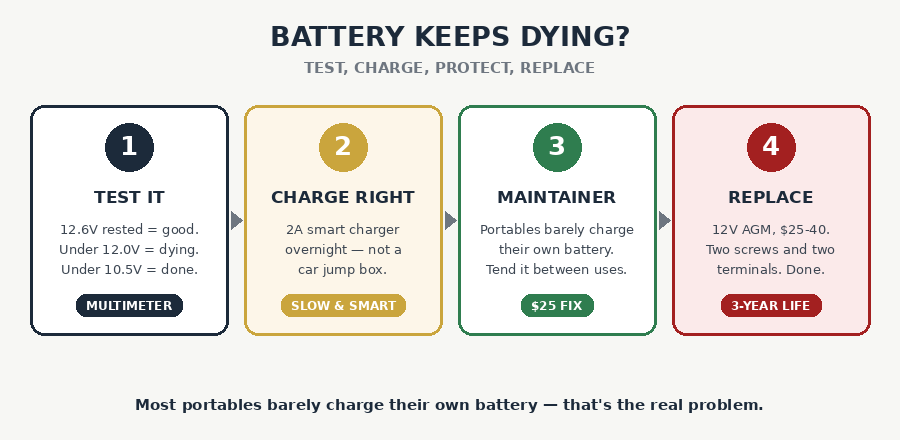
Test It Before You Buy Anything
Set a multimeter to DC volts across the terminals with the generator off and the battery rested a few hours. The verdict is immediate: 12.6V or better is a healthy full charge, 12.0 to 12.4V is a good battery that’s been neglected, under 12.0V needs a real charge before judgment, and a battery that reads under 10.5V — or charges up but collapses right back within a day — is sulfated and done. One more reading worth ten minutes: check voltage again with the engine running. If your model actually has a charging circuit, you’ll see 13 volts or more at the terminals; if the number doesn’t budge from the resting voltage, you’ve just confirmed the machine does nothing for its own battery, and the maintainer stops being optional.
Charge It Right (Not With the Car Method)
This one paragraph is the whole section because the rule is short: small generator batteries want a low-amp smart charger — 2 amps, overnight — not a 40-amp car charger and not repeated jump-boosts. Big current cooks small batteries, and jump-starting past a dead battery every outage just means cranking off a battery you’re simultaneously murdering. A basic smart charger costs $20 to $30 and fully rescues the “it keeps going flat” battery that hasn’t sulfated yet.
The Maintainer: the Actual Fix
Since the generator won’t tend its own battery, something else has to, and that’s the whole job of a battery maintainer — a small smart unit that floats the battery at full charge indefinitely without overcooking it. Clip it on whenever the generator’s parked — same put-away moment as the fuel storage routine — and the storage-drain half of this problem disappears permanently. I keep one on my own unit year-round (a habit that started decades ago around equipment that absolutely had to start when called on) and I haven’t touched the pull cord in anger since. A quality 12V battery maintainer runs about $25 — the cheapest reliability upgrade the machine will ever get. If your unit has a constant draw (hour meter glowing, remote-start receiver waiting), the maintainer covers that too; otherwise, pulling the negative terminal for storage does the same job for free.
When It’s Just Dead: Replacing It
Three years is the honest service life, and past it no charger resurrects sulfated plates. The good news: generator batteries are cheap and generic — most portables take a small 12V sealed AGM in the 7 to 9 amp-hour range, $25 to $40, matched by the dimensions and terminal style on your old one. Two screws on the hold-down, negative off first and on last, ten minutes total. Buy sealed AGM, not the flooded style that wants water checks. And if a fresh, charged battery still won’t spin the starter, the battery was never your problem — the solenoid-and-switch diagnosis is over in electric start won’t crank.
Even a small battery stores real energy: disconnect negative first, reconnect it last, and keep metal tools from bridging the terminals. Charge in a ventilated spot — charging batteries vent hydrogen. If a battery is swollen, cracked, or was ever frozen solid, it doesn’t get charged, it gets recycled; any auto parts store takes them free. And a battery this size has no business being jumped from a running car — the car’s charging system can shove far more current than these plates want to see.
Frequently Asked Questions
Why does my generator battery die between uses?
Self-discharge plus a generator that barely charges it — the built-in circuit on most portables is a light trickle that occasional runtime can’t keep ahead of. A $25 maintainer between uses ends it. This is the normal state of these machines, not a defect in yours. And if the unit sat long enough to kill the battery, give the fuel a look too — sitting is just as hard on the carb.
Does running the generator charge its battery?
Barely, on most portables — some models have no charging circuit at all. Test it yourself: terminal voltage with the engine running. If you don’t see 13-plus volts, the machine is doing nothing for the battery and never was. I’ve tested plenty that showed exactly that.
Can I jump-start a generator with my car?
With the car engine OFF, using its battery only, it’ll work in a pinch. With the car running, you’re putting a big alternator behind a battery a tenth its size — hard on the small battery and not worth the risk when the pull cord is standing right there. Better answer: charge it tonight, maintain it after.
What size battery does a portable generator use?
Usually a compact sealed 12V AGM around 7 to 9Ah. Match your old battery’s dimensions and terminal type — the sticker or a quick measure settles it — and expect $25 to $40. Skip the bargain-bin flooded batteries; sealed AGM handles the vibration and neglect better.
How long should a generator battery last?
About 3 years is what I plan on, 5 if it lives on a maintainer and never sits dead. Every deep discharge you let it endure shaves the number. Cheap insurance policy: write the install date on the battery with a paint pen so future-you knows whether to bother rescuing it.
For more on this topic, see the maintenance schedule guide.