
Here’s what’s actually happening inside that tank while the generator sits: gasoline is an unstable blend that starts oxidizing the day it’s refined. Give it 30 days untreated and the light compounds evaporate off while the rest thickens toward varnish — and if it’s pump gas with ethanol, it’s also been pulling moisture straight out of the air the whole time. That’s why draining old gas isn’t busywork. You’re removing the stuff before it turns into a carburetor repair — fifteen minutes to drain old gas from a generator beats an hour rebuilding its carb.
To drain old gas from a generator, shut the fuel valve, pull the fuel line off the carb inlet, aim it into a gas can, and reopen the valve — the tank empties itself with no siphon needed. Then open the float bowl drain screw to empty the carb. Fifteen minutes start to finish, and the bowl is the part you can’t skip.
Draining the Tank — No Siphon Required
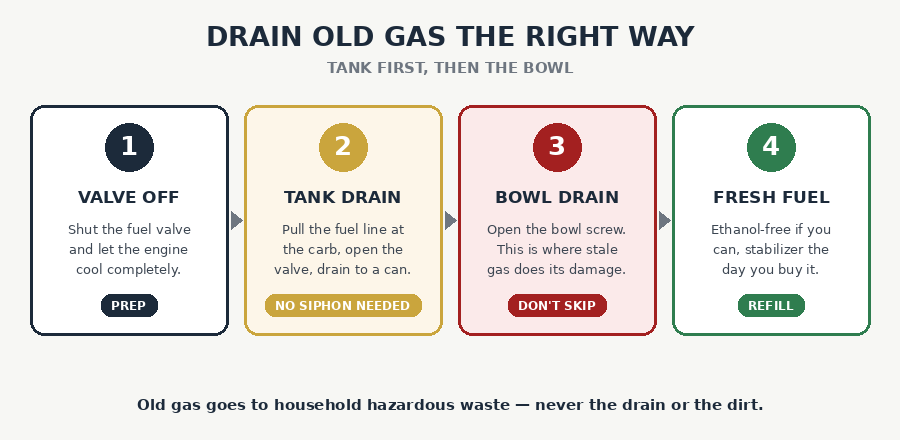
What you’ll see: a fuel line running from the tank’s shutoff valve down to the carburetor inlet, held by a small spring clamp. What’s happening: that valve and gravity are already a complete draining system — people buy siphon pumps for a job the machine does itself. What to do: engine off and cool, fuel valve OFF, slide the clamp back with pliers, work the line off the carb inlet, point it into an approved gas can, and open the valve. A 4-gallon tank empties in a few minutes. When it stops, close the valve and push the line back on. If your unit buries the carb behind a panel, a cheap hand siphon pump through the filler neck gets it done instead — just don’t ever mouth-siphon gasoline. I’ve seen a grown man learn that lesson exactly once.
The Float Bowl — the Step That Actually Matters
What you’ll see: a small screw on the very bottom of the carburetor’s bowl, sometimes with a tiny drain tube next to it. What’s happening: the bowl holds the last few teaspoons of fuel pressed right against the jets — the tightest passages in the whole machine. This is where varnish forms first and does its damage; a gummed bowl is behind about 60% of post-storage no-starts. What to do: rag underneath, open the drain screw two or three turns, and let it empty. Look at what comes out. Clear and gas-smelling, you got here in time. Dark, sour, or carrying water beads, the old fuel was already going — and if the generator’s been refusing to start or will only run choked, the varnish likely reached the jets already, which is the only-runs-on-choke problem and means the carb needs an actual cleaning, not just a drain.
The common mistake, and I see it constantly: draining the tank and calling it done. The tank is the easy 95% of the fuel and the harmless part. The bowl is three teaspoons and it’s the whole ballgame. Drain the tank without the bowl and you’ve left the varnish factory running right where it hurts.
What to Do With the Old Gas
Spent a good stretch of my working life as a hazmat responder, so let me keep this one short and non-negotiable: old gasoline goes to your county’s household hazardous waste drop-off in a sealed, labeled container — most counties take it free. Not the drain, not the gravel, not the burn pile. One borderline exception people always ask about: gas under about six months old can go into a car’s mostly-full tank, diluted at least four to one, and the car won’t notice. Truly old, sour, or water-contaminated fuel shouldn’t go in anything you value. When in doubt, it’s waste.
Refill Like You Mean It
What you’ll see at the pump: 87 octane with 10% ethanol, and — if you hunt — ethanol-free “recreation fuel.” What’s happening: ethanol is the moisture magnet that accelerates everything you just drained out. What to do: run ethanol-free if it’s available near you, and either way, treat every can with stabilizer the day you fill it — not the day you remember. Treated fuel stays honest for a year or more; untreated starts turning in a month. Date the can with a marker. Your future self, standing in a dark garage during an outage, will be grateful. The rest of the put-it-away routine, including whether to run the carb dry instead, is in storing a generator for the off-season.
Gasoline work happens outdoors, on a cold engine, away from anything with a pilot light or a spark — and that includes the water heater in the garage you were about to do this next to. Wipe up drips before the next start, cap the waste can tight, and keep it out of the sun and out of reach of kids until the hazmat run.
If you want eyes on the fuel-line drain method before trying it, this shows the whole job:
Frequently Asked Questions
How do I get old gas out of a generator without a siphon?
Use the machine’s own plumbing: fuel valve off, pull the line at the carb inlet, aim it in a can, valve back on, and gravity does the rest. It’s the easiest way to drain old gas from a generator without buying anything. The only units that need a pump are the ones with fully enclosed bodies.
How old is too old for generator gas?
Untreated, I don’t trust it past 30 days and I expect trouble past 90. Stabilized the day it was bought, a year is fine and I’ve run 18-month-old treated fuel without a hiccup. The smell test settles arguments: sour or varnish-like means it’s done.
Can I just add fresh gas on top of old gas?
If the old fuel is only a couple months along, topping off with fresh dilutes it enough to run fine. Past that, you’re blending good fuel into bad — the varnish precursors don’t un-form. Genuinely old gas comes out first. It’s fifteen minutes; do it right.
Do I need to drain the carburetor too, or just the tank?
The carb bowl is the more important of the two by a mile. It holds fuel directly against the jets, which is exactly where stale gas causes the no-start. Tank without bowl is doing the easy 95% and skipping the part that fails.
Where do I dispose of old gasoline?
County household hazardous waste — search your county name plus “HHW” and you’ll find drop-off days or a permanent site, almost always free for residents. Sealed container, labeled. I’ve handled enough spilled fuel professionally to promise you the ground is never the answer.