
So the tank ran dry mid-outage and now you’re wondering what you broke. Quick sorting guide — where are you right now? If you refueled and it started and runs normal, jump down to the good news. If it refueled and runs but there’s nothing at the outlets, that’s the residual magnetism section — the one real casualty of running dry. If it won’t start at all after refueling, go to the carb section. Each one has a different fix, and only one of them costs anything.
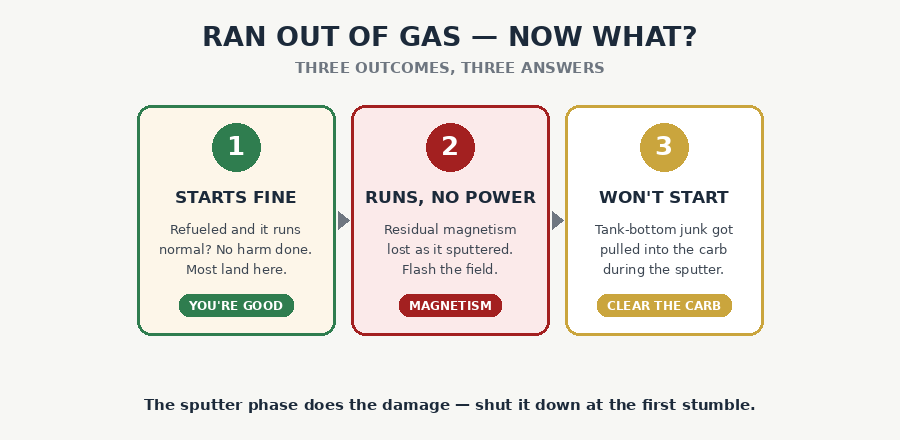
Running a generator out of gas usually does no harm at all — about 70% of the time you refuel and move on. The real risks live in the sputtering moments before it dies: a conventional generator can lose its residual magnetism and produce no power (fixed by flashing the field), and the dying gasps can pull tank-bottom sediment into the carb.
The Good News First: It Probably Doesn’t Matter
A four-stroke generator engine doesn’t get hurt by simply running out of fuel. The engine leans out, sputters, and quits — same as shutting the fuel valve off, which is literally the recommended storage shutdown. The oil system doesn’t care, the rings don’t care. About 70% of the time the whole story is: refuel, restart, done. If your generator ran out of gas and fired right back up on a fresh tank, that’s the ending — no hidden damage waiting to surface. (Two-stroke equipment that runs oil mixed in the gas is a different conversation — lean running there can genuinely score a cylinder — but if you’re reading a generator site, odds are you’ve got a four-stroke.) So no, you almost certainly didn’t ruin it. The other 30% splits into the two problems below, and both announce themselves clearly.
It Runs Now, But the Outlets Are Dead
This is the one genuine casualty of running dry, and it hits conventional (non-inverter) generators. Here’s what happened: as the engine sputtered and surged on its last fumes, the voltage swung wildly, and the generator head can lose the small residual magnetism it depends on to start building power the next time. Engine sounds perfect, outlets read zero. About 20% of run-out-of-gas cases end up here. The fix is called flashing the field — re-introducing that seed of magnetism, usually with a battery or drill trick — and the full walkthrough is in generator runs but no power at the outlets. It costs nothing and takes ten minutes. Annoying, sure. Damage, no.
OK, so the outlets work but now it won’t even start? That narrows it to the fuel path.
It Won’t Start After Refueling
So your generator ran out of gas and now refuses to restart even on fresh fuel. Here’s what happened: as the tank emptied, the fuel pickup started drinking from the very bottom — where every bit of sediment, rust flake, and water that ever entered the tank has been settling. Those last sputtering minutes pulled that junk toward the carb, and about 10% of the time enough of it lands in the jets or the inlet needle to cause trouble. Check the little screen at the tank outlet, then crack the float bowl drain and look at what comes out — grit or cloudy water droplets confirm it. From there it’s a standard bowl-and-jets cleaning, and the whole fuel path from tank to carb is mapped in the generator fuel system guide. I keep an inline fuel filter on my own open-frame unit for exactly this reason — a $6 part that catches the tank’s basement before it reaches the carb — and you can grab one in any inline fuel filter pack sized for 1/4-inch line.
The Part Nobody Tells You: the Sputter Is the Damage Window
Everything bad about running dry happens in the last ninety seconds — the surging, the voltage swings, the bottom-of-tank slurp. Which leads to the two habits that matter. First, when you hear the surge begin, kill the engine yourself instead of letting it ride down; you skip the wild voltage swings and most of the sediment pull. Second — and this is the one I’d tattoo on every inverter generator owner — get your electronics unplugged before it starves. An inverter unit protects its own board reasonably well, but a conventional generator sputtering to death sends whatever voltage it feels like into your fridge, your sump pump, your phone chargers. During a 2022 outage I let my own unit run down while a chest freezer was on it, told myself it’d be fine, and spent the next morning testing the freezer’s control board. It lived. I stopped gambling. If you’re running sensitive gear, an inverter unit like the ones covered in the inverter no-power guide handles the dying-swan act far more gracefully — but the unplug habit is free on any machine.
How to Never Do This Again
Fuel math beats fuel anxiety. Most portable units burn roughly half a gallon to a gallon per hour depending on size and load, so a 5-gallon tank at half load is an overnight run at best — the runtime numbers by tank size and load are laid out in how long a generator can run continuously. Set a phone alarm for two-thirds of the rated runtime and top off on your schedule, not the tank’s. Refuel with the engine off and cooled a few minutes — never pour gas into a running or hot machine.
Frequently Asked Questions
Is it bad to run a generator completely out of gas?
Mostly no — the engine itself doesn’t care. The two real risks are losing residual magnetism (runs fine, no output) and pulling tank sediment into the carb during the final sputter. Both are fixable cheap. The best habit is shutting it down at the first surge instead of letting it die on its own.
Why is there no power after my generator ran out of gas?
The voltage swings during the sputter-out likely wiped the residual magnetism the generator head needs to build output. Flashing the field restores it — a ten-minute, zero-dollar fix. It feels catastrophic and it’s the cheapest repair on the whole machine.
What happens if a generator runs out of gas overnight?
It sputters, dies, and whatever was plugged in rode through some ugly voltage on the way down. Check that your connected equipment still works, expect a possible field-flash, and refuel. The generator sitting there empty until morning did it no additional harm — empty is exactly how it stores best.
Should I let my generator run out of gas before storing it?
Close — the right move is shutting the fuel valve and letting it die from an empty carb, not an empty tank. Same ending, but the fuel dies at the valve instead of the engine slurping the tank’s sediment layer. I run mine dry that way before every storage stretch.
Can running out of gas damage the inverter board?
Rarely — inverter units have low-voltage protection that usually shuts things down cleanly. The gear at bigger risk is whatever’s plugged into a conventional generator during the sputter. Unplug loads the moment you hear it starving and both the generator and your electronics stay out of trouble.