
A flooded generator engine has too much raw fuel in the cylinder — the plug is soaked and can’t fire. Shut the fuel valve, open the choke fully to RUN, and pull the cord 8 to 10 times to purge the cylinder. If it still won’t catch, pull the plug, dry it, and try again. Total fix time: about five minutes.
How to Tell It’s Flooded (and Not Something Else)
The tells are unmistakable once you know them. You smell raw gas at the exhaust or around the engine after cranking. The plug comes out wet and black. And the classic setup: the engine was recently running, you shut it down, tried to restart it a few minutes later with full choke, and now nothing. If that’s your story, work through the clear-out below. If the engine’s been sitting for months, that’s a different problem — start with why a generator won’t start after sitting. If there’s no gas smell at all and the plug is bone dry, you’re not flooded — check whether you’ve lost spark instead.
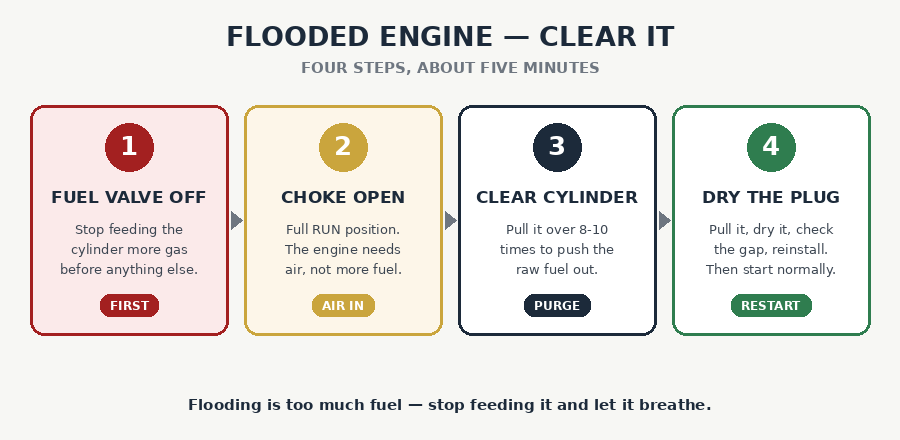
Clearing a Flooded Generator Engine, Step by Step
The whole idea is simple: stop adding fuel, and get air moving through until the mixture leans back out.
- Shut the fuel valve off. No point purging the cylinder while the carb keeps feeding it.
- Move the choke to full open (RUN). This is the counterintuitive part — a flooded engine needs maximum air and zero enrichment. Choking it now makes it worse.
- Hold the throttle open if your unit has a manual throttle, and pull the starter cord 8 to 10 times, or crank in short bursts on electric start. You’re pumping fresh air through to push raw fuel out.
- Try a normal start with the choke still open. A mildly flooded engine usually coughs, smokes a little, and catches within a few pulls.
Still nothing? Go one level deeper:
- Pull the spark plug. It’ll be wet. Dry it with a rag, or hit it with a shot of carb cleaner and let it flash off. Check the gap while it’s out.
- With the plug out, pull the cord 5 or 6 more times. This purges the cylinder fast since there’s no compression fighting you. Keep the plug wire away from the open plug hole — you’re venting fuel vapor.
- Reinstall, fuel valve back on, choke open, start normally. If you’re not in a hurry, 15 minutes of just waiting does most of the same work — the fuel evaporates on its own.
Why It Flooded in the First Place
About 50% of the flooded generator engines I see come from one habit: full-choking a warm engine. Choke is a cold-start tool. An engine that ran within the last half hour already has heat in it and wants little or no choke — give it the full cold-start treatment and you pour fuel onto a plug that’s ready to foul. Another 20% is crank-and-pray: pulling twenty times on an engine with a weak plug pumps the cylinder full of unburned gas. Around 20% is mechanical — a stuck or dirty float needle in the carb that keeps feeding fuel past where it should shut off (that one floods the engine while it just sits there, and it’s the same failure covered in a generator leaking gas). The last 10% is a tipped unit — carrying a generator on its side in a truck bed sends fuel where it doesn’t belong.
Brand behavior worth knowing: Honda EU inverters and other auto-choke units manage this for you, which is why they rarely flood. The manual-choke crowd — Predator, Champion, Westinghouse open frames — flood constantly in exactly one scenario: the warm restart during refueling breaks on outage night. When you shut down to refuel, restart with the choke OFF. The engine’s still hot. It doesn’t want the help.
A flooded engine means raw fuel and fuel vapor around a machine designed to make sparks. Work outdoors, no smoking, and wipe up anything that dripped before you start pulling the cord. One more serious note: if the unit sat flooding through a stuck float for hours, check the oil before you run it. Fuel drains past the rings into the crankcase, and if the oil level is high or smells like gas, change it first — gas-thinned oil won’t protect the bearings. And if the engine locks solid mid-pull and won’t rotate, stop pulling. That can be liquid fuel hydrolocking the cylinder; pull the plug and purge before you bend something.
What It Costs
Clearing a flood is free. The only money that ever changes hands here is a spark plug if yours fouled beyond saving — a few dollars — or a carburetor float needle if the flooding is happening on its own, which is a $5 to $10 part or comes included in a $15 to $25 replacement carb. There is no version of a flooded engine that needs a repair shop, so if someone quotes you a service call for this, that $90 to $150 is buying you a rag and ten pulls of the cord.
Here’s a good visual on what flooding does to the plug and how the clear-out looks in practice:
Frequently Asked Questions
How long does it take a flooded generator to clear on its own?
Give it 15 to 20 minutes with the fuel valve off and it’ll usually start, since the raw fuel evaporates out of the cylinder. The pull-through method just gets you there in two minutes instead. On a cold day it takes longer — evaporation slows way down, so do the work instead of waiting.
Can flooding damage the engine?
A single flood, no. Repeated or prolonged flooding, yes, two ways: raw fuel washes the oil film off the cylinder wall, and fuel that drains into the crankcase thins the oil. That’s why I check the oil any time a carb has been overflowing — the flood itself was free, but running on gas-diluted oil isn’t.
Why does my generator flood every time I refuel during an outage?
Because you’re choking a hot engine. Warm restarts want the choke open or barely cracked. I watched a neighbor go through this three times in one night during a monsoon outage before I walked over — choke off, started first pull, and he thought I’d performed surgery.
Should I remove the spark plug every time it floods?
No — try the fuel-off, choke-open, pull-through method first. It clears mild flooding without tools. The plug only needs to come out when it’s soaked enough that drying it is the difference, which in my experience is maybe one flood in three.
Does starting fluid help a flooded engine?
It’s the opposite of what you need. Flooding is too much fuel and not enough air — adding more combustible spray makes it richer still. Starting fluid has its place diagnosing a fuel-starved engine, never a flooded one. Air and patience are the cure here.