
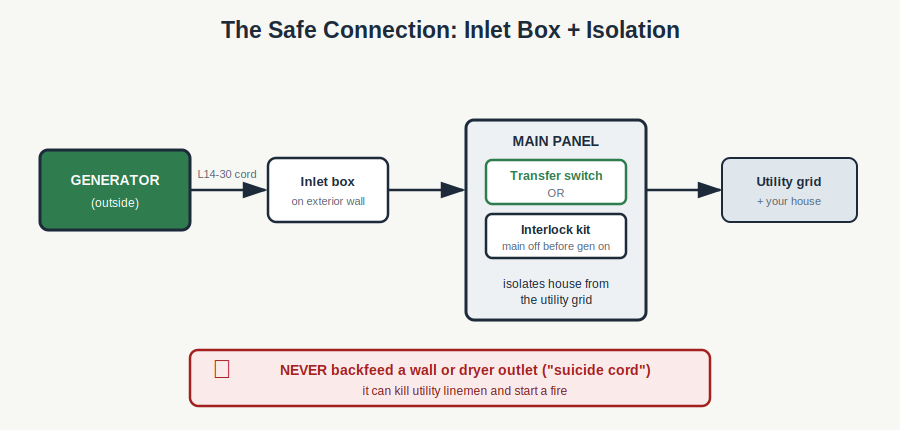
The only safe, legal way to connect a portable generator to your house is through a transfer switch or an interlock kit, installed by a licensed electrician and fed by an exterior inlet box with an L14-30 cord. Never plug a generator into a wall or dryer outlet to “backfeed” the house — that pushes power onto the utility lines, can kill the linemen restoring your power, and can burn your home down.
- Two code-legal options: a manual transfer switch (preselected circuits, simplest to operate) or an interlock kit (any circuit, cheaper hardware, more hands-on).
- Both need a licensed electrician and an exterior power inlet box wired to your panel. The homeowner’s job is operating it on outage day, not wiring it.
- The connection cord is an L14-30 (locking, 30-amp) on most setups — one end twists into the inlet box, the other into the generator’s 30A outlet.
- Backfeeding with a double-male “suicide cord” is illegal and deadly. There is no safe shortcut around the transfer switch or interlock.
- Wire it in before the storm, not during one — and test it once on a calm day so you’re not learning the sequence by flashlight.
Transfer Switch or Interlock — Which One Do You Need?
Both do the same critical job: they isolate your house from the grid so generator power can’t leak back onto the utility lines. The difference is how much they manage for you. Here’s the quick decision: if you want dead-simple operation and you only care about a handful of circuits — furnace, fridge, well pump, a few lights — go with a transfer switch. If you want access to every circuit in the house and you’re comfortable managing the load yourself, go with an interlock kit. That’s really the whole fork.
A manual transfer switch is a small subpanel the electrician installs next to your main panel. They wire your chosen critical circuits into it, and on outage day you flip those circuits from “utility” to “generator.” It’s foolproof because you physically cannot energize both sources at once, and you preselect the circuits so there’s no thinking required when the lights go out. The trade-off is you’re locked to whatever circuits got wired in — usually six to ten — and the hardware runs more.
An interlock kit is a sliding metal bracket that mounts on your main panel’s face. It mechanically forces you to shut off the main utility breaker before you can switch on the generator-input breaker, so again, both can never be live together. The big win is flexibility: you get to every circuit in the house and decide room by room what to run. The catch is you’re managing the load by hand, and the kit has to match your panel brand and model exactly.
Never backfeed with a “suicide cord.” A double-male cord plugged from the generator into a wall or dryer outlet is exactly what it sounds like. It energizes your home’s wiring and pushes high voltage back out the transformer onto the neighborhood lines — where a lineman working to restore power gets electrocuted. It also bypasses every breaker’s protection and is a documented house-fire cause. It’s illegal under the National Electrical Code for a reason. I don’t care how short the outage is: use a transfer switch or an interlock, period. And always run the generator outside, well away from windows and doors — the exhaust is carbon monoxide, and it kills fast and silent even in an open garage.
The Hardware You’ll Actually Need
Whichever route you pick, the parts list is short. You need the transfer switch or the interlock kit; an exterior power inlet box mounted on the wall (a bottom-mount style sheds weather better than a front-mount); and a generator cord to connect them.
| Part | What it does | Rough cost |
|---|---|---|
| Manual transfer switch | Preselected-circuit subpanel | $200–400 hardware |
| Interlock kit (panel-specific) | Forces main off before generator on | $50–150 hardware |
| Power inlet box | Weatherproof outdoor connection point | $30–70 |
| L14-30 generator cord | Links inlet box to generator’s 30A outlet | $50–120 |
| Licensed electrician (install) | Panel work — required, and code in most areas | $300–600 labor |
That L14-30 cord is the standard for most home setups — locking connector, 30 amps, twist-to-lock so it can’t shake loose in weather. If your generator only has 120V household outlets and no 30A locking outlet, that’s a sign it’s too small for whole-circuit backup; sizing the generator to your real load is the step to do before you buy any of this.
Hardware Callout: Match the Interlock to Your Panel
This is where people waste money. An interlock kit is not universal — it has to fit your specific panel brand and model. A Square D QO panel needs a Square D-compatible interlock; a Siemens or Eaton panel needs theirs. Buying a generic kit that “kind of fits” is how you end up with a bracket that won’t seat right and an electrician shaking his head. Pull your panel’s brand and model number off the label inside the door before you order anything, and bring it to whoever’s installing it.
How to Actually Use It When the Power Goes Out
Once it’s installed, outage day is a sequence — and the order matters. Here’s how I run it:
- Set up the generator outside first. Out in the open, away from the house, exhaust pointed away. Check the oil and fuel before you pull the cord.
- Start it and let it warm up for a minute or two with nothing connected, so it’s running steady before it takes a load.
- Plug the L14-30 cord into the generator’s 30A outlet, then into the inlet box, twisting to lock both ends.
- Make the switch. On a transfer switch, move your circuits from utility to generator. On an interlock, shut the main utility breaker OFF, then slide the bracket and turn the generator-input breaker ON.
- Bring loads up one at a time. Start the big stuff first — well pump, furnace blower — then add the fridge, then lights. Staging this way keeps a startup surge from tripping you. If the generator’s breaker pops, you’ve asked for too much; shed a load. (I learned that one the hard way years ago trying to start a well pump and a window AC at the same instant — the whole thing dropped out.)
When utility power returns, reverse it: switch back to utility, then shut the generator down and let it cool before you unplug the cord. Keep the heavy hitters off the generator entirely — an electric oven, a dryer, central AC — those will overload most portable units. If your generator’s breaker keeps cutting under what should be a reasonable load, a breaker that won’t hold sorts whether it’s the load or the breaker itself.
What It Costs to Do This Right
An interlock setup is the budget path: figure $50–150 for the kit, $30–70 for the inlet box, $50–120 for the cord, plus $300–500 for an electrician to install it — call it $450–800 all in. A transfer switch runs more, usually $500–900 installed because the switch hardware itself is pricier. Either way, the electrician is not the place to cut corners. Panel work done wrong is a fire and electrocution risk, and a botched backfeed setup can kill someone outside your house entirely. This is one of the few generator jobs where I tell people flat out: hire the licensed electrician for the install, then operating it yourself is easy.
Test It Before You Need It
The worst time to learn your hookup sequence is at 2 a.m. in an ice storm. Once it’s installed, run a full dry run on a calm day — start the generator, make the switch, watch your critical circuits come alive, then switch back. Do it once a season. The CPSC’s portable-generator safety page is worth keeping bookmarked for the placement and CO rules that go hand in hand with this.
Frequently Asked Questions
Can I just plug my generator into the dryer outlet?
No. That’s backfeeding, and it’s the single most dangerous thing you can do with a generator. It sends power back onto the utility lines and can kill a lineman, and it bypasses your breakers’ protection. I’ve never met an electrician who’d sign off on it. Use a transfer switch or interlock — there’s no safe version of the dryer-outlet trick.
Transfer switch or interlock — which is better?
Neither is “better,” they fit different people. I steer folks who want zero thinking on outage day toward a transfer switch with their critical circuits preset. I steer folks who want every circuit available and don’t mind managing the load toward an interlock, which is also cheaper. Both are equally safe when installed right.
Do I really need an electrician?
For the panel work, yes — and most jurisdictions legally require it, plus doing it wrong can void your homeowner’s insurance. The install is the part that needs a pro. Once it’s in, operating it is all you, and it’s genuinely simple.
What size cord do I need?
For most home backup setups it’s an L14-30 — a 30-amp locking cord that matches the inlet box and the generator’s 30A outlet. Keep the run as short as you reasonably can; long, undersized cords drop voltage. If your generator has no 30A locking outlet at all, it’s probably too small for whole-circuit backup.
Can a portable generator power my whole house?
Sometimes, if it’s big enough for your actual load — but most portables can’t run everything at once. The realistic plan is powering your essentials (heat, fridge, well pump, some lights) and leaving the electric oven, dryer, and central AC off. Size it to what you truly need running, not to the whole panel.