
For most portable generators, replacing the carburetor beats rebuilding it — a complete replacement runs $15 to $30 and takes twenty minutes, versus an hour or more cleaning parts that may still leak afterward. Rebuild only when the carb body is sound and you have the time. Replace when it’s badly corroded, cracked, or you need the machine running today.
Generator Carburetor Rebuild vs Replace: The Honest Answer
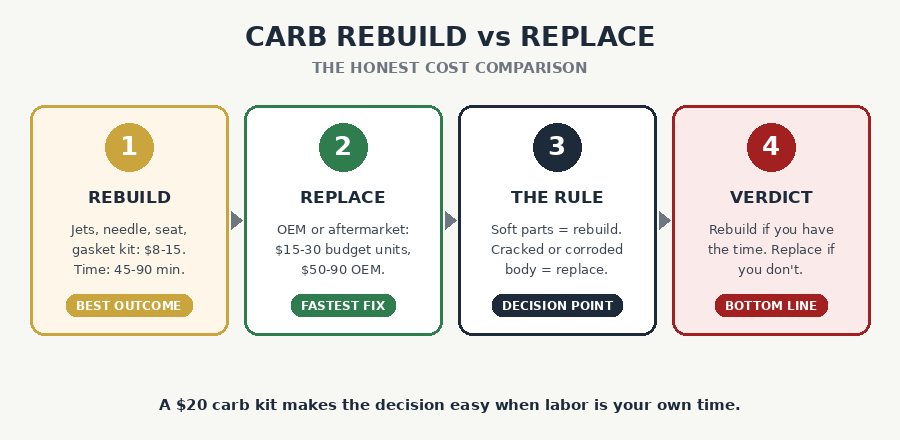
The rebuild-versus-replace question comes up constantly on generator carbs, and the answer depends on two things: the condition of the carb body and how much your time is worth. The carb body is the aluminum casting — if it’s cracked, stripped, or corroded through the walls of the float bowl or venturi, no amount of cleaning fixes it. Replace. If the body is solid and the problem is soft parts — a gummed needle, stuck float valve, varnished jets, dried-out gaskets — a rebuild kit fixes it for $8 to $15 and the carb runs like new. The failure mode I see most often is varnish in the main jet and pilot jet from stale fuel. That’s a rebuild candidate every time, assuming the body is clean and the bowl threads aren’t stripped.
When to Rebuild
Rebuild when the carb body is structurally sound and the failure is in the consumable parts. Rebuild kits for the common Chinese-built carbs — the ones on most Predator, Champion, DuroStar, and house-brand generators — run $8 to $15 on Amazon and include the main jet, pilot jet, float needle, bowl gasket, and inlet seat. The process: drain the bowl, remove the carb, pull the float pin and float, remove the needle and seat, spray every passage with carb cleaner and blow them out with compressed air until you can see light through the main jet. Reassemble with the new kit parts. An experienced tech does this in 30 minutes. First time takes an hour. It’s a good skill to have — same basic carb shows up across dozens of machines.
When to Replace
Replace when the body is compromised or when time matters more than money. A replacement carb for the common 196cc/212cc clone engines runs $15 to $25 shipped; for Honda GX series, $40 to $90 OEM or $20 to $30 aftermarket. At $20, replacement is often the right call even on a perfectly rebuildable carb — you get a new needle, new seat, new gaskets, new jets, and twenty minutes of your time instead of ninety. I replaced a lot of carbs when I was doing commercial food service equipment and the math on labor time was the same: if the new part costs less than an hour of labor, you buy the part. The full carb cleaning and rebuild walkthrough covers the procedure for both approaches.
The Parts to Replace Regardless
Whether you rebuild or put in a new carb, always replace the fuel line between the tank and carb if it’s more than three or four years old. Old fuel line cracks at the clamp ends and causes the lean stumble that brought you here in the first place. A foot of 3/16-inch fuel line costs two dollars. The inline fuel filter, if your unit has one, gets replaced at the same time — they’re $3 to $6 and they catch the tank debris that clogs the carb in the first place. Skip the filter replacement and you’ll be back on the bench six months later. The full fuel path from tank to carb is covered in the generator fuel system guide.
Rebuild kit: $8–15. Replacement carb: $15–30 for common clone engines, $40–90 OEM for Honda/Generac. Fuel line: $2. Inline filter: $3–6. If a shop is quoting you $90 to $150 to clean a carburetor on a $400 generator, the math on a $20 replacement carb and twenty minutes of your time is pretty clear.
Here’s a carb rebuild on a common generator engine if you want to see the teardown before deciding:
Frequently Asked Questions
Is it worth rebuilding a generator carburetor?
On most budget portable generators, replacement beats rebuilding on pure time economics — a $20 carb swap takes twenty minutes versus an hour or more of soaking, cleaning, and reassembling. Rebuild when you have a higher-end unit where the OEM carb is expensive, or when you want to develop the skill. Either way, the carb body has to be sound.
How do I know if my generator carburetor needs replacing?
Cracked body, stripped bowl threads, or corrosion through the casting wall — replace. Gummed jets, stuck float, dried gaskets, varnished passages — rebuild or replace, your call. If it leaks from the bowl even after replacing the gasket, the bowl or body threads are usually the problem.
How long does a generator carburetor last?
Indefinitely with clean fuel and proper storage, or one bad winter of sitting with untreated gas. The carb doesn’t wear out mechanically — it gets destroyed by varnish from ethanol-blend fuel left sitting. Drain it or stabilize it before storage and you may never need this conversation.
Can I clean a generator carburetor without removing it?
Partially — spray carb cleaner into the throat with the air filter off and it clears light deposits. For the kind of varnish that causes a hard no-start or choke-only running, the carb has to come off and the jets have to be removed and cleaned individually. There’s no spray that gets light through a plugged 0.028-inch main jet without physical cleaning.