
How long you can run a generator continuously is usually limited by the fuel tank — most portables run about 8 to 12 hours on a tank, and you stop there to shut it off, let it cool, and refuel (never refuel a hot engine). With careful refueling and oil checks you can run for days during an outage, but you should let the engine rest, watch the oil every 24 to 50 hours, and keep it from overheating. Inverter units at low load sip fuel and run much longer per tank.
- The tank is the main limit — typically 8 to 12 hours per fill on a conventional portable.
- Always shut off and cool before refueling. Gas on a hot engine or exhaust can ignite.
- During a long outage you can run for days, but check the oil every 24 to 50 hours and top off.
- Heat is the enemy. Give it airflow and a rest on multi-day runs so it doesn’t overheat.
- Inverter generators run longer at light load because they throttle the engine down to match.
How Long Can a Generator Run Without Stopping?
For most portable generators the practical answer is one tank of fuel — commonly 8 to 12 hours, depending on the tank size and how hard you’re loading it — and then you stop to refuel. That’s not really an engine limit so much as a fuel limit, because the engine itself can keep going as long as it has fuel, oil, and air and it isn’t overheating. The catch is the refueling step: you cannot safely pour gas into a running or hot generator, so every run cycle ends with a shutdown and a cool-down before you fill it again. String those cycles together and a portable will carry you through a multi-day outage just fine, as long as you respect the oil and the heat. I’ve run units for days straight during storms doing exactly that — run the tank down, shut off, let it cool, refuel, repeat — and the machines that survive it are the ones whose owners checked the oil and gave them air.
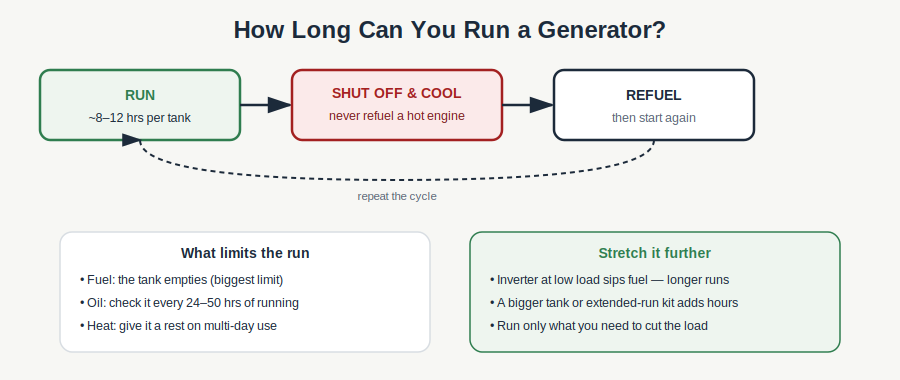
The Hard Limit Is Refueling, Not the Engine
This is the part people get wrong. The engine doesn’t need to stop after a set number of hours — it stops because the tank runs dry and you have to refill it safely. Pouring gasoline near a hot engine and exhaust risks a flash fire, so the rule is absolute: shut it down and give it several minutes to cool before you open the fuel cap. Some owners stretch run time with a larger tank or an extended-run fuel system that lets the generator draw from an external supply, which cuts down how often you stop. But even then, you’re not running forever — you’re just refueling less often, and the oil and heat limits still apply.
Watch the Oil on Long Runs
Fuel gets the attention, but oil is what quietly decides whether your engine survives a marathon. On a long continuous run, check the oil level every 24 to 50 hours and top it off, because these small engines can consume or lose a little oil over many hours, and running low is the fastest way to ruin one. Many generators have a low-oil shutoff that kills the engine to protect it — which is a good thing, though it sometimes trips with oil still present, a situation covered in a low-oil shutdown with the oil full. Either way, don’t wait for the sensor; check the dipstick during your refueling stops.
Heat and Rest on Multi-Day Use
Run any engine hard for days and heat becomes the limiting factor. Give the generator open airflow on all sides, keep it out of tight corners, and on a long outage let it rest when you can — overnight, or whenever your loads allow. A unit that’s packed against a wall or buried under a cover will heat-soak and can shut down or wear faster, which is the same airflow problem behind most overheating and hot-shutdown cases. Running only the loads you actually need also lightens the engine and lowers the heat.
Never refuel a hot or running generator — gasoline vapor near hot metal or exhaust can ignite. Shut it down and let it cool first. And remember the bigger danger of long runs: carbon monoxide. The generator must run outdoors, well away from the house with the exhaust pointed away, the entire time it’s running — CO from an enclosed or too-close generator kills, and a multi-day run is exactly when people get careless about placement. Keep a battery-backup CO alarm in the house.
What It Costs to Run
The real “cost” of long run time is fuel and oil, not repairs — if you do it right. Budget for the gas your unit burns per hour (heavier loads burn more), keep a few quarts of the right oil on hand for top-offs and a change during a long outage, and you’re set. Skip the oil checks and you risk a seized engine that costs more than the generator. An inverter unit pays you back here: by throttling the engine to the load, it can run far longer on the same fuel when you’re only powering a few things, which adds up over a multi-day outage.
Frequently Asked Questions
How long can you run a generator continuously?
Usually as long as you keep it fueled and oiled and it doesn’t overheat — but you stop each tank to refuel, which is about every 8 to 12 hours on most portables. Through a long outage that means running in cycles: burn the tank, shut off, cool, refuel, repeat. Check the oil every 24 to 50 hours along the way.
Can you refuel a generator while it’s running?
No — never. Pouring gasoline near a hot engine and exhaust can cause a flash fire. Always shut the generator off and let it cool for several minutes before opening the fuel cap. If you need fewer stops, use a larger tank or an extended-run fuel system rather than refueling hot.
How often should I check the oil during a long run?
Check it every 24 to 50 hours of continuous running and top off as needed, since these engines can lose a little oil over many hours. Use your refueling stops as a natural time to pull the dipstick. Running low on oil is the quickest way to destroy the engine, so don’t rely only on the low-oil sensor.
Will running a generator for days damage it?
Not if you keep up with fuel, oil, and airflow. The engines are built to run long during outages; what kills them is running low on oil, overheating in a tight space, or refueling carelessly. Give it open air, check the oil, change it during a multi-day run, and let it rest when you can.
Do inverter generators run longer than regular ones?
At light loads, yes — an inverter throttles the engine down to match what you’re using, so it burns less fuel and runs longer per tank when you’re only powering a few things. A conventional generator runs the engine at full speed regardless of load, so it doesn’t get that efficiency. Over a multi-day outage the inverter’s fuel savings add up.