
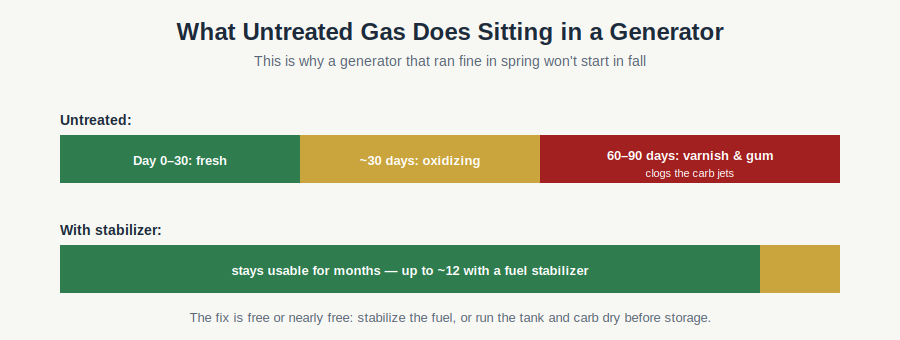
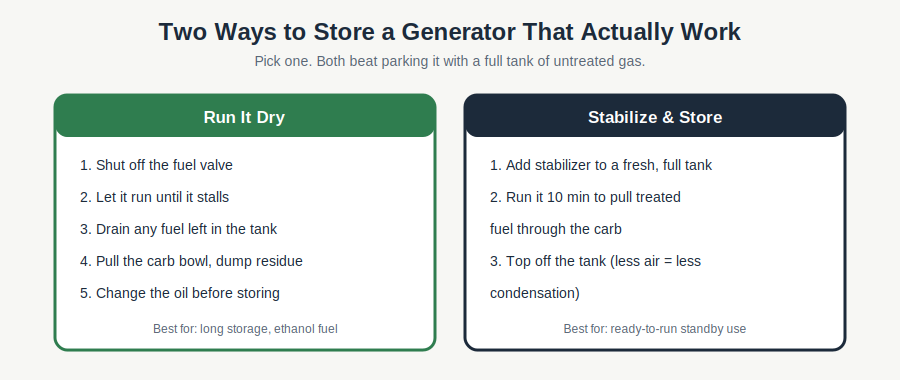
To store a generator, pick one of two paths: run it completely dry — shut the fuel valve, let it stall, then drain the tank and carburetor bowl — or stabilize a fresh full tank and run it 10 minutes so treated fuel reaches the carb. Either way, change the oil and store it dry and covered. Untreated gas turns to varnish in 60 to 90 days, and that gum clogging the carburetor is the number-one reason a stored generator won’t start come spring.
- The enemy is stale fuel. It gums the tiny carburetor jets and that’s what kills a stored generator.
- Two methods that work: run it dry, or stabilize a full tank and run it briefly. Don’t do neither.
- Change the oil before storage — used oil holds acids and moisture that eat the engine while it sits.
- Top off and stabilize, or empty completely; a half-full tank invites condensation and rust.
- Store it dry, covered, off bare concrete, and pull the electric-start battery onto a tender.
Why Stored Generators Won’t Start: It’s Almost Always the Fuel
Here’s what’s happening inside that tank while the generator sits in the corner of the garage. Gasoline isn’t stable — the light, volatile parts that make it easy to ignite start evaporating within weeks, and what’s left behind oxidizes into a sticky, varnish-like gum. A carburetor runs on passages and jets that are barely wider than a pin, and that gum dries right inside them. So when you go to start the generator six months later, fuel can’t get through the jets, the engine starves, and you’ve got a no-start that has nothing to do with the engine being worn out. After doing this work for decades, I can tell you the busted assumption here is huge: people think a stored generator that won’t start is “shot.” It almost never is. About 80% of the time it’s just varnished fuel choking the carb — a cleanout or a $20 carburetor, not a new generator. Store the fuel right and you skip that whole problem.
The Two Methods That Actually Work
You’ve got two good options, and which you pick depends on how you store and how fast you need it ready. Both beat the thing most people do, which is park it with a full tank of untreated pump gas.
Option 1: Run It Dry
What you’ll do: shut off the fuel valve while the engine is running and let it burn through whatever’s left in the carb until it stalls on its own. Then drain any fuel remaining in the tank, and if you want to be thorough, pull the carburetor bowl and dump the residue. What’s happening: with no fuel left to oxidize, there’s nothing to turn to varnish — the carb stays clean because it’s empty. What to do it for: this is my pick for long storage, and it’s the right call if you’re running ethanol-blend pump gas, which goes bad even faster. The only downside is the generator isn’t ready to go instantly; you’ll add fuel before the next use.
Option 2: Stabilize and Store
What you’ll do: add fuel stabilizer to a fresh, full tank, then run the generator about 10 minutes so the treated fuel pulls all the way through the carburetor — not just sits in the tank. What’s happening: the stabilizer slows the oxidation that creates varnish, keeping the whole fuel path usable. What to do it for: this is the better choice if you want the generator ready to fire on short notice, like a storm-season standby unit. Keep the tank topped off, because a full tank has less air space for moisture to condense in.
The common mistake that guarantees a no-start: parking the generator with a full tank of untreated gas “so it’s ready to go.” That’s exactly backwards — you’ve just loaded the carb with fuel that will varnish solid over the next couple of months. Ready-to-go means stabilized fuel or a dry carb, not a full tank of pump gas slowly turning to gum. If you’re handling fuel during any of this, do it well away from the running engine and any ignition source.
Don’t Skip the Oil Change
Fuel gets all the attention, but old oil does damage while the generator sits too. Used oil carries combustion acids and moisture, and leaving that in the crankcase for months lets it corrode bearing surfaces. I change the oil right before storage every time — it’s a 15-minute job that protects the part of the engine you can’t easily fix. While you’re at it, glance at the air filter and the spark plug; if the plug’s due, it’s an easy swap covered in how to check, gap, and replace a generator spark plug.
Battery, Location, and Cover
If it’s an electric-start unit, the battery will self-discharge sitting in the cold and may be dead — and possibly sulfated — by spring. Pull it and put it on a battery tender, or at least charge it monthly. For location, store the generator somewhere dry, up off bare concrete (which wicks moisture), and throw a breathable cover over it to keep dust out without trapping condensation. Don’t seal it in plastic — that traps moisture against the metal.
If You Skipped All This and It Won’t Start Now
Plenty of people find this article after the fact, generator already pulled out and refusing to fire after a winter of neglect. If that’s you, the fix follows the same logic: the fuel went bad and the carb is gummed. Start with cleaning the carburetor — that resolves the large majority of post-storage no-starts. If it fires and then dies a few seconds later, that’s the classic clogged-jet signature covered in why a generator starts then dies. And if you want the whole fuel path walked end to end, tank-to-carb fuel troubleshooting covers it.
What Proper Storage Costs vs. What Skipping It Costs
The math is lopsided. A bottle of fuel stabilizer is $8 to $15 and treats many tanks. Skipping it costs you a carburetor cleanout or a $15 to $35 replacement carb plus your afternoon — or a $90-plus small-engine shop bill if you hand it off. I’ve never once regretted the ten minutes it takes to stabilize or run a unit dry, and I’ve cleaned a lot of carbs for people who skipped it. The cheapest repair is the one you prevent.
Frequently Asked Questions
How long can gas sit in a generator before it goes bad?
Untreated pump gas starts degrading in about 30 days and is usually varnishing the carb by 60 to 90 days, and ethanol blends go faster. With a stabilizer you can stretch that to several months, even close to a year. My rule is simple: if it’s going to sit more than a month, stabilize it or run it dry.
Should I run it dry or stabilize it?
Run it dry for long, hands-off storage or if you’re on ethanol fuel — an empty carb can’t varnish. Stabilize it if you want the generator ready to fire on short notice. Both work; what doesn’t work is leaving untreated gas in it, which is what causes the no-start in the first place.
Do I really need to drain the carburetor bowl?
If you’re running it dry, draining or emptying the bowl is the part that matters most, since that’s where the gum forms. Shutting the fuel valve and letting it stall gets most of it, and pulling the bowl to dump the last bit is the thorough version. If you stabilized the fuel instead, you can leave the bowl full of treated gas.
What oil should I put in before storage?
Use whatever weight your manual calls for — commonly a small-engine 10W-30 — and the point is that it’s fresh, not what brand. The reason to change it before storage rather than after is that fresh oil has no acids or moisture to sit and corrode the engine. I change it going into storage and don’t touch it again until the next season.
Should I keep the battery on a charger?
Yes, for electric-start units. The battery will slowly discharge over months of sitting in the cold and can end up dead by spring. Pull it onto a battery tender or charge it once a month — it’s a lot cheaper than buying a new battery every storage season.