
A portable generator needs four things on a consistent schedule: an oil change annually or every 100 hours, a new spark plug annually, a clean air filter each season, and stabilized or drained fuel before storage. Do those four things and the machine will start reliably for a decade. Skip them and you’ll be on this site looking up why it won’t start.
Generator Maintenance Schedule — What to Do and When
The generators that fail during outages almost always have one thing in common: the owner put them away after the last emergency without servicing them and assumed they’d be ready for the next one. They usually aren’t. A generator doesn’t accumulate miles or wear in a way you can see — it sits, and sitting is what kills them. The oil oxidizes, the fuel varnishes the carb, the battery self-discharges, and the plug fouls from sitting rather than running. None of this is mysterious and none of it is expensive. One hour and $25 to $35 in parts once a year is the entire maintenance budget for most portable generators.
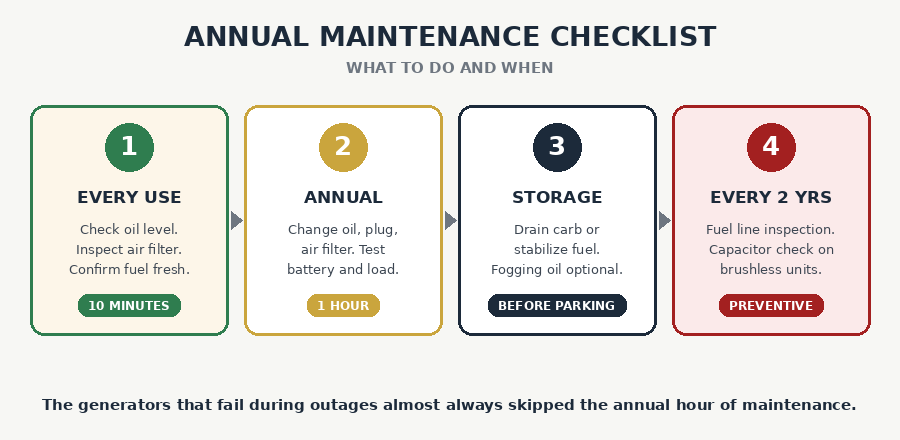
Every Use: The Two-Minute Check
Before every run: check the oil level on a level surface, confirm the fuel is fresh (or treated with stabilizer), and take ten seconds to look at the air filter. These three checks catch 90% of the problems before they strand you. After every run: let it cool before storing, check for any new leaks, and if it’s going away for more than 30 days, handle the fuel (drain or stabilize — more on that below).
Annual Service — the One Hour That Matters Most
Oil change: Every 100 hours of operation or once a year, whichever comes first. Most homeowner generators don’t see 100 hours a year, so the calendar drives it. Warm the engine for five minutes first so the oil flows cleanly. Drain, refill to the full mark with the correct weight oil. The full guide with oil type recommendations by temperature is at generator oil change guide.
Spark plug: Replace annually whether it looks bad or not. A new plug is $4 to $8. A plug that looks okay but has 200 hours on it is harder to start and wastes fuel. The plug reading guide (what the deposit color tells you) is at generator spark plug guide. Gap the new plug before installing — most small engine plugs want 0.028 to 0.030 inch.
Air filter: Inspect every season, replace when it’s gray or brown. A clogged filter causes rich running, hard starting, and premature carb fouling because the engine tries to compensate by pulling more fuel. The filter guide is at generator air filter guide.
Battery (electric start units): Put a smart maintainer on it for the season and test it under load before hurricane season. A battery maintainer costs $20 to $25 and eliminates the dead-battery-during-an-outage failure mode entirely. The battery diagnosis and replacement is at generator battery keeps dying.
Storage — Fuel Is the Decision Point
Every generator owner eventually has the stabilize-versus-drain argument with themselves. Here’s the straight answer: either works if you do it right. Stabilizer works if you add it to fresh fuel (not fuel that’s already three months old), run the engine for ten minutes to circulate it through the carb, and use a name-brand stabilizer at the correct ratio. Run-dry works if you shut the fuel valve and run the engine until it dies from fuel starvation — the carb is then completely empty and can’t varnish. What doesn’t work: adding stabilizer to old fuel, or shutting the engine off with fuel still in the carb and hoping for the best. The storage method comparison is at storing a generator for the off-season.
Every Two Years: Deeper Checks
Fuel line inspection: squeeze the line along its full length and look for cracks, especially near the clamps. Old fuel line cracks at the fittings and causes the slow fuel leak that smells like gas for weeks before you find it. Replacement costs about $3 for a foot of 3/16-inch line. On brushless generators: the capacitor that handles voltage regulation degrades over years of service. If you’re getting low voltage output on a generator that’s more than five years old and the carb and spark are clean, a $10 capacitor is worth testing. The capacitor test is at generator capacitor test and replace.
The Monthly Exercise Run
Run the generator under load for 30 minutes once a month during off-season storage — not just idle, but with a real load (a space heater, shop lights, something that pulls amperage). This keeps the battery charged, circulates oil to the bearing surfaces, burns off any moisture in the carb, and confirms the machine will actually start under power. The generators that fail during the first outage of the season are almost always the ones that went eight months without running. Thirty minutes a month prevents the entire problem.
This covers the annual service interval questions clearly:
Frequently Asked Questions
How often should a generator be serviced?
Oil and spark plug annually, air filter every season (inspect more often in dusty conditions), fuel system at storage. Battery maintainer year-round on electric-start units. That’s the complete schedule for most homeowner portable generators.
How long does a portable generator last with proper maintenance?
A well-maintained unit should run 2,000 to 3,000 hours before needing major engine work. For a homeowner who runs it 50 to 100 hours a year during outages, that’s 20 to 60 years of service life. The machines that die at 300 hours almost always suffered maintenance neglect, not mechanical failure.
What happens if you don’t change the oil in a generator?
Old oil breaks down and loses its viscosity, stops protecting the bearings and cylinder walls, and accumulates combustion byproducts that accelerate wear. An oil change once a year costs about $8. A new engine or engine replacement costs $200 to $800. The math is not complicated.
Do generators need to be winterized?
Yes — “winterized” means fuel stabilized or carb drained, oil changed, battery tended, and stored somewhere that won’t see extended freezing temperatures if possible. A generator stored with untreated gas and a dead battery in an unheated garage is the machine that fails on the first cold outage of the season.
Should I run my generator dry before storing it?
Either run it dry or stabilize the fuel — both work. Run-dry is more reliable because there’s nothing left to varnish. Stabilizer works when it’s added to fresh fuel and the engine runs long enough to circulate it through the carb bowl. The failure mode is adding stabilizer to already-old gas, which doesn’t un-varnish what’s already started to break down.
If eco mode or idle control is hunting or unstable, see the eco mode / idle control problems guide.