
A generator GFCI outlet that won’t reset almost always has a fault on the circuit — something plugged into it is causing a ground fault, or a previous overload tripped it and it needs a firm, deliberate push to reset. Unplug everything, press the reset button with a firm click, and plug loads back in one at a time to find the fault.
Generator GFCI Outlet Not Working — The Reset Sequence That Actually Works
GFCI outlets on generators work the same as the ones in your bathroom — they monitor the difference between the current going out on the hot wire and coming back on the neutral. If that difference exceeds about 5 milliamps, the outlet trips. On a generator, the most common triggers are: a tool or appliance with a ground fault, a wet cord connection, a previously overloaded circuit that tripped it, or a GFCI module that’s failed internally. The generator’s main panel breaker and the GFCI outlet are separate protection systems — one being tripped doesn’t mean the other is. Check both. The full generator breaker diagnosis is at generator keeps tripping the breaker.
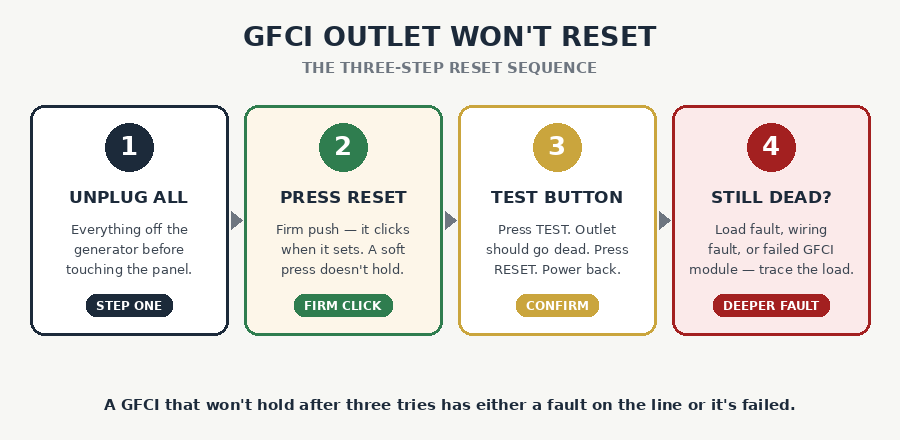
The Correct Reset Procedure
This sequence solves most GFCI problems without tools. First, unplug every load from the generator — nothing should be connected. Second, find the RESET button (usually labeled, sometimes recessed) and push it firmly until you feel or hear a distinct click. A gentle tap doesn’t latch the mechanism; you need deliberate pressure. Third, press the TEST button — the outlet should go dead. Press RESET again — power should return. If it holds with nothing connected, start plugging loads back in one at a time. The load that trips it is your ground fault. Common culprits: extension cords with damaged jackets, power tools with failing insulation, or appliances that have gotten wet. Any load that trips a healthy GFCI should not be used until it’s repaired.
If It Won’t Hold Even With Nothing Connected
A GFCI that trips immediately with no load has either failed internally or there’s a wiring fault in the generator’s outlet circuit. Some generator GFCI outlets can be replaced independently — they’re standard GFCI receptacles wired into the generator panel. Measure the replacement size (most are 15 or 20 amp) and replace the module. If the new GFCI also trips with nothing connected, the fault is in the generator’s wiring, not the outlet, and that needs electrical diagnosis beyond a simple outlet swap. Test the non-GFCI outlets to confirm the generator itself is producing clean power — use a multimeter on the output to rule out voltage problems first.
GFCI Outlets and Inverter Generators
Inverter generators with floating neutrals sometimes cause GFCI outlets in the equipment you’re powering to trip — the GFCI in the RV or the house circuit can’t find a stable neutral-ground reference. This is a grounding and bonding issue, not a GFCI fault. The full explanation of bonded versus floating neutrals and the bonding plug fix is in grounding a portable generator.
This GFCI diagnosis applies directly to generator outlet panels:
Frequently Asked Questions
Why won’t my generator GFCI outlet reset?
Most likely a ground fault on a connected load — unplug everything and try the reset with nothing connected. If it holds then, add loads one at a time to find the faulty device. If it won’t hold with nothing connected, the GFCI module itself has failed or there’s a wiring fault in the outlet circuit.
How do I test if a generator outlet is working?
Plug in a lamp or a simple resistive load (not a motor) and confirm it works. For actual voltage measurement, a multimeter set to AC volts in the outlet slots reads the voltage directly — 110 to 125V is normal. A GFCI outlet tester (the three-light plug-in type) confirms wiring polarity and GFCI function in about ten seconds.
Can a GFCI outlet wear out?
Yes — the mechanical tripping mechanism has a rated cycle count, typically 6,000 operations, and the electronics can fail. A GFCI that trips for no apparent reason, won’t latch on reset, or won’t trip on the TEST button has failed and should be replaced. They’re not worth diagnosing — a replacement GFCI outlet runs $10 to $20.